
COMMENTARY
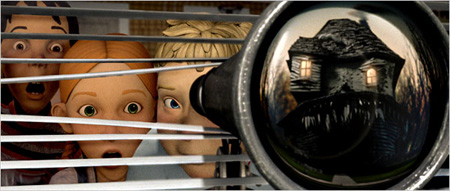
What's In a Name?
Long before I saw Monster House, I'd come to think of it not as a computer-generated film, made with motion-capture technology, but as the occasion for an incomprehensible review by the San Francisco Chronicle's movie critic, Mick LaSalle, which was followed by infuriated responses from animators. These paragraphs in LaSalle's review were the casus belli:
Animated films always had the advantage of being able to go anywhere and show anything, to defy the laws of physics and follow the imagination as far as it could go. But they never had the ability to show the human face. There was never any point to a close-up in an animated film—there was never really anything to see. But with the motion-capture process, real actors give their performances with computer sensors attached to their face and body, and that recorded information becomes the template for the computer animator. If an actor is bug-eyed, the character will look bug-eyed. Moreover, if the actor is thinking or is full of doubt, the technology will be able to render subtle qualities of pensiveness or doubt in the animation.
Imagine what Disney might have done with this in the creation of the Seven Dwarfs. Imagine all the things that will be done with this in the future. Monster House looks like the ground floor of something important.
Cartoon fans, in and out of the business, often fume and fret about what they consider unsuitable opinions, by which they usually mean judgments that differ from their own and that have something to back them up. But here they were confronted by a truly bizarre "opinion," published in a major newspaper, that was actually a wildly inaccurate statement of fact. It was as if LaSalle had written in praise of "Orson Welles' Technicolor epic of the Civil War, Casablanca." Anyone even passingly familiar with Hollywood animation's history knows that its greatest practitioners have always been searching for ever more precise and meaningful expression, through their characters' bodies as well as their faces. (In his emphasis on closeups, LaSalle ignored the body's capacity for expression even when the face is blank).
It's possible to make excuses for LaSalle—there have been plenty of cartoons with truly empty and monotonous facial expressions, including more than a few Disney features—but it's no wonder that so many animators who read his review went up in smoke. What made his review particularly galling, I'm sure, was that it appeared at a time when not just hand-drawn animation's capacity for expression but also the medium itself has been under sustained siege. The Disney studio is supposedly reviving hand-drawn animation—and I have my doubts about what will come of that—but it is computer-generated animation, in its various forms and with its still-limited capacity for subtle movement and emotional shadings, that dominates theater screens and DVD sales.
Computer animation has infiltrated live-action films to the point that "live action" is frequently all but a misnomer. By the same token, an "animated" film may rely so heavily on live actors, through motion capture or sophisticated new forms of rotoscoping, that it can be called "animated" only through an elastic use of the term.The Academy of Motion Picture Arts and Sciences, with its usual perspicacity, has begun awarding a separate Oscar to the Best Animated Feature just when the line between animation and live action has become impossible to define.
These developments have made Monster House and A Scanner Darkly, another new "animated" film, tempting targets for people who believe passionately that animation, hand-drawn animation in particular, deserves and is fully capable of independent existence as an art form. Their criticism has not been entirely fair; the technologies involved in both films have proved to have real but limited virtues. But it's those limits that are most visible in Monster House and A Scanner Darkly—limits that have no equivalents in the best hand-drawn or computer-animated films.
Monster House's motion-capture technology was used, I thought very effectively, in Robert Zemeckis's The Polar Express (2004), where it contributed to a magical, dreamlike atmosphere. Mo-cap, which is really a sophisticated form of rotoscoping, shares that much older technique's greatest failing: it reproduces movement in an essentially random way, without the real animator's sense of what's important and what's not. We take such arbitrariness for granted in a dream, though, and because the "animation" in Polar Express suppresses the most obvious artifacts of its live-action origins, the arbitrariness is all the easier to accept. I've even become reconciled to the glassy eyes of Polar Express' characters; if those characters were fully alive, wholly present, they'd seem awake, and so out of place in the movie's dream world.
The eyes are much livelier in Monster House, directed by Gil Kenan under Zemeckis's auspices (and Steven Spielberg's—the two Big Names are executive producers ). But the characters themselves are less believable; as in every other CGI film I can think of, they reveal the difficulties involved in reproducing the look of skin and in designing three-dimensional human characters that are not photo-realistic but are convincing on their own terms. Bigger heads won't do the trick.
The effects animation is better executed, but it belongs in an ostensibly live-action film—that is, one with real actors on the screen. The climactic battle between the three kid heroes and the rampaging house that gobbles up the unwary is instantly evocative of similar climaxes in live-action comedies like Men in Black. There was no reason for this film to have been made with motion-capture technology at all, except as a marketing gimmick (one that didn't work very well, to judge from the film's mediocre box-office performance). The technique itself is handled more expertly in Monster House than in Polar Express, but although there's less evidence of mo-cap's essential arbitrariness, there's also none of Polar Express' saving otherworldliness.
In sum, Monster House is a dead end. It's hard for me to imagine filmmakers embracing its mo-cap technology, except when they're making films whose atmosphere might be reinforced by that technology—and how many more films like Polar Express can there be? (The short answer: none.)
In one respect, though, mo-cap might turn out to be of considerable value to serious animators. I remember talking with Bill Cottrell years ago about the live action the Disney studio shot when it was making Snow White and the Seven Dwarfs (Cottrell was a story man and then a director on that film, working with Joe Grant on the sequences involving the Queen). Where it helped most, he said, was in small ways—"We had a younger woman doing the action to playback of the Queen's voice. When she came down the stairs (a mockup circular stairs, on the sound stage) wearing the costume of the Queen—the crown and the cape—she held the corner of her robe and as she turned on the stairs the wind caught it, and it furled like a sail. It was very effective. You don't think of that, necessarily. That was immediately adopted for the scene—a great touch."
There are "touches" throughout Monster House that clearly owe their existence to mo-cap—gestures, postures, subtle movements that give this pseudo-animation an authenticity so often lacking in other kinds of computer animation. There's really too much of this authenticity—as Ward Jenkins remarked in a recent email, "The mo-cap captures everything. This includes all the little ticks and subtleties that we humans are prone to do involuntarily, but that were never meant to be picked up through the medium of animation." True enough. But I can't help but think that here's a tool people working in less confined sorts of animation, whether hand-drawn or computer-generated, could use profitably, a modern equivalent of not just old-time rotoscoping or live-action reference filming of the Snow White kind, but, going further back, the sort of intense observation of real movement that the Disney people cultivated starting in the early thirties. Mo-cap, I think, could isolate small but revealing movements without the distraction of a real actor's physical appearance, making it easier to find ways to use them to bring animated characters to life. Perhaps this is already being done.
 Speaking
of rotoscoping: Richard Linklater relied on something like that
venerable technique in Waking Life (2001), but his team,
using software developed by Bob Sabiston, achieved its results less
by tracing the live action he shot on video than by painting over
it (not literally, but that's the effect on the screen). In Waking
Life, as in Polar Express, the on-screen world
is that of a dream—or what may be a dream—but that connection
is only superficial. Waking Life's dream, if that's what
it is, is far more fluid and richly colored than that of Polar
Express, hallucinatory rather than magically detached from reality.
The arbitrariness of rotoscoped movement all but vanishes under
the undulating shapes and patterns that fill the screen. What anchors
this incredible visual activity is a torrent of philosophical talk
that probably has no parallel in American movies other than My
Dinner With Andre, Louis Malle's 1981 feature (perhaps Linklater
could be talked into making a rotoscoped version of that overrated
gabfest). Waking Life is inconceivable in anything but its
rotoscoped form; it would be a hopeless bore as a conventional live-action
film. The rotoscoping and the talk, so superficially different,
depend on each other.
Speaking
of rotoscoping: Richard Linklater relied on something like that
venerable technique in Waking Life (2001), but his team,
using software developed by Bob Sabiston, achieved its results less
by tracing the live action he shot on video than by painting over
it (not literally, but that's the effect on the screen). In Waking
Life, as in Polar Express, the on-screen world
is that of a dream—or what may be a dream—but that connection
is only superficial. Waking Life's dream, if that's what
it is, is far more fluid and richly colored than that of Polar
Express, hallucinatory rather than magically detached from reality.
The arbitrariness of rotoscoped movement all but vanishes under
the undulating shapes and patterns that fill the screen. What anchors
this incredible visual activity is a torrent of philosophical talk
that probably has no parallel in American movies other than My
Dinner With Andre, Louis Malle's 1981 feature (perhaps Linklater
could be talked into making a rotoscoped version of that overrated
gabfest). Waking Life is inconceivable in anything but its
rotoscoped form; it would be a hopeless bore as a conventional live-action
film. The rotoscoping and the talk, so superficially different,
depend on each other.
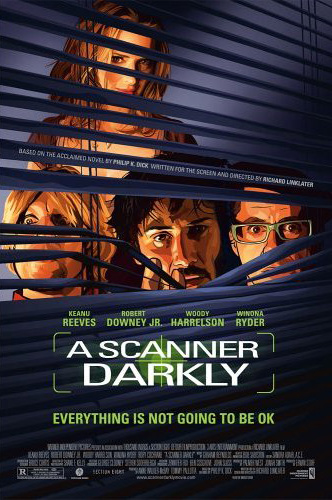
Linklater's new film, A Scanner Darkly, is much less successful, for reasons that Linklater himself identified in an interview with the New York Times in 2001: "Film is, by definition, linear. It's a line of images that goes in one direction. And yet I think our minds work in a nonlinear fashion, that we jump around in time, compress and expand it. Our minds are darting around, and things flow at different speeds." Linklater captured that sense of the "nonlinear" in Waking Life, but it eludes him in Scanner Darkly. The Philip K. Dick novel on which the film is based must have seemed like excellent source material, with a cast made up of spaced-out junkies and narcs who wear sinister "scramble suits," identity-shifting coverings that appear to give the wearer a constantly changing face, body, and wardrobe. But only rarely is what we see as striking and inventive as what filled the screen in almost every scene in Waking Life. The story is stubbornly linear—there's a real plot and a surprise ending of sorts—and, as with Monster House, there's a nagging sense that the animation, if it can be called that, simply isn't necessary.
This is yet another film that would have made more sense as live action with CGI special effects, especially given how fine some of the actors, particularly Robert Downey, Jr., are under that computer-generated paint. Surely that's a basic test of the worth of rotoscoping: if it dilutes the actors' performances, as it does in A Scanner Darkly, what's the point? In some incidental scenes the live action is barely disguised, probably because the money was running out. (As Wired magazine reported last March, production did not go smoothly: the film exceeded its original budget, and Sabiston was fired early in the 15-month rotoscoping process).
Scanner Darkly is as dead a dead end as Monster House, the Linklater/Sabiston technology having proved itself as limited in its applicability as mo-cap. But in neither case can the technology be dismissed completely, because it gave birth to an artistically successful, one-of-a-kind film. Hidden (or maybe not so hidden) in both these failures are tools that other filmmakers will undoubtedly use to much greater effect. By the time that happens, perhaps the question of whether their films should be called "animation" will no longer seem quite so pressing.
[Posted September 8, 2006; revised and corrected, May 11, 2009 and September 19, 2009]