
COMMENTARY
Buddy Flick
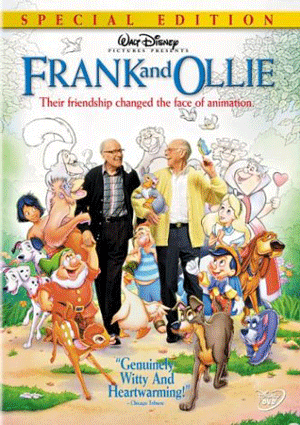
Frank and Ollie, the 1995 film devoted to the veteran Disney animators Frank Thomas and Ollie Johnston, has appeared on DVD, loaded with "extras" that are for the most part of real substance: outtakes, Thomas's and Johnston's first animation from a couple of short cartoons, film of Johnston aboard his backyard trains and of Thomas playing piano with the Firehouse Five Plus Two, and a lot of other stuff.
 The
film itself captured Thomas and Johnston in their early eighties
(they both turned ninety in 2003). They are undeniably old in the
film, and, in Thomas's case, visibly frail, but they have not yet
been overtaken by infirmities. Polly Huemer, the widow of the Disney
animator and writer Dick Huemer, once remarked to me that a person's
seventies could be wonderful, health permitting, but that life got
a lot dodgier past eighty (she was in her late eighties at the time).
Certainly that is consistent with what I've observed of people who
make it into their ninth decade. In Frank and Ollie we see
Thomas and Johnston, as it were, on the cusp—still robust camera
subjects, but obviously vulnerable to time's injuries. That they
have both survived almost ten years longer, in increasingly fragile
health, lends the film a poignance that I think it would lack if
it had caught them a few years earlier, when age's effects were
not yet so visible.
The
film itself captured Thomas and Johnston in their early eighties
(they both turned ninety in 2003). They are undeniably old in the
film, and, in Thomas's case, visibly frail, but they have not yet
been overtaken by infirmities. Polly Huemer, the widow of the Disney
animator and writer Dick Huemer, once remarked to me that a person's
seventies could be wonderful, health permitting, but that life got
a lot dodgier past eighty (she was in her late eighties at the time).
Certainly that is consistent with what I've observed of people who
make it into their ninth decade. In Frank and Ollie we see
Thomas and Johnston, as it were, on the cusp—still robust camera
subjects, but obviously vulnerable to time's injuries. That they
have both survived almost ten years longer, in increasingly fragile
health, lends the film a poignance that I think it would lack if
it had caught them a few years earlier, when age's effects were
not yet so visible.
There's an endearing nineteenth-century quality about the friendship of the two men, who have now lived with or next door to each other for seventy years, first by themselves and then with their wives and children. In today's sex-soaked atmosphere, the occupants of such a semi-compound would be expected to make up a ménage à quatre—or cinq or six or sept—but the friendship of Thomas and Johnston and their families is a blessed relic from a time when society permitted people to form deep attachments of many kinds.
Frank and Ollie is, however, not some extended Charles Kuralt-like video essay on two charming old gentlemen who play jazz and tinker with trains. The film commands our attention because its subjects are animators—or, as the film argues, and as I believe, artists who happen to be animators. It is when the film turns to their art that it becomes claustrophobic.
Watching the film again, I marveled, as I so often do, at how blinkered and self-contained so much of the talk about Disney animation is. It doesn't matter whether the talk comes from Disney animators like Glen Keane and Andreas Deja or from outside writers like John Canemaker and John Culhane, all of whom appear on camera in Frank and Ollie. As usual, Canemaker is judicious and Culhane is windy, but they both, like Thomas and Johnston and the other Disney people who appear in the film, embrace without question premises that are dismayingly flimsy.
The film, through its emphases, asks us to believe not just that Thomas and Johnston animated at roughly the same exalted level throughout most of their careers, but also that if there was any variation, the best came near the end, when they animated most of The Jungle Book (1967). That film receives more attention than any other. I've written elsewhere about how Thomas and Johnston's first book, Disney Animation: The Illusion of Life, propagated the strange notion that the dull, literal animation in such latterday Disney features as The Jungle Book was somehow the pinnacle of the art, and Frank and Ollie offers more of the same.
The two animators earned their glowing reputations in much earlier films, starting in 1937 with Thomas's animation of the grieving Dwarfs in Snow White and the Seven Dwarfs. Thomas was the greater of the two animators, I think; I know of nothing in Johnston's work to match the incredible subtlety and precision of some of Thomas's animation, like that of Captain Hook in Peter Pan (1953). Johnston's animation could seem a little obvious and unshaded by comparison—I'm thinking of his Mister Smee in the same film—but that may well have been more a matter of casting than of talent. Which is to say, I don't know how anyone could have animated Smee better, given how broadly the character was conceived.
Such early triumphs get mostly a nod in passing, the clips sliding by amid excerpts from dreary failures like The Aristocats (1971) and Robin Hood (1973). Frank and Ollie is, in short, yet another of the many Disney-sanctioned products—like Thomas and Johnston's own Disney Animation: The Illusion of Life—that smudge the distinction between the ordinary and the extraordinary, to the disadvantage of the latter. Perhaps it could have been nothing else. This is, after all, a film directed by Frank Thomas's son, Theodore Thomas, and released (and copyrighted) by the Walt Disney Company. But a less affectionate and more searching examination of Thomas's and Johnston's careers would have better served both them and their art.
[Posted January 29, 2004]