
COMMENTARY
The Emperors' Clothes
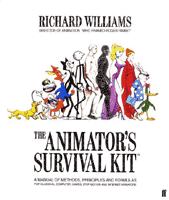
In his long-awaited book, The Animator's Survival Kit (Faber & Faber, trade paper, $30), Richard Williams describes the epiphany he experienced when he saw Walt Disney's Jungle Book (1967). "I went back to my studio in shock," he writes, "and, through the night, wrote a long fan letter" to Milt Kahl, whose animation in the film had particularly impressed him. The Jungle Book, he told Kahl, was "the absolute high point of pure animation performance."
In reading Williams, I was reminded of my second reading of Frank Thomas and Ollie Johnston's Disney Animation: The Illusion of Life a few years ago. I realized then that their gold standard—the animation they had done that they felt best represented their ambitions and their abilities—was in films like The Jungle Book, Robin Hood (1973), and The Rescuers (1977).
Like Williams's book, the Thomas and Johnston book, published in 1982, contains a lot of advice for aspiring and even practicing character animators (Thomas and Johnston's advice more general, Williams's very specific). Most of it is undoubtedly suited to practical application. Anyone who takes all the advice in these two books to heart, and masters the skills they prescribe, will find himself equipped to make animation like that in The Jungle Book and Robin Hood. The question is, why would anyone want to?
The aforementioned films, and others made around the same time—most of them directed by Wolfgang Reitherman—are just about the worst features ever to emerge from the Disney studio. They are shoddily constructed as stories and lack any emotional depth, or even emotional coherence. I'll cite some of what I found wrong with just one of these films, quoting a review I wrote for Funnyworld after The Jungle Book was reissued in 1978:
Baloo the bear has apparently been killed, and Bagheera the panther is eulogizing him in pseudo-scriptural language. It is hard to tell whether we are supposed to take this seriously or not; the director's signals are not clear. If we knew from the beginning that Baloo was still alive, we could chuckle at Bagheera's sanctimoniousness; if we were persuaded that Baloo was really dead, we could weep with his friend, the boy Mowgli. But we are shown that Baloo is still alive precisely at the moment when it seems most like a cheat—we have been sucked in, but not quite far enough.
The animation of The Jungle Book, I wrote, "has a dry and studied look. Bagheera moves marvelously, like a real panther, but since there is nothing in the story itself that requires him to move like a panther (the fact that he's a specific kind of animal doesn't make much difference), his feline movements look too much like academic exercises."
I added that the dryness of the animation was used to advantage in one instance, "to enhance the elegance of Shere Khan the tiger." So Dick Williams and I at least agree that Milt Kahl's animation of the tiger is the highlight of the film. But otherwise the character animation in Jungle Book, as in other Disney features from the Reitherman period, is overwhelmingly literal and unimaginative. It is always polished and technically impeccable, but it reaches consistently for the easy, obvious answer to any animation question—of timing, staging, expression, pose, you name it—and it clutches gratefully at the crutch offered by the hammy performances of the voice actors.
It's clear from Thomas and Johnston's book that they enjoyed animating on such films much more than they enjoyed working on superior films like Cinderella, and for understandable reasons: the span of their control was greater on the later films. There is, however, no necessary correlation between how much an artist enjoys himself and the quality of what he produces. Otherwise the world would be full of masterpieces painted by amateurs on Sunday afternoons.
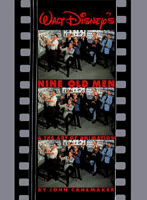
Thomas and Johnston, both now ninety years old, are the last of the famed Disney character animators known as the "nine old men," a group that also included Kahl and Reitherman. They and the other members of the nine are the subjects of Walt Disney's Nine Old Men and the Art of Animation (Disney Editions, $60), the latest in a series of lavishly illustrated books by John Canemaker devoted to biographies of Disney artists.
Canemaker teaches at New York University, but his writing is mercifully free of the vices that afflict most academic writing about animation. The typical faculty paper consists of fashionable campus boilerplate (on race, say, or gender, or class, or American foreign policy), usually masquerading as "theory," into which are plugged facts cribbed from Leonard Maltin's Of Mice and Magic or, often as not, pulled out of thin air. (Sometimes the inventions come in batches, as in the reference to "the Jim Crow cartoons of Columbia's Heckle and Jeckle" in the anthology called Reading the Rabbit. Those Terrytoons characters, the "talking magpies," were not black stereotypes—one spoke with an English accent, the other in Brooklynese—and Terrytoons were distributed by Fox, not Columbia.)
Canemaker's writing is, by contrast, solidly grounded in research of the kind that most other academics shun. He often seeks out family members who may be the only good sources for much of the information he needs. Having done considerable research of that kind, I admire his fortitude.
Not only is Canemaker a good researcher, but he writes about his subjects with real enthusiasm for their work and real affection for most of them as people. Because of my respect for his methods and his results, I made available to him, for his new book, interviews I conducted with Milt Kahl, Les Clark, and Eric Larson (his Larson chapter in particular draws heavily on my 1976 interview).
My reservations about the new book go in part to the biographical approach that Canemaker has adopted for all of his recent books. Animation as practiced at the Disney studio was very much a collaborative enterprise, and I'm not sure how illuminating it is to examine the studio's output by pursuing individual biographical threads. That's especially so when the people involved worked together closely for much of their careers. Canemaker strains to keep his chapters on Thomas and Johnston from repeating themselves, and the problem recurs throughout the book.
Because Canemaker writes about the nine as if they were of roughly equal importance, and thus writes about them at roughly equal length, some of his chapters feel padded. This is especially true of the chapters devoted to Les Clark and John Lounsbery, whose work was regarded, correctly, by their fellow "old men" as being on a somewhat lower plane than that of the other seven. The Lounsbery chapter contains a great deal of fresh and valuable information about that very good but relatively obscure animator (he was the first of the nine to die, in 1976, a few months before I made a trip on which I interviewed all the survivors except Reitherman). It's hard to believe, though, that we really needed to know about his churchgoing habits.
My larger reservation stems from the seriousness with which Canemaker takes the very idea of the "nine old men"—he places them and their work on a pedestal of towering height. He is hardly alone among writers on animation in doing that, of course. Leonard Maltin, at a tribute to Thomas and Johnston in April, praised them for "laying the foundation of animation and then building upon it to incredible heights." When Ward Kimball, another of the nine, died last summer, Charles Solomon wrote in the Los Angeles Times that the work of the "old men" "set the standard by which all animation is judged."
But did it, really? Consider the roughly thirteen years between the release of Steamboat Willie in 1928 and the release of Dumbo in 1941—years when almost all the Disney films were dominated not by any of the "nine old men," but by an earlier generation of character animators that included Ham Luske, Norm Ferguson, Fred Moore, Art Babbitt, and Bill Tytla. The advances made in those years are simply astonishing. To watch the Disney shorts of the thirties in roughly chronological order is to see a wonderful medium being born, as the crude, puppet-like characters of the earliest cartoons give way to thinking, feeling creatures of tremendous vitality.
Now consider a slightly overlapping period twice as long, starting in 1940 with Pinocchio—the first feature shaped by major contributions from several of the "old men," including Kahl, Thomas, Johnston, Kimball, and Larson—and ending with the death of Walt Disney in 1966. And ending also with production of, ah, yes, The Jungle Book.
Compared with the trajectory of Disney animation in the thirties, what came later was a steady decline, bottoming out in the dismal features made in the years just after Walt Disney died. If the "nine old men" cannot be blamed for that decline, most of them did little or nothing to arrest it, and Reitherman certainly accelerated it. Many of the nine were gifted animators (Frank Thomas's animation in particular could be marvelously subtle and intelligent), but it was only Ward Kimball, in the forties, whose animation consistently bucked the creeping literalism that ultimately ruined the features.
It was the earlier Disney animators, rather than the nine, who "set the standard by which all animation is judged." But in the forties, fifties, and sixties, most of those earlier animators were working elsewhere, if they were still alive. It was the nine who were working for Disney. Their designation as the "nine old men" was in common use by the fifties; there's a group photo in Bob Thomas's 1958 book The Art of Animation. Starting then, and continuing for the next few decades, the interests of the Disney studio, and the animators themselves, coincided all too closely with those of friendly journalists like Thomas, Solomon, and John Culhane. Over time, thanks to a stream of public appearances and laudatory newspaper and magazine articles, the nine acquired iconic stature.
We've been living for some time now with the consequences. I've been struck, when watching recent Disney features like The Emperor's New Groove (2000) and somewhat older features like The Great Mouse Detective (1986), by how good the character animation often is, how fluid and graceful. And how empty, so that Basil, in Mouse Detective, moves wonderfully well but almost never seems to have anything going on inside his head (as opposed to grimacing in imitation of thought) and so never emerges as more than the weakest simulacrum of Sherlock Holmes.
This is the sort of animation—expert only in giving the character on the screen a superficial reality—that has emerged from the trends that took hold during the reign of the "nine old men," especially when Reitherman was directing the features. There's a painfully ironic passage in Richard Williams's book in which he quotes Frank Thomas as criticizing such animation in 1972. Expert-but-empty animation is, unfortunately, the natural outcome when the practice of "personality animation" takes place in an artistic vacuum like the one that was already sucking all the air out of the Disney features by the early seventies.
Expert-but-empty animation is also what anyone who takes Dick Williams's book too much to heart is likely to produce. Williams's own animation, in films like his Christmas Carol, has always amounted to moving illustrations (very well-drawn ones), with the barest nod toward how a character's mental state might be reflected in its movements. He recoils from animation with conspicuous stretch and squash, seeing in it only crude comedy, rather than a tool that can be used to reveal a character's emotions with great precision. You'll not find Bob Clampett or Rod Scribner mentioned anywhere in Williams' book.
Williams devotes a few pages at the back of his book to acting—that is, to what should be the character animator's all but exclusive concern once he has a grip on the mechanics—but it's clear his heart is not in it. To his credit, he admits as much, reproducing a telephone conversation with Frank Thomas in which Thomas gently refuses to rise to Williams's invitation to give him praise he did not deserve for his disastrous animation direction of Who Framed Roger Rabbit? (1988).
Neither the Williams book nor Canemaker's Nine Old Men has received any attention from serious reviewers. Such neglect is a symptom of a larger problem.
Consider the low rankings of Disney features in the American Film Institute's 1998 poll on the hundred greatest American films. Questions have been raised about how that poll was conducted, but there's still no denying that Snow White and the Seven Dwarfs and Fantasia finished much lower (forty-ninth and fifty-eighth) than many films with weaker claims to a high ranking. All the other Disney features were shut out entirely. Likewise, the hundredth anniversary of Walt Disney's birth received scant attention from anyone except the Walt Disney Company itself—and if anyone used that occasion to seriously examine Disney's legacy as an artist, I missed it.
We are paying now for decades of impotent Disney animation, a good part of it by the "nine old men," and for the extravagant claims made on its behalf. That payment is taking the form of a long, slow slide in public esteem for the greatest Disney films, and for the kind of animation that made those films great.
[Posted May 2003]