
INTERVIEWS
John McGrew
An interview by Michael Barrier
[Click here to hear a 56-second (880KB) audio excerpt (MP3 player required) from the McGrew interview, and here to read an excerpt from Hollywood Cartoons: American Animation in Its Golden Age about McGrew's work for Chuck Jones.]
In an interview posted elsewhere on this site, Chuck Jones says of John McGrew, his layout artist in the early forties, that he "did the layouts on both The Aristo-cat and The Dover Boys, and he had very interesting ideas that I was willing to try." McGrew was, Jones said in another interview, "a great student of film techniques." It was thanks mainly to McGrew that some of Jones's Warner Bros. cartoons, starting with Conrad the Sailor (1942), were the first distinctively "modern" Hollywood cartoons. They anticipated in their semi-abstract designs and self-aware techniques the UPA cartoons of the early fifties, which spawned in turn many more such cartoons, in the United States and other countries.
McGrew himself was a rather mysterious figure for many years, known only to be living somewhere in France since moving there just after World War II. It was thanks to Steve Schneider, author of That's All Folks: The Art of Warner Bros. Animation and the leading collector of Warner Bros. cartoon artwork, that McGrew's whereabouts finally came to light in 1995. He was, it turned out, living in a 300-year-old house in a village in the Beaujolais region, about an hour's drive from Lyon. He and his longtime companion, André Gonnet, had performed as classical musicians throughout Europe for many years—McGrew as pianist, Gonnet as cellist—but then McGrew's hearing had deteriorated and he had once again become a full-time artist, specializing in extraordinary trompe-l'oeil paintings.
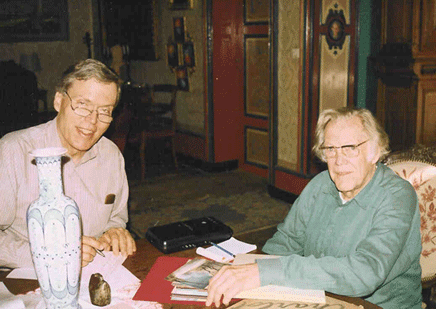 Phyllis
and I were planning a driving trip to France in the fall of 1995,
so I wrote to McGrew and asked for an interview. He responded with
an invitation to stay with him and André at their home—which
we accepted, for two nights. In between guided tours of old Lyon
and the beautiful Beaujolais countryside—André is a
native of the area—McGrew and I looked at his paintings (he
had saved a generous sampling of his color sketches for the Jones
cartoons) and recorded an interview. The procedure was unusual.
Because McGrew was so nearly deaf, I wrote my questions and spoke
them aloud for the tape recorder; he then read them and responded,
occasionally lapsing into the strongly American-accented French
that had become his principal language. (Phyllis took the accompanying
photo during the interview.)
Phyllis
and I were planning a driving trip to France in the fall of 1995,
so I wrote to McGrew and asked for an interview. He responded with
an invitation to stay with him and André at their home—which
we accepted, for two nights. In between guided tours of old Lyon
and the beautiful Beaujolais countryside—André is a
native of the area—McGrew and I looked at his paintings (he
had saved a generous sampling of his color sketches for the Jones
cartoons) and recorded an interview. The procedure was unusual.
Because McGrew was so nearly deaf, I wrote my questions and spoke
them aloud for the tape recorder; he then read them and responded,
occasionally lapsing into the strongly American-accented French
that had become his principal language. (Phyllis took the accompanying
photo during the interview.)
John was one of the most charming and memorable of all the hundreds of people whom I've interviewed. Among many other things, he had been a theatrical set designer before working in animation, and when we arrived at his home, the first thing he did was take me into the entryway to show me a model of a stage set he had designed. Throughout our visit, he made a point of showing Phyllis and me work he had done, both at his home and in other places (I particularly recall a Lyon stairwell decorated in trompe-l'oeil fashion). Other artists might have done the same thing, but what made John so remarkable was his generosity of spirit. He wasn't showing off. Rather, he clearly wanted us to share his own pleasure in the lovely things he had made.
John Burton McGrew died on January 11, 1999, at the age of 88.
Excerpts from my September 11, 1995, interview follow, beginning with McGrew's memories of the Leon Schlesinger studio's background department, which was headed by Art Loomer. In the late thirties, that department painted the backgrounds for most of the Schlesinger studio's cartoons, which were released through Warner Bros. Jones, then a new director, rebelled against the backgrounds' poor quality. In 1939, he pulled McGrew out of the background department to be the layout artist for his cartoons, and Paul Julian became his background painter.
To reduce the time required to load this page, I've provided links to a separate page on which I've reproduced photos of five of the sketches that McGrew and I discussed during the interview. Most of McGrew's sketches, now in a private collection, measure about 4 3/4 inches by 6 1/3 inches. McGrew described these sketches as layouts, but they differ significantly from most layouts for Hollywood cartoons of the period.Typically, layout artists worked in pencil, making full-size drawings of the backgrounds and perhaps providing guidance to the background painter in the form of a few small color sketches. McGrew, on the other hand, worked almost entirely through color sketches.
BARRIER: Tell me what you remember about working in the background department under Art Loomer. Was his nickname really "Muddy"?
McGREW: I don't remember ever having heard his nickname as "Muddy." That was a word that Chuck used in describing the things. It was quite descriptive, because the backgrounds were a bit muddy. Art had two basic ideas: watercolors must be pale; and to start, you always did a wash of yellow ocher on the paper, and when it was dry, you would color it—you didn't paint it, you colored it. The word that Chuck used was not very elegant; he said it was "shit-brindle," which is a pretty good description.
BARRIER: Was Loomer difficult to work for on a personal level? That is, was he a bad boss as well as a poor artist?
McGREW: No, he was an excellent boss, and on a personal level, very fine, a very pleasant person. Whenever we would begin to get bored and nervous, he would get up and do a soft-shoe shuffle and make us all sing "Let's All Sing Like the Birdies Sing, Tweet Tweet Tweet Tweet." This eliminated the boredom, but it was usually very embarrassing. But he was a very pleasant person, and I think he was aware of his limitations, because he was not at all pretentious—I mean, as an artist.
BARRIER: What do you recall about the changes that led to your going into Chuck's unit? Was Loomer painting backgrounds for you after that change occurred?
McGREW: Chuck was dissatisfied with the backgrounds that were being produced by the background department. When he became a director, he chose me as his layout man. I took a long time to understand why he chose me. There was no particular reason, except I came from Chouinard's, as he did, and he was very enthusiastic about the training at Chouinard. Loomer did no more backgrounds for the Chuck Jones unit.
BARRIER: You made some interesting comparisons of Paul Julian and Gene Fleury [who succeeded Julian as Jones's background painter in 1941] last night. Can you elaborate on how they differed as background painters?
McGREW: Paul, first of all, was an excellent watercolor painter; he had a very free, loose style, which was not very appropriate to animated cartoons. It attracted the attention to the background rather than to the action. I had an idea of what backgrounds should be, without knowing exactly how to do it, and I helped Paul get into the right spirit with silly poems. Shall I tell you one? Sometimes you have a scene which is essentially a nature mort [still life]. If someone looks at a clock, for example, you'll have a short scene of a clock; and Paul's very free, fluid background style was not appropriate [for such scenes]. So I wrote a series of poems on all the principles; I think I had twelve or fourteen of them. The only one I remember is not very elegant:
If the thing is what you paint,
And the thing is what the scene is,
Make it hard and firm,
Like a questing penis.
That became quite well known in the studio, of course.
Gene Fleury, on the other hand, was an explorer in painting. He had possessed all possible modern styles up to that period, and was continually searching and trying out new ideas, so Gene and I fitted together perfectly in what we were looking for. We completed each other; we were both looking for something, and we finally found something that was satisfying. That is to say, the backgrounds became in the same style as the animated persons, and frequently, instead of using them as a backdrop, [as in] a theater, we would have different levels of depth, so that the characters were in the setting, instead of in front of a setting. But that was because Gene and I cooperated in this searching and trying out ideas all the time. That was not Paul's style. Paul's style was to render something very pretty—I don't mean that in a disparaging way—[and] very interesting in the technique, but not to seek for something new.
BARRIER: Even though you wanted to get away from the idea that the characters were performing in stage settings, weren't you able to put your theatrical training to use in making the layouts?
McGREW: Yes, of course. Because in theatrical training, a setting is not just a place, it's an atmosphere—and it must convey an emotion, or a sentiment, or a reaction. That's the great difference between a certain type of illustration and another type. Just an ordinary Polaroid camera will take good photos, but it's not creative, and it doesn't communicate anything. The theatrical training was very important for all of my work, because you had to get something across to the public.
BARRIER: I'd like to look at the sketches now, and talk about the ideas you were trying to put across in each film.
McGREW [talking about sketches for The Dover Boys]: What I was trying to do here was get something more original in the composition, by using diagonals and slightly exaggerating the forms. Because up until then everything had been very realistic and slightly sentimental. As you can see, we were trying to get away from that pale, washed-out look that the backgrounds had up until then.
BARRIER: How many such color sketches did you usually make for a cartoon?
McGREW: Between forty and sixty layouts for a film. That is, [for] every background, I did a layout, and then the background was done from that. Certain films were longer, but forty to sixty was the average.
BARRIER: But most of your layouts were in pencil, weren't they? Did you do a lot of watercolor sketches for each film as well?
McGREW: No, none of my layouts were in pencil. I worked entirely in color, except on the panoramics, which were long things. I would do one layout for the first frame, in color, and the rest in charcoal, simply because it was very rapid; and I knew that Gene or Paul was perfectly able to do the whole thing, starting with the harmony of the first sketch. But I worked entirely in color. I don't remember Chuck ever having changed or criticized a layout, because we had the same ideas.
I saw an exhibition of Tex Avery recently, and I was very surprised to see that the later layouts were in pencil, or in black and white. Because I had no idea that they worked that way. That meant that someone else would put the color on them.
BARRIER: So you left it up to the background painter to handle the technical stuff, like pan moves and registration and so on? Because your color sketches are much smaller than the finished background paintings would have been.
McGREW: We simply didn't consider that. I would give him a layout, and he would draw the same thing, a bit larger, and do the color according to the layout—except for the pans, where he had a starting point in color, and could do the rest in the same style. [A little later in the interview, McGrew showed me an example of such a charcoal sketch/color sketch combination, from the opening scene of the bookshop in Sniffles and the Bookworm—he had saved a photostatic copy of the charcoal sketch, which was as detailed and polished as any Disney feature layout, as well as the color sketch.] We had confidence in each other. And about working in color, instead of pencil: I couldn't have imagined working in black and white. See the red in the woodwork here, and the red in the woodwork here—they look the same, but they're not the same red, because this red is influenced by the green wallpaper. So I had to change it, to make it look the same. Colors work on each other; they're contagious. So I simply couldn't have worked in black and white.
I think it was very fortunate that Chuck went through that unhappy period of Sniffles, because instead of putting the accent on gags, he learned how to be a real director. He could be a director of [live-action] movies; he has a sense of direction. Tex, I'm afraid, never had a sense of directing; he was a gag man. He knew how to string them together like beads—remarkable gags, absolute genius—but Chuck learned to be a director and construct a film, during the Sniffles period.
By the way, there was always cooperation between Tex and Chuck and Friz. When they were working on the storyboard, frequently they'd all be together. It would be Chuck's film, but the others would contribute.
BARRIER: What about the other directors then? Do you have any memories of Bob Clampett and Friz Freleng?
McGREW: No, because we lived in quite separate compartments. I don't know what Bob and Friz did about their backgrounds. I do know that except for Chuck, all the backgrounds went up to the Loomer department, to be ruined.
BARRIER: Could you tell me again about the soap bubbles [which McGrew had mentioned in an earlier conversation]?
McGREW: There was supposed to be a basin full of soap bubbles [in Tom Thumb in Trouble], and when they first started drawing the things, they imagined that soap bubbles are always spherical. They are, when they're alone in the air. But I said no, they [have] parallel, flat sides, except on the top surface, if there's a group of bubbles. They didn't seem to believe me, so there was one of those insane scenes that we found often. Chuck and Tex and I don't how many people were in the toilets, filling the wash basin with soap and blowing straws into them to see. They finally agreed that soap bubbles, when they touch, become flat and geometric, and are only rounded on the outer surface. I have always believed that there's a great difference between looking and seeing. Everybody knows how to look, but very few people know how to see—that is, to see what is there and understand it.
BARRIER: So it was a matter of how the bubbles should be animated?
McGREW: That's right.
BARRIER: On the sketches for Conrad the Sailor—tell me about the experiment you made on that film, involving the golden section and other things.
McGREW: The whole thing was based on the golden section, which is simply a system of proportion. It was only used for the background, not for the animation. You can't even perceive that it's there. But as I tell my students, the structure of a composition is like a pretty girl: She has a skeleton, and the structure is the skeleton—if she didn't have a skeleton, she'd be a horrible mess—[but] you don't want to see the skeleton when you see a pretty girl. The only places you can see the skeleton are her elbows and her ankles and a few places where the bones touch. So the construction, the composition, is hidden—but it's there, and it feels satisfying.
BARRIER: Weren't there other things you attempted in that cartoon, like matched cuts, that were new to the Schlesinger cartoons?
McGREW: Matched cuts—the idea that a certain element of one composition would be repeated in the next—came from my analysis of the films of Eisenstein. Gene and Chuck and I talked about it a great deal, and we used it, but mostly it's in the backgrounds. The public doesn't see it—but they feel it. It's like the girl's skeleton.
BARRIER: You mentioned using Eisenstein-like cutting—rapid cuts. Did you show Potemkin to Chuck?
McGREW: I don't believe so.
BARRIER: So did you and Gene simply talk with Chuck about using more rapid cutting and encourage him to do it?
McGREW: Yes. Gene and I would have long discussions about what was being done, analyzing the thing, and Chuck always took part, or at least he listened to us, patiently. You see, the atmosphere was quite special—it was not a boss and two assistants on backgrounds. [Instead,] we were three artists.
BARRIER: Tell me more about Chuck's attitude in general, and about his receptiveness to innovation.
McGREW: Chuck was young, and it was his first experience as a director, so he was very eager to learn and show what he could do. Also, he's one of the very few people in animated cartoons who's cultivated and well educated. In his letters, he will quote James Joyce and Racine, which is extraordinary. So he would take part actively in this [discussion]; as I say, we were three people working together, not a boss and two assistants. And we were, all of us, experimenting and searching. It was always very exciting.
BARRIER: Do you recall if John McLeish—John Ployardt—was involved in work on The Dover Boys?
McGREW: I don't remember at all. I know the idea of The Dover Boys made an awful lot of fuss; everybody was pretty much excited about it. Some were for, some were against.
BARRIER: You said your job, and Chuck's, were threatened because of The Dover Boys—did you really believe that your job was in danger?
McGREW: No. Schlesinger, and most of the [management], were people without real experience in any form of art. They had a certain sense of inferiority about the artists, and since Schlesinger was in a position of authority, he made a lot of thunder and lightning from time to time, but no one really took him seriously, because he needed us.
BARRIER: Tell me again about your introducing mistakes into your layouts so that Schlesinger could spot them and order corrections.
McGREW: That's rather indiscreet, don't you think? I'll tell you, anyway. Schlesinger from time to time would go on a tour and inspect what was being done. He loved to show his importance by criticizing, and he would find a detail in one of my layouts and make a big scene about it. So, knowing that he needed to be right, I would say, "How right you are. I'm very glad you told me that." To protect myself, I would, on other layouts, make a small mistake on the background itself and attach it with rubber cement, especially so that Schlesinger could find it—leave it in evidence. When he would roar about that, I would again say, "How right you are. I'm very sorry. I'll change it." When he left, I'd simply peel off the mistake, wait a couple of hours, and then show him the corrected thing—which was corrected from the start.
BARRIER: What kinds of mistakes were these?
McGREW: I don't remember. Just something, perhaps, in which the colors didn't harmonize with the rest, or was badly drawn. Nothing important, just a detail.
BARRIER: Back to the sketches—this looks like Fox Pop.
McGREW: That was my biggest mistake. I had a theory that the color should vary in intensity according to the intensity of the action. I had a long strip of paper divided into compartments which represented the length of each scene. Up above, there were three or four bands which were the colors of the animated character. The colors would be intense for a certain scene and very neutral for another scene. Aesthetically, it was fine—but no one understood why the backgrounds were continually changing. It was a big mistake; so I humbly demanded pardon. I was the first one to admit it was wrong. It also took a great deal of time, which you cannot do in a cartoon factory.
BARRIER: I think that cartoon was Fox Pop, about a fox who wants to be a silver fox; does that sound right?
McGREW: Frankly, I don't know. I very often didn't know what the titles of the films were until I saw them.
[Referring to the color sketches for the backgrounds for To Duck .... Or Not to Duck] This was another mistake. I had imagined that it would be interesting to eliminate all the elements of the background, [leaving] just enough to indicate where it was and what were the elements being used. So I airbrushed the backgrounds. The mistake was, it's full of very subtle atmosphere, and we had two-dimensional, outlined characters acting in it. They were out of place. Nobody but Chuck, Gene, Paul, and I recognized the trouble.
[Referring to color sketches for My Favorite Duck] This style, we finally found what we were looking for. It was a style in which these two-dimensional characters would be at home—giving an impression of three dimensions, but using two-dimensional forms. It has become quite ordinary, conventional, now—everyone uses it--but at the time it was considered violently revolutionary.
BARRIER: For the tape recorder, these sketches are very close to the finished film, and clearly governed the appearance of the finished film, in both color and composition.
McGREW: Then we got into very abstract things. I think this one [referring to color sketches for the backgrounds for The Case of the Missing Hare] came before the others.
BARRIER: Gene Fleury said that Schlesinger actually liked these backgrounds—do you remember that?
McGREW: No, I don't remember that. One thing that influenced Schlesinger's opinion was, in spite of his personal opinions, different trade papers praised them. This, I think, is one of the best, because it's slightly abstract, it says what it says, and it gets a message across. Then I went further, and here I slipped into a mistake—I went too far [referring to color sketches for the backgrounds for The Unbearable Bear]. Too far, simply because the abstraction attracted too much attention from the action. But it's better to go too far than not to go far enough.
[Referring to color sketches for the backgrounds for Flop Goes the Weasel] This is one of the last, and I think one of my best works, in which color harmony—which is not necessarily in harmony with nature—is in harmony with itself. Chuck was delighted with that, this harmony of color, unreal but which seems to be real.
BARRIER: If you had stayed with Chuck, do you think you would have continued doing more backgrounds like those for Flop Goes the Weasel? Was this the real solution to the problem of how to reconcile characters and background?
McGREW: I think so. It would never have been the same, because I'm allergic to routine, but the idea of a particular color harmony, which suits the action and the emotion, and forms which suit it, even if it's not realistic—that was the thing we were looking for.
BARRIER: How much did you work with Bernyce Polifka before you left Chuck's unit?
McGREW: I never worked with Bernyce; she came after. But I knew her, I knew her work. I once proposed to Chuck that we rotate—that I would be the layout man and Gene would be the background; the next picture, Gene would be the layout man and Bernyce would be the background; the next one would be the layout woman and I would be her assistant, and then we would start over again. She was someone I liked and admired, someone you could work with and get along with, without any conflict, and her work was good.
BARRIER: And why didn't that happen?
McGREW: It never got beyond the stage of a proposition. Although Chuck would have accepted it, the unions were suspicious. They didn't know why, but it was doubtful because it might go somewhere they didn't like; so we dropped it. I think it would have been very good for Bernyce, because at the time she was designing wallpaper. She was worth much more than wallpaper.
BARRIER: So, when you left, Gene began doing the layouts?
McGREW: Frankly, I don't know what happened when I left. It was the period of the war, and there was immense confusion everywhere. No one knew who was going into service, who was going to stay. For most people, it was a period of anguish—not for me; I've never been anguished.
BARRIER: Tell me about your involvement in the Disney strike, and your puppet "Screwy McGrewy."
McGREW: As you've seen in [Chuck Jones's book] Chuck Amuck [on page 85], there's a list of people who signed up for the manifestation [French for demonstration] against Disney. Chuck is number one and John McGrew is number two on the long list. The thing that we were indignant about was that Disney had the habit of hiring girls for three months, as apprentices, for practically a starvation wage, and at the end of three months he would either put them out and take other girls in their place, or they could stay on at the same price. We were indignant about that, because they were using these girls' work in the films; it was not apprentice work, it was professional, and he should [have been] paying standard wages. So a strike was organized. I had been amusing myself with ventriloquism, and I had made a dummy caricature of myself—I showed you the photo, I think. Somebody got the idea of using it in a manifestation. There was a big meeting, because there was no union for the cartoonists; we cooperated with the Screen Writers Guild before they formed the cartoonists' union. They had a big meeting—lots of speeches—and I did a number with my puppet and my ventriloquism, which I think was very funny, but I don't remember; the text was written by some of the best gag men, and I have no idea what it was. I've lost it. Then we decided to use humor. Most of the manifestations, especially communist, will parade with a coffin on their shoulders—perfectly stupid—and we decided to use humor. Disney was having his preview of The Reluctant Dragon in a big theater, with the arcs in the sky and inviting all the celebrities, so we organized a manifestation of our own. We got a half a dozen very elegant cars—Buicks and a Rolls—and everybody in our group was in evening dress, long dresses and tux and black tie. A very rich car would come around and stop in front of the theater, the reporters would hand us a microphone, and the person would get down, and they would say, "Of course, you're coming to see [The Reluctant Dragon]," and they would say, "Not at all, I'm coming to protest against Mr. Disney's abuse," and so forth. The person would take a poster and become a part of the picket line. We finally had the most elegant picket line that anyone had ever seen. Of course, the reporters were enchanted.
In the grand number at the end, a car came around that had been converted in such a way that there was a bathtub on the back of it. In the bathtub [was] a nude man, [with] his valet, his servant, behind him, rubbing his back. It drove up to the theater, and the servant gives him a big towel that he wraps himself in, and he gets down and says, "You must excuse my appearance, but I had forgotten the time and I didn't want to miss this for anything." So he takes a sign and goes into the picket line. That made quite a sensation; and the guy in the bathtub was me. There was another fellow who was supposed to do it, but his wife wouldn't allow it. My wife didn't refuse, because she didn't know about it. She learned the next day, and that was another story. Disney finally gave in, because I think he realized he couldn't fight humor. He had the best humorists in the industry working against him. So he hired the girls on a standard basis; they came in for three months as apprentices, but afterwards they got a normal salary.
BARRIER: Tell me how you came to France and how you wound up staying here.
McGREW: I had this big exhibition at New York, at the Lilienfeld Galleries, and I had a friend, a Romanian aristocrat, and he came to France right after my exhibition. One day he wrote and said, "I think you're ready for an exhibition in Europe, so come to France." So I went to France; it was as simple as that. That's how I came to France; and I stayed because I felt at home. In the States, they say, "What do you do?" and you say, "I'm a painter." They say, "Oh, that's interesting—but what do you do?" I found in France that being a painter was considered an honorable [profession].
BARRIER: Did you speak French when you came here? How quickly did you learn?
McGREW: I had studied French with the Linguaphone method while I was in the Navy, so I was able to understand a bit and speak very little, but it was not efficient. The son of the concierge where I was lodged invited me to go camping with a group of young people, the Auberge de la Jeunesse, and so every weekend, with a sack on my back, I would go out camping, hitchhiking all over France with this group, and I learned French there. I learned a highly spiced French—extremely vulgar, which had to be cleaned up later. Sometimes, my French would be very shocking. But I really learned how to speak, because they didn't speak anything else.
[Posted November 2003]