
INTERVIEWS
Ward Kimball
An Interview by Michael Barrier
[Click here for a one-minute (954KB) audio excerpt from my June 6, 1969, interview with Kimball, in which he talks about his conflict with Ben Sharpsteen, Dumbo's supervising director, over how the crows should be animated (MP3 player required).]
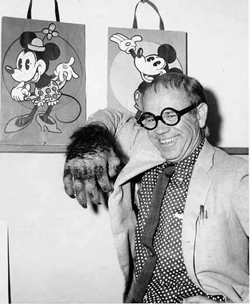
Ward Kimball, one of the most famous and distinctive of Walt Disney's great animators—and the most personally eccentric—died in 2002 at the age of 88. With his passing still a fresh memory—and with his "Tomorrowland" entries from the "Disneyland" TV shows of the fifties due to be released as a "Walt Disney Treasures" set of DVDs in the fall of 2003—it seems appropriate to revisit one of my interviews with Kimball.
 When
I interviewed Kimball on December 12, 1986, it had been ten years
since we last sat down with a tape recorder between us. He was one
of the first people in animation I interviewed, on my first trip
to Los Angeles in 1969, and we did another long interview in 1976.
By 1986, I had talked with many people who crossed paths with Kimball,
at the Disney studio and elsewhere, and I had accumulated a long
list of statements I wanted to check with him. The 1986 interview
was in that respect typical of many of my later interviews—not
tell-me-about-your-career retrospectives, but much more focused.
Such interviews don't lend themselves to publication in toto—parts
of them are usually incomprehensible without a lot of background
information—but extended excerpts can convey the flavor of
the person and his work, and such excerpts are what I've reproduced
here.
When
I interviewed Kimball on December 12, 1986, it had been ten years
since we last sat down with a tape recorder between us. He was one
of the first people in animation I interviewed, on my first trip
to Los Angeles in 1969, and we did another long interview in 1976.
By 1986, I had talked with many people who crossed paths with Kimball,
at the Disney studio and elsewhere, and I had accumulated a long
list of statements I wanted to check with him. The 1986 interview
was in that respect typical of many of my later interviews—not
tell-me-about-your-career retrospectives, but much more focused.
Such interviews don't lend themselves to publication in toto—parts
of them are usually incomprehensible without a lot of background
information—but extended excerpts can convey the flavor of
the person and his work, and such excerpts are what I've reproduced
here.
These excerpts deal mostly with Kimball's work in the fifties; I've organized them more or less chronologically. The fullest and most accurate recounting of Kimball's whole Disney career is in John Canemaker's recent book, Walt Disney's Nine Old Men and the Art of Animation. You'll find in Kimball's remarks here, however, a considerably franker and more detailed account of his disastrous run-in with Walt Disney over Babes in Toyland (1961) than the one in Canemaker's book. Kimball was at one point in line to direct that live-action musical comedy, but it wound up instead in the hands of Jack Donahue, and Kimball's career remained in eclipse for the rest of Walt Disney's life.
The excerpts conclude with discussion of the undying subject of Walt Disney's supposed anti-Semitism (and related prejudices). Kimball identifies Gunther Lessing, the Disney's studio's longtime attorney and Walt's ferociously anti-union ally during the 1941 strike, as being Jewish—which, if true, would certainly complicate the efforts of the many people who want to paint Walt and Roy Disney as anti-Semites. Unfortunately, Lessing's Jewish identity, if it existed, was as thoroughly submerged as Art Babbitt's. (Babbitt, the animator who was a leader of the strike, was of Russian Jewish descent, but he turned away questions about whether he regarded himself as Jewish.)
I had planned to offer an audio excerpt from this interview, but the sound quality of those tapes (I accidentally used Type II cassettes, rather than Type I) is too poor, so I'm offering a clip from my 1969 interview instead. The excerpts from the 1986 interview follow—the first excerpt quite typical, as I tested Kimball's memories about Sleeping Beauty against those of Eyvind Earle, that film's designer and background painter.
BARRIER: Eyvind Earle talked about your involvement in Sleeping Beauty, when Chuck Jones was there and the two of you were working together. I don't have a clear sense of what was going on when you were involved in Sleeping Beauty, but this is the way it looked to Eyvind Earle: "Ward at this point was all for a big revolution at Disney's—a new direction. And Walt gave him a chance, on Sleeping Beauty. Ward got Chuck Jones in from Warner Bros., or somewhere, and the two of them got a room right above me—I was on the second floor, where the background department was. Right upstairs, on the third floor, were Chuck Jones and Ward Kimball, getting ready to do this fantastic new something that had never been done before. I was knocking out these first paintings—I even remember clearly the day I brought this painting [reproduced in one of a group of stills that I had brought to the interview] up there, because the original looked quite impressive. I remember saying `How come you two aren't doing anything?' Weeks and months went by, and every time I'd come up there, they're sitting there talking—no sketches on the wall, nothing anywhere. I said to Ward, 'How come you're not doing anything?' He said, 'You don't know Walt like we do.' I don't know what he meant by that, because I didn't know Walt."
Later in the interview, Eyvind said, "The only one who did nothing was Kimball." I asked him, "Was he supposed to be working on story, too, at that time?" and Eyvind said, "I don't know. I don't know what he was supposed to be doing, except that he was supposed to be originating something brand-new that had never been done before. And, of course, many were telling me to be more modern, and I knew that for Walt, that wasn't it. So I didn't listen to anybody; I just did them the way I thought it would work."
KIMBALL: First of all, we weren't trying to do anything new and different, because I recognized I was filling in—I don't know what year that was—
BARRIER: If you were with Chuck, it would have been '53, because Warner Bros. was closed the last half of that year.
KIMBALL: '53 . . . that's before I went to work on television. I was between animation assignments, so Walt said, "Why don't you go up and work on that sequence about the fairies changing colors," and so forth. It was a fill-in. That happened a lot. I could leave the animation department and go and work on things of that sort, as a story man. I guess he had a little confidence in me. Bill Peet got off on something else at that point; he should have been working on it. We weren't trying to do anything different. You have to understand Eyvind Earle. He works in a certain style, and I must give Walt credit for experimenting on Sleeping Beauty and going along with an Eyvind Earle look. And I pushed that at meetings; I said, "Why do we always have to paint these things the same way? Can't we do this story more or less like the Renaissance art, the distorted perspective, and those great illuminations where the people are too big for the castle?" That sort of thing; and Eyvind Earle agreed with that, and it fit his style of over-designing. So, I'll admit, I was pushing it. He had worked with me on Toot Whistle Plunk and Boom, and we had done Melody and were cutting out old valentines and were gluing them to the background—all of those things, because I had discovered Graphis magazine, and it opened my eyes to some other way of doing things. Here, on those two musical things—which were destined, I thought, for the schools, why not do it a cheaper and easier way, and use other things? Well, they went into the theaters. That's when I met Eyvind Earle; he came to work, and I grabbed him because they wouldn't give me anybody else.
So we used his style, and Walt liked it, so Walt went out on a limb and used him on Sleeping Beauty. But I think later Walt and other people came to the conclusion that Sleeping Beauty, because of that style, was a little cold; and it's cold because in comparison to the regular "Disney style," it was designy. But Walt let it go through, and that's the way it is today. There is just as much incompatibility with the characters the way the animators drew them and the background style as there ever was on any of our pictures. An incompatibility the way the animation is flat and outlined, and the backgrounds are fully rendered. But we were going to do something different—no, that wasn't it. I think he's confused with my making the pitch on the overall Sleeping Beauty—"Let's do something different"—and that's why it came down on Eyvind's shoulders. But story sketches, no; you just do those the way you would, for the business.
BARRIER: So when you were working on Sleeping Beauty, you knew you weren't going to be on that very long.
KIMBALL: Yeah. Chuck wanted to know if there was any chance of his coming over, and probably sent a letter to Walt. Walt was not excited about it, but he said, "Well, let's give it a chance." I always felt double-crossed, because that gave him a little paycheck while he was navigating the dry spell at Warner Bros. I always felt I'd been had.
BARRIER: So the two of you were sitting up there in that room together.
KIMBALL: All we did was sit around; there was a lot of it. I think every time Eyvind came up there, Joe Rinaldi, he, myself, and Chuck Jones would get into these gabfests; and as I explained [in an earlier interview], Chuck had just discovered one-upsmanship, and he ran into his nemesis with Bill Peet, because Bill Peet wouldn't say much, but he was funny, and he could cut you to the quick. I started enjoying it, because I knew Chuck always wants to dominate the conversation, and Peet would cut his legs out from under him. Maybe that's one reason he didn't want to work there.
BARRIER: So as far as you were concerned, the whole episode was marking time until the next animation assignment.
KIMBALL: Yes, yes. Let's see . . . '53 we won the Academy Award for Toot Whistle, '54, '55, I was on television, the whole space [series]. That's why I was so glad to get off of Sleeping Beauty.
BARRIER: Was Jack Kinney originally supposed to do those space shows?
KIMBALL: We first came in, and we didn't know really what to do. Walt was opening up Tomorrowland, he had to have something, and we were going to have something with Daws Butler—very amateurish ideas, everything was being thrown out, and Jack was going to work on it also. But Jack was not necessarily interested in the fact that we were going out into space, and I was always a UFO fan anyway. So when I went to Walt with the Collier's [article on space exploration] and he said, "Hey, this is the way we should go," it was sort of mutual agreement, I think. Jack realized that this was the sort of thing that wasn't his bag. I was probably the most enthusiastic one, and I was going to take it very scientifically; it wasn't going to be a comedy hour. I think Walt sensed that, and gave Jack something else to do.
BARRIER: I've seen [Norman] Ferguson's last animation for Disney, a cartoon called Social Lion [directed by Kinney] that he did all the animation for, and it's really sad.
 KIMBALL:
Well, that wasn't Ferguson's fault. That was in the fifties? We
had just finished Toot Whistle Plunk and Boom, and before
that the Melody picture, and to everybody's surprise, Walt
accepted it and liked it, and one won an Academy Award. Walt was
surprised; they were better than he expected. John Hench had put
us down for doing it—"Walt's gonna fire your ass when
he gets back." But we came through; call it luck or whatever.
So the word got around, "Walt likes that modern stuff."
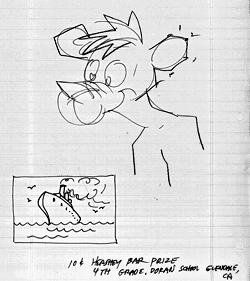
Ferguson might have done this in the old days. [Kimball drew a lion
in an older cartoon style—see the accompanying illustration,
with Kimball's tongue-in-cheek notation that it won the "10-cent
Hershey Bar Prize" at the Doran School in Glendale] Ferguson
would have drawn it this way, because he didn't draw any other way.
To make it modern, Jack Kinney—I think he was the director—not
understanding what we were doing, they would [Kimball went over
the "Ferguson" drawing and squared off the round corners].
It looked like these things where you follow the dots. I couldn't
believe it. We looked at it, Marc Davis and me, after working on
those other things—how stupid can you be? That was their idea
of modernism. You can see where this would throw Ferguson. We would
design the whole face so it wasn't the regular comic line. On our
Melody, and more on Toot Whistle, I set up a style,
with Tom Oreb, who was good at it, and X. Atencio was in charge
of cleaning up. We had animators on Toot Whistle that
did this way, but when they were cleaned up—the owl, and so
forth—X. Atencio did it, and he did a good job of designing
and keeping the movement.
KIMBALL:
Well, that wasn't Ferguson's fault. That was in the fifties? We
had just finished Toot Whistle Plunk and Boom, and before
that the Melody picture, and to everybody's surprise, Walt
accepted it and liked it, and one won an Academy Award. Walt was
surprised; they were better than he expected. John Hench had put
us down for doing it—"Walt's gonna fire your ass when
he gets back." But we came through; call it luck or whatever.
So the word got around, "Walt likes that modern stuff."
Ferguson might have done this in the old days. [Kimball drew a lion
in an older cartoon style—see the accompanying illustration,
with Kimball's tongue-in-cheek notation that it won the "10-cent
Hershey Bar Prize" at the Doran School in Glendale] Ferguson
would have drawn it this way, because he didn't draw any other way.
To make it modern, Jack Kinney—I think he was the director—not
understanding what we were doing, they would [Kimball went over
the "Ferguson" drawing and squared off the round corners].
It looked like these things where you follow the dots. I couldn't
believe it. We looked at it, Marc Davis and me, after working on
those other things—how stupid can you be? That was their idea
of modernism. You can see where this would throw Ferguson. We would
design the whole face so it wasn't the regular comic line. On our
Melody, and more on Toot Whistle, I set up a style,
with Tom Oreb, who was good at it, and X. Atencio was in charge
of cleaning up. We had animators on Toot Whistle that
did this way, but when they were cleaned up—the owl, and so
forth—X. Atencio did it, and he did a good job of designing
and keeping the movement.
BARRIER: I've heard a couple of stories about the original version of the Siamese-cat animation in Lady and the Tramp. One was that the original version was thrown out by Walt as being "too good" for the rest of the picture; and the other was that the cat sequence was done in what Cliff Nordberg called "two-dimensional animation" and had to be redone for that reason. Which one is closer to the truth? Or are both of them correct?
KIMBALL: Who said it was two-dimensional?
BARRIER: That's what Cliff Nordberg told an animation class at Disney's.
KIMBALL: I never heard that. I went off on another picture. I started that—what was the date when we were starting to animate on Lady and the Tramp?
BARRIER: The picture came out in '55, so it probably would have been early '54.
KIMBALL: Well, see, I was on television. I got off of Sleeping Beauty—maybe I was waiting for Lady and the Tramp—and Walt needed somebody to do the Tomorrowland shows. "Too good for the picture" or whatever the thing was, he really needed me on [the TV show]. This was important to him, this park, and he had no Tomorrowland stuff. Rather than dwell on whether it was two-dimensional or too good—they're sort of [at] cross-purposes, those comments—overriding all of that was that he wanted me to develop the television show.
BARRIER: But the cat animation in the picture is still largely your work, isn't it?
KIMBALL: No, I animated some scenes—who ended up doing it? [Bob Carlson, Bill Justice, and John Sibley are credited in the Disney's studio's draft, the scene-by-scene record of who animated what. Kimball is not credited for any animation.] I did some scenes, and they might have kept one or two scenes. As you get along, they keep changing the character, and they might have gone back and changed the proportions. I remember "it's too good for the picture," [but I don't remember in] what context that was said. Too real, or something. Those things happen. You see, you're developing something, and you have to go back; [you] do that all the time. You learn things, and you redo all of it, to bring it up to what you like.
BARRIER: You mentioned [off the tape] Walt's being in Europe in early '53; of course, he was in Europe a lot in the early '50s—
KIMBALL: He was gathering material for Disneyland.
BARRIER: And before that, he was in England periodically for the shooting of the first live-action features. He was away from the studio for six months at a time. How did this affect you and the others?
KIMBALL: Once he got this bug about the park, it was an obsession. That's all he thought about. I was in on the very beginning of that, because he started with his interest in the railroad, his inch-and-a-half-scale steam. He began to meet people that were connected with his scale of railroads; I think the nurse and his doctor said he needed a hobby. Even though the shop built the locomotive, Walt's baby was building that inch-and-a-half-scale caboose. He was proud of it; he liked it. He'd come down Saturday and Sunday, to the studio, and work on this. In those days, his idea was to have the "Disneyland" across Riverside Drive, where the scene dock eventually ended up. Then we took trips up north to see a guy who had possession of all the railroad equipment that had been used in the San Francisco Exposition in 1916. It was in San Francisco proper, where they had the Palace of the Legion of Honor and all that fake classical architecture that they made out of stucco and two-by-fours. Walt's first conception on Disneyland [was] that you get about on a small railroad, twelve-inch gauge, like the old Venice, California, engines that we had out here in the early twenties. You could ride all over the city of Venice, like streetcars. But Walt's ideas changed, on the size of the railroad, I think really after he came out here one night and we steamed up the three-foot gauge and he got to pull the throttle. He got away from the miniature, and ended up with a three-foot gauge railroad in Disneyland. In Walt Disney World, it's still three-foot gauge, but those locomotives, instead of being slightly scaled down, in reference to the track, are full size; they got them from Central America.
But this was his new baby; that's all he could talk about. That's why he left me alone on the space series. That never would have happened; those pictures never would have come out—that way or at all—because he would have been there checking on me every week, and I knew there were things on the board that if he saw before we put them in production, he wouldn't approve of. After he saw them, like the Mars picture, he sat there with his mouth open. So that was pure luck, and coincidence. We were protected by his zeal and enthusiasm about a park where people could come and have fun.
BARRIER: But most people seem to have regarded his absences as a problem rather than an opportunity—something they had to work around.
KIMBALL: That's right, and I was a different type of person. I looked at it as, here's a chance. And I interpreted it as giving me the responsibility—which he had never done before. The other guys, maybe he didn't say, "Hey, do this while I'm gone," and so they were lost without his coming up there and having a story session once or twice a week. In our case, like that story where he takes a piece of folded blank paper and hands it to me the day he decided to do these things based on the Collier's article--it's like here, write your own ticket. That was written up in Dave Smith's article in Future magazine [in 1978]. Guys never got over that, around the studio, when that got around, that Walt had handed me a blank piece of paper, with a pencil, and said, "Write your own script. Do anything you want."
BARRIER: I would think his attitude toward the features would have been different, though.
KIMBALL: That's true. He felt that I was on the right track, and I was not totally knowledgeable but that I would do a job that he would approve of. And we did check with him. It was a hard job getting him to come in, when we had the thing all up on the boards, [but] he made good suggestions, and he met [Wernher] Von Braun, and as soon as he started talking to Von Braun, he got really enthusiastic. He knew that I was working with Von Braun, and that Kimball couldn't get too far off the subject with our leading space expert looking over his shoulder. So it was a unique circumstance, and I would say it was a hell of a lot of luck. I don't think, when I look back on it, that we let him down on it, even though, when he was trying to put me down and he thought I was getting too big for my britches, he said, "Goddammit, Kimball, you know that space stuff you're doing, my wife saw the first show and it bored the shit out of her."
BARRIER: [In that connection] Lew Keller was talking about the Babes in Toyland episode.
KIMBALL: Yeah, that was kind of a low period. Unfortunately, his gofers and yes-men, like [Bill] Anderson and the rest of them, didn't like my taking responsibility while Walt was away. I had the sets designed, we decided on Ray Bolger, things like that, and those were the province of Walt. I stepped over, but I had learned this from the space pictures. I should have analyzed it; maybe we're getting into a different territory. So, it was bad, and he was going to teach me a lesson, and I was a naughty boy, I suppose, but it wasn't my fault. This publicity guy, who knew that our rights to Babes in Toyland were about to expire in a year or so, didn't want any other studio starting the project, so he took this ad in the Variety and Hollywood Reporter: "Congratulations, Ward Kimball assigned to direct Babes in Toyland." I was embarrassed; I opened it and I called him: "What the hell did you do this for, what's Walt going to say?" "Well, we had to, it's for our own protection." Walt heard about it—of course, Anderson and the rest showed him—"We've got to do something about Kimball here." Walt thought that I put that in, and that was bad, and I don't think that I ever convinced him that I didn't.
BARRIER: Did the publicity guy confess that he had done it?
KIMBALL: They got rid of him. No, he never went to Walt.
BARRIER: Lew Keller said—and I don't think this is something that you mentioned—that another pretext Walt used for giving you a hard time was that you had been away from the studio for a few days with the Firehouse Five; you were absent for six days, or something like this, playing in Reno.
KIMBALL: Well, no. Basically, it's what I'm relating—I took too much initiative in a territory that was Walt's prerogative. I should have waited; I should have presented it to him—"This is a set we've been working on, we were considering Ray Bolger"—we hadn't hired him, he just did a try-out; it was an experimental scene. Had not the ad appeared, it would have been all right. But those were two unfortunate—-so it's not always been luck with me. I just felt really shot down by circumstances. Along with that—it all added up, because when Walt got back, he was backing Nixon [for President]. Somebody talked Walt into contributing to Nixon, and talking to us about the dire circumstances of the movie industry if we didn't have Nixon, all that crap that had been given to us by Gunther Lessing …. When they came up to me, I said, "Hell, no, I'm not going to contribute to this. Walt shouldn't be doing it. What if the trade papers get hold of this thing, that Walt is putting the pressure on his supervisors to contribute to Nixon? That's bad. Even if I was a Republican, that would be bad. I wouldn't run this risk." So the stories got back to Walt that Kimball wasn't cooperating. What saved me from his full wrath was when they got to Milt Kahl, who was a rock-ribbed conservative. He got mad about being pressured, and he jumped up and down and raised hell. At least he had two of his favorite animators, with divergent opinions [but] both agreeing that Walt shouldn't collect—and that changed in a week or two to "the candidate of your choice." [But] that was thrown in the hopper.
BARRIER: This business about your going to Reno to play with the band—was that also something that was thrown in?
KIMBALL: He was so proud of that band for years that he went to all our openings at the Mocambo; he got up there on the stage, I remember, at the Mocambo, a place he'd never go. He said "my boys" and made speeches in front of all the rest of the stars. But when these things all got added up, the band got thrown in the hopper, too. I remember he was having a picnic out at the Golden Oak Ranch—a barbecue, an all-day thing. We were playing baseball, and everything else. Walt had already talked to me about the Babes in Toyland thing. This was on a Saturday, and I went to the picnic at 10 o'clock in the morning, and it was going to go through until the evening, with Japanese lanterns and everything else. But I had to leave and drive to San Diego to play at the Hotel Coronado with the band, like we did on the weekends; we never let it interfere with the studio—it was Saturday or Sunday, or Friday night. I wanted something to eat, I smelled this barbecue cooking, but I had to leave at, say, 2 o'clock, so I went over and asked them if I could have a plate of food earlier. We'd had the games, and I remember Walt didn't think it was funny earlier in the day because I was playing catcher at the time, and Keenan Wynn was into motorcycles, and he kept roaring out there. Somebody was going to bat for him, and he would go around the bases on this motorcycle. Walt walked over and saw Keenan going around, and I said, "Heh, heh, Keenan's got this idea, he's going to run the bases." Walt scowled, like "what the hell's this all about?"—which didn't do me any good; he thought it was my idea. So he walks up, while I'm sitting all by myself, with Betty [Kimball's wife], and I'm eating, and he says to Betty, "Don't you feed him at home?" I said, "Gee, Walt, I have to go and play a job in San Diego." He made some sarcastic remark: "Don't we pay you enough?" You see, this fed the way he was feeling. That's what Lew is probably talking about. Walt couldn't understand why I would leave a Disney party that he planned, desert it at 3 in the afternoon, and go to San Diego and play with the band. Betty came in and said, "Well, Ward likes the applause"—some silly remark. So I think that's the real story behind it.
BARRIER: Once his inclinations had changed—
KIMBALL: Yes, once you'd been pegged—
BARRIER: —then everything feeds that, whereas before, your going to San Diego to play with the band might have been a plus.
KIMBALL: Greed, money—"Don't we pay you enough?" And it was a dull party.
BARRIER: Something I've never been clear on is the extent to which the Nine Old Men, in the postwar years, played a formal role, as a committee, in deciding who got screen credit and recommending people for raises, and that sort of thing. The implications of what people say are that you performed a sort of review function, but it's never stated that clearly.
KIMBALL: Well, here is my perspective on it. From the very moment I started animating, doing crowd scenes in the early days, and the late '30s, and coming over to the new studio, we were isolated all the more; we all had our separate rooms. On Hyperion, there were two animators to a room, and two assistants; that's four guys in a little narrow room. We got to Burbank, we had carpets—the animators got carpets and the assistants got hard linoleum. We were isolated, and I kept questioning: Why aren't we animators in on these story meetings? We are the ones that eventually put it on the screen; why shouldn't we be familiar with it? Why don't they ask for our input? And I realized there was sort of a wall between the story department and the animators. That's one of the things I brought up on my trip back to Chicago with Walt [in 1948], the lack of animators' participating in the story. I could see that he realized that that was a good idea, but he never told you if you had a good idea. So I fought for that. And the strike brought everything to a head as far as screen credit was concerned, because we never got it on the shorts; Walt, through his own choice, put our names on the features. The strike, and the agreement with the Guild, worked out the problem of credit on the shorts, and that became industry-wide, that the animators and story men got credit, which was a good thing. We always had somebody who was a front for the animation department. First it was Hal Adelquist, but he was more or less chosen by us.
BARRIER: Really? You chose Hal Adelquist?
KIMBALL: I mean, he had our backing. If we didn't think it was a good idea, I don't know whether he would have said anything, but he worked with us, he represented us. Then, when he left, they had to get another representative; that's when we all got together, as a group—not with Hal sitting there—and tried to think of somebody who would be expendable, who had the least amount of talent as far as the animation, or even in-between or clean-up. We chose Ken Peterson, because he seemed to be articulate at meetings, and he was a little power-hungry. And we didn't need him. So he went in, really, with our blessing. That meant we had control of things; and we let him know that when we had gripes, we want meetings called. At that time, we were going through financial problems, too, and we had to let people go, so who would they let go first? That was a tough thing. We had to vote on it; who else would have voted?
BARRIER: But who was in there doing the voting? Was it just the Nine Old Men?
KIMBALL: Yes, the supervising animators. The guys who stayed in the place during the strike. They were the animation committee. And, of course, we knew about a guy's work more than anybody. How was anybody to know in the personnel department? How are they to know in the story department? It was a fair way of dealing with it. We hated to do it. They would agree that they had to get rid of two people and who they would be. Then, in good times, we needed animators, and we would discuss the people on the outside who could come in and work in the Disney style. So it was very helpful. But at the same time, we began censuring the directors we didn't like, especially Gerry Geronimi, and it got so none of us would work with him any more. The final blow came when [John] Lounsbery, who was on the committee also, refused to pick up work. So we exerted a little power. But it was to make ourselves known and make sure we got things like being invited to meetings. This was a thing I always, from the very beginning, thought was screwy about the place. When I was Ham's assistant: "You just picked this up from the director; you haven't heard how they arrived at this idea. You're the one who puts it on the screen; why didn't they call you?" It's always been a stormy-petrel attitude I have. …
BARRIER: In the fifties, some of you started going out of animation—Marc Davis going into WED, and you going into the TV show and live-action features. Did you remain a member of the committee?
KIMBALL: More or less, yes. I became a director.
BARRIER: But the committee was loose enough—
KIMBALL: Yes, yes. We never took it that seriously. I'd sit there and doodle and draw. I think Frank [Thomas] and Ollie [Johnston] saved one of my drawings—all of us sitting around, holding hatchets, and Peterson says, "We've got to cut down." Then [in another drawing] we're all holding pillows—you know, the opposite. We hated to be part of it, so we made fun of it, made fun of ourselves, and kept it very light. But it was fair. And the only guy who really got mad was Geronimi.
BARRIER: How long did the committee continue to function as such?
KIMBALL: It sort of petered out.
BARRIER: As people started retiring—
KIMBALL: Well, Walt died. The beginning of the end of Geronimi was Lounsbery going to Walt; and then we backed him up. … I know [Walt] enjoyed the conflict; he knew that this was good for the place, one guy fighting the other.
BARRIER: An interesting thing came up when I was up in Palo Alto and dropped by to visit Art Davis, who was a director and animator at Mintz and then Warner Bros. He had talked with Walt in the early thirties about going to work for Disney's then, and Walt had offered him a job. He decided, I guess it was shortly after the strike, that he was going to make a move. He was very close friends with Norm Ferguson at the time, and he said that he talked to Norm about coming over to Disney's, and talked to Walt, and was assured this would be no problem, and just to wait for things to take their course. Nothing ever happened, and he was never able to find out from Norm Ferguson what the problem was. He did hear later that the problem was that he was Jewish. Obviously, it's difficult to substantiate any individual case, and I've never heard any convincing evidence that Walt himself was anti-Semitic—
KIMBALL: Well, the climate of the times was a little more pronounced. Somebody brought up the fact about the crows, and I said, "Well, you've got to put yourself back there." When we did Dumbo, that was approved, to have a Jim Crow, and "yowsah, boss," and all that [sort of] thing. I said, "Don't forget, we had blacks, with great glee, doing the soundtrack." There were ethnic jokes everywhere you went, and all of a sudden it was a no-no. For years, Dumbo couldn't be shown because of the crows. It finally broke out of the cage of censorship when it was run in Montreal, at the Expo [in 1967]; everybody realized this shouldn't be hidden.
Sometimes that [the presence of anti-Semitism at the studio] would be easy to say, and I can see from the point [of view] of a person being Jewish they might say that, or [be] inclined to be that way, but we had Otto Englander, Joe Grant--you can name a lot of guys that were there working for Walt, that he depended on—Gunther Lessing . . .
BARRIER: Gunther Lessing was Jewish?
KIMBALL: Yeah, right. Walt was prone to remarks about Jews, I guess like everyone else. We had a story meeting on the part of Pinocchio where he's telling a lie, and his nose gets longer and longer and longer. For a gag, I think Joe Grant did a caricature of [himself] and Dick Huemer, who were working in the same department then, drawing the "Grant-Hume bird." So when the bird appeared on the end of Pinocchio's final stretch of the nose, that was the topper, even with a nest. To top that, he had baby birds—that's how he did it, he had a Joe Grant bird and a Dick Huemer bird, kind of an in-house [joke], and Walt says, "Well, jeez, if you're gonna do that, why don't you have a little Ward Kimball Irish bird in between them." So, I would say in an indirect way that was one time I heard him [make an ethnic joke]; but everybody was doing it. The comedians.
BARRIER: Dave Hilberman [a leader of the Disney strike] was both Jewish and Communist—
KIMBALL: How bad can you be?
BARRIER: —and he said that at the time, the equation of Jew and Commie was quite common.
KIMBALL: Yeah, they were one and the same [to] people like Walt; he would love things like that…
BARRIER: Somebody said to me that Art Babbitt was Jewish. That had never crossed my mind.
KIMBALL: Oh, yes. But, see, Walt—he talked with me once, he said, "Jesus, Ward, I know you're kind of a socialist yourself. For Christ's sake, I'm on your side; my father was a socialist." My mother thanks you, my father thanks you, my sister . . .
BARRIER: It does seem that after the strike, people like Berny Wolf got laid off . . .
KIMBALL: Yeah, but the goys were laid off, too. But you see, Babbitt and [Bill] Tytla had the temerity to go out on strike. He didn't care about the lesser lights.
BARRIER: It seems that after the strike, the people with strong flavoring, ethnic flavoring of various kinds, tended to disappear, and the people who remained prominent, as animators at least, were more in the California, Protestant, middle-class mold.
KIMBALL: The guys like Thomas, and so on? Don't forget, the New York guys were the old guys that were animating before Walt even came to California. And they were older; and Walt, somewhere in his thinking, said, "They're tied down to old styles and work habits. They're not trained as artists." So you can't forget that. It wasn't necessarily that he was against the ethnics.
BARRIER: I don't think it was necessarily a conscious thing at all. I just wonder if, given his own personality and his own background, he would not have felt more comfortable with people like you, Frank, Ollie . . .
KIMBALL: That's because he saw us come up from nothing. We were his guys. Whereas the other people were imported. That's the difference.
BARRIER: They had a separate identity before they came to Disney's.
KIMBALL: We were trained and fed and nursed and weaned under his wing.
BARRIER: So it was more or less incidental—
KIMBALL: Yes. With this wave of artists who came there in the mid-thirties, we were the preponderance of the people he leaned on, the Nine Old Men. People are liable to read too much meaning; there are other conditions and influences on all of these things. The fact that Babbitt was the ringleader—Walt never forgave him. Like I said, he felt that he took you on, gave you a job when there were no jobs, paid you a salary, so he had a right to your loyalty, and you shouldn't cross him. That's a common syndrome among bosses with talent and bosses without talent.
BARRIER: They don't ever think they're getting something in return that is equal in value to what they pay you.
KIMBALL: That's right. And Walt had all of that.
[Posted August 2003]