
FUNNYWORLD REVISITED
Robert Crumb and the Human Comedy
By Harvey Pekar
Reprinted from Funnyworld No. 13 (1971).
[An introductory note: When Harvey Pekar's essay "Robert Crumb and the Human Comedy" appeared in Funnyworld No. 13 (1971), I identified him as "a writer on jazz whose work appears frequently in Down Beat and other publications." A few years later, Pekar began self-publishing a comic book called American Splendor, a Dostoyevskian record of his life as a file clerk in Cleveland. Fame of a sort followed, including multiple appearances on David Letterman's late-night show, trade-paperback anthologies of the comic books, and, most recently, an American Splendor feature film that has won critical huzzahs. To the relief of those of us who follow his work avidly, Pekar has remained among the downtrodden in spirit.
[For some reason, Pekar's piece on Crumb aroused more extreme reactions, pro and con, than any other article I published in Funnyworld in the early seventies. As for Crumb (who later illustrated many of Pekar's scripts for American Splendor), he wrote to me soon after I sent him a copy of No. 13:
["Harvey Pekar ... what a crazy guy!!! The last of the working-class Jewish intellectuals ... he's my good buddy, old Harvey ... I stay with him whenever I'm in Cleveland and we have long debates about things and I learn a lot from him ... he's a vast encyclopedia of historical knowledge and seems to have a really good perspective on the world, but he's better in person than in his writing." (The ellipses are Crumb's.)
[Pekar and I exchanged a lot of letters, and at one point I hoped to publish an essay by him on Spain Rodriguez, another underground cartoonist, but for some reason our correspondence petered out at the end of 1972. Soon after that, Pekar found much better things to do. MB]
In his work, Robert Crumb generally portrays the world as a sideshow and the people in it as freaks. He sometimes shows compassion for his characters, but he almost always views them in a humorous light. Crumb laughs at everybody, regardless of race, creed, color or national origin. He views his role as a cartoonist as that of producing work that is funny. If it's profound, as it sometimes is, that's a bonus.
In his "Life Among the Constipated," he makes fun of lower-middle-class whites, the kind of people he grew up among. This isn't too startling. A cartoonist whose audience contains a lot of young people who are political leftists is on safe ground when he gives hard-hat America the razzberry.
But Crumb doesn't stop there. He puts down and makes fun of blacks as well as whites. Angelfood McSpade and the jiveass guy who gets the chick away from Percy and Sy in "The Lighter than Air Boys" (in Despair) and the black nationalists who try to shakedown Shuman the Human in Mr. Natural do not add up to a very flattering picture of contemporary black Americans. Some of Crumb's readers apparently can't believe that he is as capable of expressing condescension toward blacks as he is toward whites. Thus, Rolling Stone reports that Angelfood McSpade has been viewed as "a symbol of the deep-rooted basis of American race prejudice." She isn't, any more than Beulah was.
Crumb has also made fun of Chinese and Jews. He's democratic-he ridicules everyone.
Crumb bends over backward to avoid pretentiousness and artiness. His "Abstract-Expressionist Ultra Super Modernistic Comics" is, in fact, intended partly as a satire, a put-down of "arty" modern art. Anti-intellectualism: can be detected in his attitude toward Shuman the Human.
 He
usually doesn't try to put into his work moral and political messages
like Spain Rodriquez's "Fight the oppressor" or Charles Biro's (you
remember Biro—one of the great moralists of our time) "Crime
does not pay." Insofar as he has political views, he is sympathetic
to leftists. (In the course of some discussions Crumb and I had
last September [1970], for example, he was quite critical of capitalism,
describing it as an unsound system that had to expand like a plague
to live. I think the implication of his remarks was that capitalism
would eventually run out of resources and people to exploit and
burn itself out, i. e. capitalism carries the seeds of its own destruction.)
He
usually doesn't try to put into his work moral and political messages
like Spain Rodriquez's "Fight the oppressor" or Charles Biro's (you
remember Biro—one of the great moralists of our time) "Crime
does not pay." Insofar as he has political views, he is sympathetic
to leftists. (In the course of some discussions Crumb and I had
last September [1970], for example, he was quite critical of capitalism,
describing it as an unsound system that had to expand like a plague
to live. I think the implication of his remarks was that capitalism
would eventually run out of resources and people to exploit and
burn itself out, i. e. capitalism carries the seeds of its own destruction.)
However, it seems to me that some of Crumb's best work may be his preachiest. His two "Lenore Goldberg and Her Girl Commandos" stories, which are satires of the women's liberation movement, and his "It's Really Too Bad," one of the most overtly philosophical things he's ever done, are outstanding, really meaty pieces.
In the Lenore Goldberg stories, which appear in Motor City Comics, Crumb comes closer to taking a political stand than he does in anything else I've seen by him. He pokes fun at Lenore and her friends but portrays them sympathetically, He pictures policemen as stupid and one particular FBI type in the second Lenore story as an evil, bigoted dirty old man.
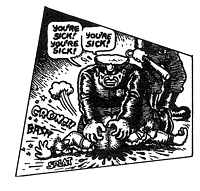
One panel in the first Lenore story is especially notable. In it, a policeman is shown pounding Lenore's girlfriend's head on the sidewalk in a pool of her own blood while he screams, "You're sick, you're sick." If this panel were lifted out of the story and printed by itself it would make an excellent Herblock-type political cartoon.
But even in these Lenore Goldberg stories, Crumb does not sustain his angry criticism of today's political injustices. The first story ends with Lenore performing an oral sex act on her boyfriend as he says, "Viva la revolucion." It's as if Crumb is saying that what's most important to Lenore is sex, not politics.
In the second story, Lenore escapes from the police and finds safety living in a commune in Canada, where she has a baby. Her girl friend from her days in the women's lib movement comes to visit her and upon seeing her with her son, says in surprise, ".I never thought I'd see the day when you'd—." Lenore interrupts her to say, "Well, y'know . . . life goes on and things change. . . " Then Crumb ends the story with, "Will Lenore Goldberg turn out to be a Jewish mother? Only time will tell."
This is a very funny way to end the story but, in a sense, an unsatisfactory way. During most of the story Crumb is behind Lenore and her movement, but at the end he makes fun of her. It's as if he's reproaching himself for taking her so seriously. His "always-leave-'em-laughing" endings to both stories seem to be an attempt to make up for what he considers to be the preachiness in the stories. In response to my praising these stories he remarked that they were rather preachy. Frankly, I think he's overly concerned about getting too serious.
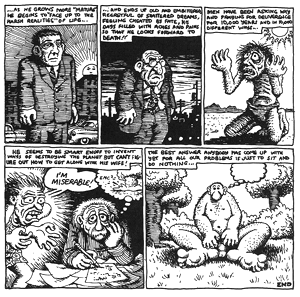 "It's
Really Too Bad" deals with the hopelessness of it all. After showing
panel after panel of miserable people suffering, crying out for
help and not receiving it, searching for answers and not finding
them, Crumb concludes with a panel showing a big, naked, childlike
moron sitting with an empty thought balloon over his head. Above
him is Crumb's comment, "The best answer anybody has come up with
yet for all our problems is to sit and do nothing."
"It's
Really Too Bad" deals with the hopelessness of it all. After showing
panel after panel of miserable people suffering, crying out for
help and not receiving it, searching for answers and not finding
them, Crumb concludes with a panel showing a big, naked, childlike
moron sitting with an empty thought balloon over his head. Above
him is Crumb's comment, "The best answer anybody has come up with
yet for all our problems is to sit and do nothing."
"It's Really Too Bad" is a very funny piece, due partly to Crumb's skill at caricature, but it's also a grim, sad piece in which Crumb, perhaps despite himself, is quite serious. The anger and pain and emptiness in the lives of the people he draws can be clearly seen in their faces. When you see a wife with her eyes bulging out screaming, "I'm miserable" at her melancholy-looking scientist husband (a caricature of Albert Einstein), you'd better believe Crumb isn't just kidding around.
Crumb is no bleeding heart, but he's aware of all the people who lead lives of desperation, quiet and otherwise. He was brought up in a strongly Catholic environment and knows firsthand the problems religious hangups can cause. He was raised among working people, wasting their lives working at boring, tiring jobs. He's seen some of his friends turn to drugs for relief and destroy themselves.
"It's Really Too Bad" is not typical of Crumb's work, but he has done a number of other pieces that accurately and powerfully portray alienated, tormented people, e. g. "Just Us Kids," "Duck's Yas Yas," "Whiteman," "Dirty Dog." Crumb seems to have an ambivalent attitude toward these people; he feels sorry for them while laughing at them. Maybe that's what the human comedy is all about.
[Posted August 2003; corrected version posted December 14, 2003]