
FUNNYWORLD REVISITED
The Filming of Fritz the Cat, Part Two
From Funnyworld No. 15, Fall 1973
V. A Strange Breed of Cat
The animated feature that emerged from all this travail is one of the most important cartoons ever made. In it, Bakshi established himself as almost the only cartoon director whose current work is worthy of serious attention.
This is so even though Fritz the Cat is, in many respects, a pretty bad movie.
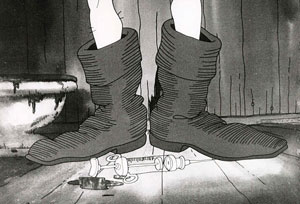 In
almost every way, Fritz is a patchwork film. Bakshi assembled
his screenplay (that word is not usually appropriate for animated
cartoons, but it is for this one, for reasons I'll explain later)
from parts of three Crumb stories. The opening scenes are taken—with
relatively few changes—from the Fritz story in the Head
Comix book; the middle of the picture is based on "Fritz
Bugs Out," with the scenes in Harlem greatly expanded from
those in the book; the closing scenes draw on "Fritz the No-Good,"
although here Bakshi's hand is more in evidence than anywhere else
in the movie. Bakshi interspersed material of his own throughout
the picture—the pig policemen, for example, and the scene in
the synagogue—but it was in the last half of Fritz,
from the Harlem riot onward, that Bakshi really departed from Crumb.
The movie is much grimmer than Crumb's stories past that point,
and far more violent.
In
almost every way, Fritz is a patchwork film. Bakshi assembled
his screenplay (that word is not usually appropriate for animated
cartoons, but it is for this one, for reasons I'll explain later)
from parts of three Crumb stories. The opening scenes are taken—with
relatively few changes—from the Fritz story in the Head
Comix book; the middle of the picture is based on "Fritz
Bugs Out," with the scenes in Harlem greatly expanded from
those in the book; the closing scenes draw on "Fritz the No-Good,"
although here Bakshi's hand is more in evidence than anywhere else
in the movie. Bakshi interspersed material of his own throughout
the picture—the pig policemen, for example, and the scene in
the synagogue—but it was in the last half of Fritz,
from the Harlem riot onward, that Bakshi really departed from Crumb.
The movie is much grimmer than Crumb's stories past that point,
and far more violent.
Even when he stuck pretty close to Crumb, Bakshi reshaped the Crumb stories in his own image. Bakshi is a New Yorker, and so Fritz is a New Yorker, too, even though Crumb's Fritz does not live there (he lives in only one identifiable city—San Francisco, in "Fritz the No-Good"). In the specifically Jewish elements—the synagogue, the Jewish policeman—Bakshi moved even further from Crumb, and closer to autobiography.
The problem with this is not that Bakshi departed from the letter of Crumb's stories—those stories are not Holy Writ—but that he so rarely improved on Crumb. For example, the sequence in the synagogue fails not because it is pure Bakshi, but because it is messy and confusing.
What is most aggravating about the screenplay for Fritz, however, is that Bakshi made such clumsy attempts to tie his loose ends together. In the film, Winston, Fritz's fox girlfriend, appears after the riot, and drives Fritz to the West Coast, just as in "Fritz Bugs Out"; but in that story, Winston had been introduced earlier, first in conversation and then in person. In the movie, those parts of the story were not used, and so Bakshi had to make a choice: should he simply introduce Winston without preparation, and trust the audience to figure out that she is Fritz's girlfriend, or should he find some way to bring her into the story earlier? Bakshi's solution is embarrassing in its crudity, At the start of the picture, when Fritz has lured three girls into a bathtub orgy, Fritz refers repeatedly to one of the girls as "Winston," even though there is little similarity in voice, personality or even appearance to tie the two "Winstons" together. To make matters worse, the bathtub "Winston" reappears at the end of Fritz, when the orgy is replayed in a hospital bed.
Many other characters are handled just as clumsily. For example, the pig policemen are comic bunglers on the order of the Three Stooges most of the time (Bakshi even called them "lovable cops" in one interview), and it is hard to accept the deaths of these two slapstick comedians at the hands of a mob of murderous crows.
In any event, Fritz is not offered to us as a "well-made" film, but as a portrait of the 1960s. According to one source, the film's opening reference to that decade was an afterthought; Bakshi supposedly realized that the subject matter might seem dated if he didn't tie it together with a theme of some kind. But, deliberately or not, Fritz really is about the Sixties, and it must be judged, according to whether it gives us a sense of what life was like then. It fails because it has no fullness, no feeling of life beyond the screen.
Bakshi's failure can be measured by comparing the young revolutionaries in his film with those in Crumb's "Fritz the No-Good."
Crumb ridicules his revolutionaries, but gently—they are dangerous, but not nearly as dangerous as they'd like to be. They are naive, self-important, and casually destructive; their "ideals" are mere slogans. The attitudes of these revolutionaries were common in the late 1960s, and there are psychological bonds uniting them with other young people of that time, even those who did not want to blow up the Golden Gate bridge.
Bakshi's revolutionaries, by contrast, are cold and sinister, with strong homosexual overtones; more important, they are isolated maniacs. As such, they're reasonably interesting—but they have no place in a movie that proclaims from the beginning that it's about the 1960s.
Most cartoonmakers have not even attempted anything like what Bakshi attempted in Fritz. Traditionally, animation has been devoted to bringing to life characters who seemed to embody a wide variety of human experiences; they did not so much live in the world as carry it within them. In this respect, the animated cartoons of the thirties and forties were very much the heirs of the silent comedies of earlier decades.
Sometimes, though, animated cartoons have tried to give some sense of a society in which their characters live. In Pinocchio, for example, there is a very elaborate shot in which Gepetto's village bustles with life in the morning. This shot, for all the money and effort that went into it, is artificial and unconvincing, and for most of the picture, the village is nothing but a prop for the activities of the principal characters. It may be that the calculation and planning that must go into such animated scenes are simply too great, so that the scenes can no more seem natural and open than can a carefully choreographed ballet.
Fritz is the most ambitious attempt yet to bring to a cartoon some of the feeling of life observed, rather than life transformed by art. To some extent, Bakshi's poorly constructed screenplay gets in the way of this, because of the great grindings and crashings as the plot's gears fail to mesh. Bakshi was limited as well by his inability to handle scenes with a large number of characters in them. In such scenes, the effect is usually confusion, rather than abundance; there is a simple lack of coordination when more than two or three characters are in a scene. For example, at the start of the bathtub orgy, when Fritz and the three girls are alone in the tub, Manny Perez's animation is almost an improvement on Crumb, since it makes plausible the four bodies writhing in the tub; but as the room fills with other animals, and other animators take over, the screen becomes crowded and the characters' movements slip into mechanical patterns.
Sometimes, even when the individual scenes are adequate, the editing—and here Bakshi is clearly to blame—is deadly. This happens during the Harlem riot, which is crudely conceived and even more crudely executed. Bakshi asks his audience to accept the bombing of Harlem—which is asking a lot—but the riot does not grow in a way that would make the bombing seem inevitable, rather than ludicrous. The editing reduces the violence to fragments, and so the political point that Bakshi wanted to make (which is underlined by a shot of the silhouetted figures of Mickey and Minnie Mouse and Donald Duck cheering the jets on) is presented to us naked.
There is much more to giving a sense of real life on the screen than simply filling it with people; even if Bakshi had successfully managed his large-scale scenes, he would still have been left with dialogue that served his purposes poorly, in different ways.
Bakshi tried to give his dialogue a rougher texture by improvising part of it, as in the scenes with the two pig policemen (Bakshi himself supplied the voice for the Jewish policeman, and his friend Phil Seuling did the voice for the other pig). More important, he recruited as voices people who were the real-life analogues of some of the characters in the film; his own father provided the voice of a rabbi in the synagogue. Bakshi says he went to Harlem with a tape recorder and spent several hours talking to blacks in a bar, and getting drunk with them as he asked them questions; most of his questions were based on a script, so that he could get answers that could be used as lines of dialogue in the film.
"First I hired this famous black writer and told him to go up there and get the answers for me, because I thought, what the hell am I going to do up in Harlem? He came back and said, 'Hey, man, no one's saying a goddamn word.' They were all uptight. But I didn't like the guy because he was pompous, and I thought, how can he relate to people? So I took my tape recorder, and went up myself, and it worked. None of it was paid for.
"Some guys would come by (in the bar) and ask who I was, you know, what I wanted. There was a feeling that I was a white in Harlem, a white and not belonging. It was not exactly enjoyable for me all the way; it got enjoyable only after I got drunk, and forgot where the hell I was."
Later, Bakshi edited the tapes, rearranging the blacks' replies in the order he wanted for the film. It is a little of this taped conversation that we hear in a corner bar at the start of the Harlem section of Fritz.
Some of this unrehearsed dialogue is arresting (although sometimes incomprehensible), but even in the bar, the animation—what we see—works against what we hear, as the crows toss bottles in the air, plunge knives into tables, and grope inside dresses. It's as if Bakshi were chafing against the restrictions we the dialogue imposed on him. Other directors—most notably John Hubley—have worked with dialogue that was improvised (Hubley's The Hat) or even recorded without the speakers' knowledge (Hubley's Moonbird), but this procedure is questionable, because it reduces the director's control over his cartoon, and especially its timing. Dialogue can be a straitjacket for a cartoon director, even when the director has written it; when he surrenders that responsibility to someone else, he is tightening the straps. Bakshi seems to have realized this, perhaps instinctively, and so he fights the dialogue that he had recorded himself.
Not all the voices were amateur, and not all the dialogue was improvised. Bakshi picked up many bits and pieces from Crumb's stories, sometimes inserting them in his script awkwardly, or distorting their meaning. At places in the picture, Bakshi used great chunks of Crumb's dialogue, taken from all three stories, and it is here we come to the heart of Bakshi's failure to recreate the ambiance of the Sixties.
The three Crumb stories that Bakshi used—compressing them into one story covering a week or so—were written and drawn several years apart, and Crumb, with his usual sensitivity to what is going on around him, depicted some distinctly different attitudes in those stories. The country changed traumatically between 1965 and 1968, and Crumb's stories reflect this. The Fritz of 1965, in "Fritz Bugs Out," is still within the tradition of youthful self-assertion—the posturing and emotionalism that have always been part of growing up, even though their forms differ from generation to generation. Fritz talks of poetry, and spouts romantic nonsense, and rebels at the thought of studying, but we can see that he's really only striking these poses as covers for his laziness and his sexual appetites (he is quickly diverted by sex when he and Winston interrupt their cross-country trip so that he can write some poetry). However, he thinks he's sincere—most of the time, anyway—and his play-acting is modeled on what other people were really feeling and doing at the time.
In "Fritz Bugs Out," there are hints of the future in Fritz's dabbling in radical politics (i.e., exhorting the poor to revolt) and his encounter with marijuana, and these elements are greatly magnified in "Fritz the No-Good." The sense of separation is much deeper in "No- Good," even though Fritz himself is still apolitical; he is as much a dabbler in radical politics in "No-Good" as he was in "Fritz Bugs Out.'" If Fritz were still a college student in "No-Good,'" he probably would be emulating other students, just as he was in "Fritz Bugs Out," but he would be different because the pace-setting students were so much different in 1968 from those of a few years earlier. Many of the most important students of the late 1960s were distinguished by their willful ignorance—their conviction that a rotting society had nothing to teach them that could be worth learning. Since knowledge was readily available to them, they had to consciously reject it. This gave the young radicals of the late Sixties their distinctive tone: an oddly corrupt naiveté. If Bakshi had caught that tone in Fritz's voice—and in the film as a whole—he would really have had something. But Fritz is instead a confused film, freely mixing elements from periods that were very different even though separated by only a few years.. and Fritz's voice—far from echoing the decade—is thin and superficial.
Because Fritz fails to give any sense of what life was like in the sixties, it is pointless to talk about it as a "political film" (Bakshi's phrase), or a satirical film, or whatever. What Bakshi has to say about the sixties is of interest only to the extent that he shows some understanding of the sixties, and he did not do this in Fritz.
Good animation can sometimes bring to life characters who—like Bakshi's Fritz—seem doomed by a poor story. It is not always the animator himself who can do this; his choices are limited by the instructions he gets from the director, the staging required by the layout man, and the number of feet of film he must fill each week. But even when the animator must be more concerned with turning out footage than with bringing out a character's personality, the director can provide guidance—especially in drawings—that will help the animator to make the most of the opportunities he has.
Fritz falls short here, too. There is no unity of style in the animation—the sections of the picture animated in New York and Los Angeles are too different, even though the New York animation was patched up by the Hollywood crew. Fritz himself does not act the same from scene to scene; it is as if different actors were playing the same role.
The New York animation is what might be expected—cartoony, bouncy, but without close control, and threatening always to fly apart into careless, sloppy animation of the sort that was common in the old Terrytoons. This actually happens during the bits of animation by James Tyer, a Terrytoons veteran who did a little work on Fritz in New York. When Fritz and Duke the crow are careening through the streets of Harlem, one of the pig policemen grabs their car and is slugged by Duke and sent flying through the window of a Negro church; he fires after the fleeing car until he realizes that his pants are gone, and he is naked below the waist. Tyer animated the pig, and his work is New York animation at its most extreme—loose and scribbly, a jumble of lines that gives no sense of outlining a solid body.
At the other extreme is the animation of John Sparey, who was responsible for Fritz himself in California. Sparey's work is far more precise than any of the New York animation, and has a solid, structural feeling that Tyer's animation lacks. But much of Sparey's work is stiff and literal, with little in it of what animators call "stretch and squash," which is just another way of saying "elasticity."
At the Disney studio, stretch and squash—before it was suppressed almost entirely—was elaborated into a formula: the volume of a character's body must remain the same no matter how much it is stretched or squashed. Directors at other studios—especially Tex Avery and Bob Clampett—went far beyond the Disney boundaries, and did it successfully, but they understood the important point, which is that the body may be distorted, but its physical reality—its plausibility—must not be destroyed. In Fritz, Tyer's work encourages disbelief; Sparey's work does not test the limits of belief.
Other directors have worked with animators as different as Tyer and Sparey, and have made cartoons with much greater unity than Fritz. This would have been difficult for Bakshi to do in any event, because of his move to California; in Hollywood, he was working with animators who were unknown quantities, and he could learn only through trial and error (and, because of his low budget, with little room for mistakes) which animator could best perform which kind of task. But Bakshi's methods of directing may have made some visual inconsistencies inevitable under any circumstances.
Most theatrical cartoon directors think from the beginning about how their pictures will look on the screen, and work from there. Stories are "written" as storyboards—that is, as a series of drawings that tell a story—and not as scripts; this means that the scenes must be drawn from the beginning, and not just described. The director will provide animators with not only the layouts from the layout artist, which indicate how the characters must move through each scene, but also action and gesture poses of the characters in key moments in each scene. Thus the director's ideas about how the picture should look will have been dominant from the first.
Bakshi's methods—as pieced together from what I have been told by him and by people who worked for him—were significantly different when he made Fritz. He began with an actual script, taken with only a few changes from the Crumb stories; according to one person who saw it, this script consisted mostly of dialogue. Bakshi began work on his second feature, Heavy Traffic, in much the same way, by filling notebooks with dialogue.
Even though Bakshi left his script for Fritz far behind as he worked his ideas out in the layouts and the animation, the point remains that he emphasized words over pictures—or, at least, before pictures.
The pattern established at the beginning persisted throughout the production of the movie; there seems always to have been a paucity of drawings. Fritz never coalesced around any clear indications from Bakshi as to what the animation of the picture should be like, other than that it should be full animation in the old style (and, eventually, that it should be "Hollywood animation" as opposed to the New York variety.) Neither Bakshi nor his layout men fed the animators the poses that other directors have used to define the type of animation they wanted. An animator when given a scene might receive, at best, only a few rough sketches, in addition to the layouts. (He would also get exposure sheets, which prescribe the general timing.)
Even though he did not supply them with lots of drawings, Bakshi worked with his animators in other ways. He would discuss a scene with an animator, acting it out and giving the animator an idea of what he wanted (in New York, Anzilotti often did this for him). Other directors do that, too, but Bakshi went further; he apparently tried to make up for the lack of strong visual guidance by adopting another procedure that is far less common. Norm McCabe has described as a "practice peculiar to Ralph" "his habit of closely checking animation as it was being done. He'd come in at least once a day and flip your work. I found this somewhat disturbing at first. but became used to it. I found if you didn't have enough new stuff, you simply told him, and he'd bounce away to see someone else."
Bakshi also relied heavily on "live-action" camera angles, as if to distract our attention from the animation. Near the opening of the picture, when Fritz is luring the three girls to the bathtub, the camera hops and jumps all over the place—it looks straight down on Fritz, it looks up at him from ground level, it looks down on him from a doorway, and so forth. Fortunately, the camera is not quite so jumpy during the rest of the picture, but it is restless enough to call attention to itself on more than one occasion.
If Fritz is deficient in so many ways, then why is the picture worthy of our attention? For that matter, why pay any attention to Bakshi himself?
The second question is easier to answer. The animators who won Bakshi's confidence and worked for him for any length of time are virtually unanimous in their praise for him. His knowledge of all phases of animation is evidently tremendous—an outgrowth of his years in the New York studios, where he did almost everything by himself, of necessity—and what he seems to have been doing in Fritz was learning how to put that knowledge to work in a cartoon far more ambitious than any he had made before. Moreover, he was making Fritz under conditions that made it difficult or impossible for him to correct his inevitable mistakes. If he disliked a piece of animation—and he eventually decided that he disliked much of what had been done in New York—Bakshi often had no choice but to use it or throw it out completely. There was not much money to do anything over. Bakshi wound up throwing out great chunks of the New York animation, and that accounts for the jerky, hard-to-follow editing of some sequences.
However, even with all these handicaps, there are segments of Fritz that shine like small gems. One of the best is the brief sequence (animated by John Gentilella) that introduces us to Blue, the rabbit motorcyclist, and Harriet, his girlfriend; here, at last, is a sequence carefully put together. The idea of a rabbit as a Hell's Angel is funny enough in itself, but in Bakshi's editing, we get only glimpses of Blue, and they reinforce the basic incongruity—this rabbit wears boots, has long fingernails on hands bedecked in rings, and has the stupefied, lurching manner of a caricatured dope fiend. Appropriately, we don't even see Blue whole until he's seated on his motorcycle. What makes this brief episode so satisfactory is that it is filled with cross-currents of ridicule—of motorcyclists, of movies that appeal to motorcyclists, of our fears of motorcyclists—all blended and refined by the cartoonmaker's art.
Such scenes may be only happy accidents; certainly that could be the case, in a production as chaotic as Fritz. But they are more likely indications of Bakshi's capabilities once he has digested all that he learned during the filming of Fritz. Bakshi's worst handicap in Fritz was his own screenplay, but there are moments in the picture—like the sequence with Blue and Harriet—that offer hope that Bakshi can triumph even over his deficiencies as a writer, especially if he begins "writing" more in visual terms. Bakshi seems much happier telling a story with pictures than trying to enliven a long Crumb monologue.
But whatever happens to Bakshi's own career, Fritz will remain a significant film, because it has enriched animation's language.
In the first place, Fritz reconciles the conflicting approaches in two different kinds of animated films. Traditional animated cartoons, as exemplified by the Disney features, are populated by three-dimensional figures who live in a world that exists in depth. This approach has been abandoned in "art" cartoons or "design" cartoons, as they are often called, which have been influenced instead by the fine arts and graphic arts of the twentieth century, and share its characteristics: flatness, strong patterns, abstract forms.
The animation—the actual movement—in these two kinds of cartoons differs enormously. In traditional cartoons, the styles of animation range from the extreme realism of the Disney cartoons to the extravagance of Avery and Clampett, but the common denominator is that we are asked to believe in the characters as real, physical creatures. In "art" cartoons, by contrast, the cartoonmaker reminds us constantly that we are looking at drawings on a flat surface, not only through the design of his characters (usually abstract or semi-abstract) but through their highly stylized movements. Usually, traditional animation is full, whereas the animation in "art" cartoons is limited—but not the same kind of limited animation that is used in most television cartoons. The TV animation is a corruption of traditional animation; television cartoons frequently look like traditional cartoons with most of the movement subtracted. In "art" cartoons, by contrast; movement may be equally skimpy, but it is a new kind of movement, tailored to the cartoons' visual style. Sometimes, in fact, the animation in "art" cartoons is full, although it may not seem so because other elements in the picture—color, form, texture—overshadow the animation itself.
The UPA studio, in the early fifties, was the first great exponent of this new approach to animation, and in its wake, other cartoon studios—Disney, Warner, Lantz—aped the UPA style to some extent, mostly by using background paintings (and occasionally characters) that were flatter in design and more simplified than before. The results were usually poor; the new style of graphics and animation diminished the cartoon characters, sapping them of their vitality without providing anything in return. Only Ward Kimball's Disney cartoons (Toot Whistle Plunk and Boom, etc.) and some of Chuck Jones's Warner cartoons (in which limited animation and full animation are blended so artfully that the eye hardly notices the difference) succeeded in bridging the gap, but even these cartoons look too much like sophisticated exercises in problem-solving.
What is extraordinary about Fritz is not that Ralph Bakshi has mixed ingredients from these conflicting approaches—that has been done before, and done well—but that he seems so much at ease in doing it. Bakshi entered animation at a time when UPA's lessons had been digested, and were being applied as a matter of course—even though in a cheapened form. It is natural for him to use "design" elements in his pictures—abstract and semi-abstract forms, for example, and a freer use of color—but he has also found his way back to traditional animation, because the physical reality of its characters is necessary for the kinds of films he wants to make. Even though Bakshi cannot yet speak traditional animation's language fluently, he knows why he wants to speak it—and this has given him a self-confidence that many older cartoonmakers have lost in the face of widespread contempt for their work.
Throughout Fritz, there are scenes conceived in "design" terms—as when trucks jostle Winston's Volkswagen on the night highway, and Fritz delivers his soliloquy before setting the dormitory on fire—but they never tear loose from their moorings. Even when they fail dramatically—as when the animation and the dialogue rub against one another during the soliloquy—they remain anchored in physical reality; there is no descent into abstraction, into "design" for its own sake. For the most part, the narcissism of the typical "art" cartoon is mercifully absent.
Probably the most important elements in this successful mixture—because they give the picture a unity that it would otherwise lack—are the backgrounds by Ira Turek and Johnnie Vita. Vita, who has known Bakshi since they both worked at Terrytoons, has recalled that he and Bakshi "had a ball for two months shooting stills for background material...we went in and out of Harlem, East Village, rooftops, docks, alleys, toilets, bars, synagogues, Chinatown, Times Square, Brooklyn Bridge, (a) cemetery, churches, (a) police station...Ralph was looking for reality."
Vita's photographs were turned over to Ira Turek, who drew the backgrounds with a Rapidograph pen—a technical pen that produces an inked line of uniform width. Robert Crumb uses a Rapidograph, and Turek captured much of Crumb's style in his background drawings.
The publicity for the film emphasized the photographs, to the point that it is easy to get the impression that every background was traced from a photograph. That was far from being the case; Ira Turek says that of approximately seven hundred backgrounds in the film, not more than fifty or sixty were traced, and even with those, he did not make literal tracings, but rearranged the settings considerably.
For most of the backgrounds, Turek was not only not given photographs to trace, he was not even given detailed layout drawings. The layouts that are given to background artists range from the sketchy to the highly detailed, but the layouts that were given to Turek sometimes consisted of only a few pencil lines, to indicate the horizon and the perspective. For most sequences—the scenes in the junkyard, for example, and in Big Bertha's pad—no photographs were used at all. Even the fish-eye shots of Fritz's dormitory and Washington Square Park were completely original; Turek devised his own method for introducing that perspective into his drawings. If you did not know better, it would be easy to believe that many of Turek's drawings were traced from photographs; they are much grittier and more detailed than previous cartoon backgrounds.
After Turek had completed a background drawing in ink on a transparent "cel," the drawing would be Xeroxed onto watercolor paper for Vita, and onto animation paper for the animators to use in matching the characters to the backgrounds. When Vita had finished his painting, Turek's original drawing, on the cel, would be placed over the watercolor, obscuring the Xerox lines on the painting (except that on some of the paintings, the watercolor paper shrunk, and the Xerox lines showed up on the screen).
Vita, in his paintings, used color freely and with dramatic flair; he filled the screen with bilious greens and purples, and occasional sullen reds. The paintings create and sustain moods—fear, despair, anger, depression, resentment—but not at the expense of the settings themselves. Vita's colors complement Turek's drawings; they do not fight with them, or ignore them. What we see always remains a bar, or a Harlem street corner, and above all, a stage for Fritz and the other characters. There have been distinguished background paintings for other cartoons—Eyvind Earle's delicately stylized settings for Sleeping Beauty, for example—but I doubt that there have been any that have supported the characters themselves as well as the backgrounds in Fritz.
Bakshi's task was not simply to create moods, but to represent emotions that have not had any place in animation, at least not without some clever disguise. Lust in a Tex Avery cartoon culminates naturally in a self-destructive frenzy; lust in Fritz leads inevitably to copulation. The step from lust of the one kind to .lust of the other is enormous, and it was too big for some animators to make. In Hollywood, Bakshi has said, two animators quit work on Fritz after a few days, because the picture was simply too raw for them.
Bakshi's efforts to bring a greater variety of emotions into animation were not always successful. Sometimes he slipped into comedy that would almost fit into an Avery cartoon, as when Fritz is lasciviously pursuing Bertha through the junkyard. But more often, he was simply crude and clumsy, as when Fritz interrupts his copulation with Bertha and reveals his genitals. This spoils one of the best running jokes in the picture, because up until then, this perpetually horny cat has had nothing but air between his thighs. There is reason to be thankful for small favors, however: Bakshi originally planned to show a close-up of Fritz's wilting penis after Bertha derided his erection. I have been told that the one remaining shot of Fritz's genitals would have been removed, too, if there had been any money left to do it, but that's not really the point. What's wrong with the picture is that Bakshi was explicit at times when he didn't really need to be, when he could have made a scene funnier or more affecting by holding back a little. Fritz's genitals should have been excised from the movie early in its production, before animation even started.
That doesn't mean that Fritz is pornographic; as a pornographic film, the movie is a dud, because there isn't very much sex in it. Although Bakshi—his protests to the contrary notwithstanding—must have been aware from the first that an X rating would guarantee his cartoon lots of publicity, I doubt that he included explicit sex to insure such a rating. An X would have been almost inevitable if he had just stuck closely to Crumb's stories. I am inclined to believe instead that Fritz's crudity was unavoidable, since the movie is so different from what everyone—including people in animation—had come to expect from an animated cartoon. How do you deal openly with sex in a cartoon? That is a question that hardly anyone had thought to ask, much less answer, before Bakshi made Fritz, and so it's not surprising that many of Bakshi's answers were unsatisfactory.
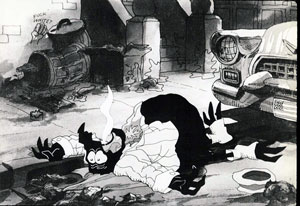 Even
when sex was not involved, Bakshi could lead himself astray. For
example, Duke's death should be affecting, since Duke is a sympathetic
character; the sequence in which he is shot and dies has in fact
been singled out by many people as one of the best in the movie.
That's true, but for me, the effects in the sequence come perilously
close to dominating the character. The central image is fine: pool
balls bounce, in order, into blood-red holes as Duke dies. But there
are too many such devices—multiple images, a "cracking"
yellow eye, a shot straight up at Duke as he dies—and Duke
himself is almost obscured by them. It's as if Bakshi didn't trust
the strength of his basic idea—the pool balls—and fussed
over it, like an amateur artist adding "shading" to a
good drawing.
Even
when sex was not involved, Bakshi could lead himself astray. For
example, Duke's death should be affecting, since Duke is a sympathetic
character; the sequence in which he is shot and dies has in fact
been singled out by many people as one of the best in the movie.
That's true, but for me, the effects in the sequence come perilously
close to dominating the character. The central image is fine: pool
balls bounce, in order, into blood-red holes as Duke dies. But there
are too many such devices—multiple images, a "cracking"
yellow eye, a shot straight up at Duke as he dies—and Duke
himself is almost obscured by them. It's as if Bakshi didn't trust
the strength of his basic idea—the pool balls—and fussed
over it, like an amateur artist adding "shading" to a
good drawing.
For the most part, Bakshi had trouble handling really strong emotions. Whether he was depicting them—or trying to evoke them in his audience, as with Duke's death—his efforts usually fell short. He would trip over something like the gimmicks in the death sequence, and we would be left tantalizingly close to animation of real depth and power. But sometimes, in sequences that were less demanding, Bakshi broke through, and everything fell into place. It is here that we get some sense of what the more important sequences would have been like if Bakshi had been able to make them as good as he obviously wanted them to be. The "Winston Schwartz" number, for instances, reproduces beautifully the harshness of an urban highway at night, and does it with animation; there is nothing about this sequence, with its bright colors and bullying trucks, that suggests live action. Later in the film, the meeting of the revolutionaries in the mausoleum is thick with a fear and apprehension that builds as the sequence progresses.
Such episodes would be much more impressive in a better movie, but they at least suggest how much unused power rests in traditional animation's hands. "Art" cartoons have explored emotions that have been forbidden to traditional animation, but the artificiality of these cartoons has robbed them of impact. Traditional animation does not suffer from that disability—it can convince us of the reality of what we see—but it has suffered from a disability of another kind: the belief of many of its practitioners that their work is trivial. Fritz, for all its clumsiness, is a long step away from that mistaken belief.
Still, there is something wrong with Fritz's handling of strong emotions that goes beyond the clumsiness and miscalculation that were inevitable, given not only that Fritz was a pioneering effort but that it was made under inauspicious conditions as well.
For example, when Fritz and Winston are stranded in the desert, a farmer with a truckload of chickens stops to help them—but first he beats his clucking chickens to death. The chicken farmer is in Crumb's story, but the bloody, senseless killing of the chickens is not. It is explicable only as a violent fantasy, of the sort that was foreclosed to animation, before Fritz. This extraordinarily ugly moment is followed by one even uglier a minute or so later, when Winston is berating Fritz for not realizing that their car was out of gasoline. As she talks, Fritz turns toward the audience and moves his hand in imitation of Winston's mouth, while smirking at us nastily. It is a smile of complicity, as if Bakshi himself, aware that his movie had just gone off the rails, were turning to us for support.
Robert Crumb, the most perceptive of modern cartoonists (and something of an expert on expressing his private fantasies in public), provided a clue as to what was going on here when I talked to him a few days after he had seen the movie.
Crumb first saw Fritz in February 1972, during a visit to Los Angeles in the company of some other underground cartoonists. He remembered the sequence of events this way:
"I told all of those guys, say, you know, we can see that Fritz the Cat movie while we're down here—Spain [Rodriguez] and [S. Clay] Wilson and Robert Williams and [Rick] Griffin, they were all there, at Williams' house. So I called up Bakshi and said, hey, I'm down here and I'd like to see the movie, and all the other guys are here, too. He said, okay, I'll call you and let you know tomorrow when you can see it. He called me the next morning and said he just wanted me to see it, he really didn't want those guys there. He was sure they'd hate it and put 'im down real bad, and he just wanted me to see it with him so that he could talk to me about it alone, and he'd feel better if just I came down by myself—he was so insistent about it. I said, well, okay, and then I hung up and I told the guys what he said. They were real pissed off and disappointed, they wanted to see it ... So we decided that when Ralph Bakshi came, I'd talk to him first and then they'd all come out and say okay, let's go. So Ralph Bakshi came—everybody's waiting around, building up; this big pressure thing—and he came, and I went out and said, listen, you've gotta let those guys come, because they're really countin' on seein' it, you know, you can't tell them they can't see it. It's fine with me, you know. He said, oh God, and really freaked out: they'll hate it, they'll hate me, they'll come down real hard on me. First he says to me, you're going to hate it, I know you're going to hate it. He felt real guilty and stuff, full of guilt about the whole thing. Apparently he's going through a lot of changes, he's torn between the big-time mass-media corporation that he works for and this personal-artist trip that I'm in, and Wilson, and Spain, and all these guys. Then all the guys come storming out of the house, saying okay, let's go, and come up and like surround me and Ralph Bakshi. Bakshi really starts freaking out, you know—paranoid stuff. Robert Williams says, we're all blood brothers, all of us underground cartoonists, and we've been through a lot together, and this thing means something to all of us. So they all get in their cars, and I get in Ralph Bakshi's sports car with him, and we take off, and Bakshi tries to ditch these guys, and he can't do it. So we get down to...where they showed the screening, and we're all waiting around for them to put on the reel, and stuff, and guys are like trying to talk to Ralph Bakshi, and he's like saying stuff that doesn't make sense, he's so freaked out. Real nervous stuff; half-finished sentences and stuff. He's really scared of those guys or something. Then after it's over, and the lights went on, . . . me and Ralph Bakshi were sitting in the back of the screening room, and all the other guys filed out, with stone faces. They didn't even look at us. Ralph Bakshi said, see, they hate me, what a bunch of nasty guys; bad vibes. He asked me, well, what'd you think of it? I just shrugged my shoulders. I didn't know what to say. Then I told him I didn't like what he did with that revolutionary scene at all, that really pissed me off, how he changed that around and twisted it, into something I didn't intend it to be at all...I didn't stay around very long. Ralph Bakshi said afterward, well, that's over with, now you've seen it, I'm glad that's over with. Poor guy, I felt sorry for him."
Crumb had this to say about the picture itself: "It's weird: it's really a reflection of Ralph Bakshi's confusion, you know. There's something real repressed about it. In a way, it's more twisted than my stuff. It's really twisted in some kind of weird, unfunny way. ... It's compulsive or something." He noted that characters urinate at three points in the movie; there is nothing like that in Crumb's original Fritz stories. "Bakshi puts in this pissing stuff, and toilet stuff. I didn't like that sex attitude in it very much. It's like real repressed horniness; he's kind of letting it out compulsively."
Some of Bakshi's own comments about the movie—made more than two months before Crumb saw it—dovetail with Crumb's:
"It was like going to a psychiatrist, working with Crumb on this stuff. All these things that I'd been blocking for years started pouring out. Whether the picture works or not, man, it's been the best thing that ever happened to me in my life, because now I understand what's locked up inside and what I want to do as a cartoonist."
Ultimately, it's almost beside the point to talk about Fritz's failure to recreate the sixties, or even to mirror Crumb's work; Fritz is only incidentally about these things. If we accept Bakshi's word about the picture's effect on him, then Fritz is a prime example of art as therapy for the artist. But I think that would be only part of the truth; I suspect that if Fritz had been made by any other young cartoon director who cared about his work, it would have much the same air of "repressed horniness." That is because it is animation as a whole that has suffered from "repressed horniness."
A multitude of conventions and taboos have settled in around animation in recent years, even as they were falling away from other films and the arts in general. Now, even the self-incineration of Avery's wolf characters is outside the bounds of what is acceptable in animated comedy. These barriers had special significance for Bakshi, because, in effect, they made the whole substance of his life off-limits to animation. There was not much to connect the Terrytoons of the sixties with Bakshi's life in Brownsville; there was not much to connect the Terrytoons of the sixties with life of any kind, but the gulf between them and Brownsville must have been particularly wide. For a man of Bakshi's temperament—impulsive, secretive, emotional, not "literary" in any sense—it must have been insufferable to work in a field that refused to let him draw on his own experiences when he was making cartoons. Small wonder that Bakshi has sometimes talked of leaving animation if he could not break away from the old formulas, and small wonder too that he threw so much of himself into Fritz, even though he was working with another man's creation. There hangs about Fritz the sweet scent of release, of freedom from old bugbears, for Bakshi and for everyone else in animation.
Fritz was necessary if animation is to survive. It is a little like Disney's Fantasia, which is dull as entertainment but marvelous as a demonstration of all the resources that Disney had available at that time. Fritz, although it is crude and unpleasant for much of its length, is successful as a demonstration of all that can yet be accomplished in animation—not technically, but artistically.
It may turn out that Bakshi himself is not capable of exploring the new frontiers whose existence he has proved; other artists have been doomed to repeating themselves once they reached a certain level of development, and Bakshi could conceivably spend the rest or his career turning out films that are simply slicker versions of Fritz. There is good evidence, though, that he is interested in doing more than that. For one thing, he is a collector of children's books illustrated by such masters as Arthur Rackham.
"It's crazy, but it's the other side of the coin," he said. "It's pure syrup. but it's beautiful... The thing is, there's a great mystery about them. Realism and humor like Crumb and Spain and these other guys, that's one side of it, and very important; but the other side of it is these great dreamers, the great Victorian illustrators like Ernest Shepard. It's obvious how much they loved what they were doing. I keep going between these two worlds—dreaming totally, and then bouncing back and doing tough stuff. Its frustrating sometimes when I sit down to draw, I'll do one sketch of one kind, and then a sketch of the other, and I get confused. I try to ask myself, Ralph, don't you know what you want to do?"
ACKNOWLEDGEMENTS
Many people helped me in the writing of this long article, and most of them have already been quoted by name; a few others have requested that they remain anonymous. I am also indebted to Graham Webb and Mark Kausler; and especially to Milton Gray, who doubled as an animator on Fritz and associate editor of Funnyworld.
[Click here to read R. Crumb's comments on "The Filming of Fritz the Cat."]
[Original article © 1973 Michael Barrier]