
FUNNYWORLD REVISITED
The Filming of Fritz the Cat, Part One
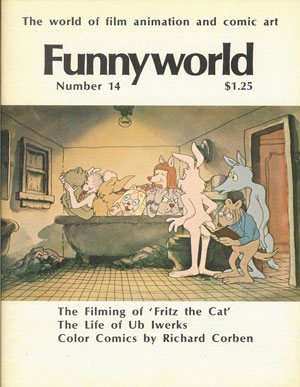
Reprinted from Funnyworld No. 14, Spring 1972.
I. Bucking the Tide
When I spoke to Ralph Bakshi, the young director of Fritz the Cat, a couple of days after the picture had been previewed in Los Angeles, he was still jubilant over the audience's response. "Everyone makes the turn," he said. "They forget it's animation. They treat it like a film. This means we can make War and Peace in animation. This is the real thing, to get people to take animation seriously."
 A
few days later, after a February 15 showing at the Museum of Modern
Art in New York, with Bakshi there to field questions from the audience,
he reported the same sort of reaction, but with a difference: "Some
guy asked me why I was against the revolution. The point is, animation
was making people get up off their asses and get mad."
A
few days later, after a February 15 showing at the Museum of Modern
Art in New York, with Bakshi there to field questions from the audience,
he reported the same sort of reaction, but with a difference: "Some
guy asked me why I was against the revolution. The point is, animation
was making people get up off their asses and get mad."
Bakshi's words may provoke discomfort in people who are familiar with animation's recent history. Other cartoon-makers have tried to make audiences forget that they were watching animated films, and that usually has meant that the cartoon-makers forgot they were making animated films. They have tried to hide animation behind a bush, or else make it indistinguishable from live action. Fritz was not made with that in mind. What Bakshi tried to do was to make an animated feature that was both "serious" and blatantly, unashamedly animated.
Fritz the Cat, which is based on several comic-strip stories by Robert Crumb, the most widely admired of the underground cartoonists, is full of blood, sex, urine, radical politics, and four-letter words. Bakshi's professed intention was to marry this fearsome subject matter to traditional, mainstream animation—that is, animation that makes the impossible seem solid and real. He was remarkably successful, especially considering the odds against him. Fritz is a messy and imperfect picture, and it bears the scars of its difficult birth, but it has the energy of a good idea behind it, and that is enough for it to be outstanding at a time when most animated cartoons are made out of habit, or for a quick buck. Fritz is like a beautiful butterfly that has just begun to emerge from its cocoon. It's easy to see the cocoon—the mistakes, the miscalculations, the compromises Bakshi had to make because he didn't have the money or the people he needed—but with only a little effort, you can see the butterfly: the movie that Fritz might have been if it had been made under happier circumstances.
There is no point in mourning the loss of a more nearly perfect Fritz, just as there is no point in regretting the clumsy animation in parts of Snow White; both films were necessary stepping stones for the people who made them. If Ralph Bakshi builds on his strengths as a director, he will make animated cartoons that leave Fritz far behind, but even if he fails to grasp this opportunity, he still will have opened doors for animation as no one has since Walt Disney. That is quite an achievement.
Some critics of Fritz—including Robert Crumb—see mostly the cocoon. Crumb says now that he never wanted the picture made, and he didn't like Fritz when he saw it late in February; it has a morbid, disturbed mood, he says, and doesn't bear much resemblance to his stories. Some other cartoonists haven't liked it either, and one has condemned what he called its straightforward, live-action approach to all its off-color activities. "I think animation is weak when it tries too hard to do the things live action does better," he said, "and Fritz really is a live-action script. It is only incidental that Fritz is a talking animal and that the film was made as an animated cartoon."
The irony in such criticism is thick, because Bakshi has proclaimed repeatedly his desire to get away from animation that walks in live action's shadow. "I don't think realistic [i.e., realistically drawn] characters have any business in animation, at all, ever, never again, please," he told me last spring in Hollywood, not long after his animation studio had moved west from New York City. But, he added, "Characters die in this picture; they do get shot. To get that kind of believability, I had to go back to a solid form—solid construction, solid motion. Also, I wanted to relate directly to what characters like Porky Pig and Bugs Bunny used to do in old cartoons, so that the audiences would understand what could have been done even in those cartoons, and what we're doing now."
At first glance, there might seem to be some conflict between such statements and another that Bakshi made last fall. "My approach to animation as a director is live action," he said. "I don't approach it in the traditional animation ways. None of our characters get up and sing, because that's not the type of picture I'm trying to do. I want people to believe my characters are real, and it's hard to believe they're real if they start walking down the street singing."
How can a director reject "realistic" animation and yet espouse a "live-action" approach to animation? The two goals are not really contradictory. What Bakshi wants to abandon is animation that tries to match the appearance of live action (Disney features such as theLady and the Tramp and Sleeping Beauty are good examples) in favor of animation that conveys the substance of the best live-action films—in other words, the emotional depth that has been largely absent from animation for the last fifteen or twenty years.
There's not any novelty in making films that are both "real" and animated. The people who made the best short cartoons in the thirties and forties filled them with sex, violence, racial caricatures, and other volatile ingredients, but they came at such subjects from oblique angles, in keeping with the taboos of the day. This means that Bakshi's task was actually quite different from theirs; he tried to put together a film that was both explicit and animated, using good animation to break through the psychological bonds that have kept cartoons languishing in the ghetto of children's television.
Bakshi says that he constructed Fritz to lure the audience in, starting funny (and so establishing his links with the old cartoons even more strongly) and then killing one of his most sympathetic characters in a Harlem race riot and leaving him lying in the street. His story turns more somber then, but the animation itself does not. The question has always been, will audiences accept this? Can they make the turn? The answer is yes, as the picture's boxoffice success testifies.
There is a disquieting undercurrent in this success, however, and it takes the form of another question: is Fritz really awakening audiences to what animation can do, or are they attracted to Fritz because it is a novelty, with its cartoon animals living hard and talking dirty? The real test of Fritz's impact will come when Ralph Bakshi directs more animated features. Thanks to Fritz, Bakshi will now have enough time and money to make features that will be a better measure of his talents than Fritz was. These new Bakshi features will go before audiences that have become accustomed to sex and blood and politics in animation. If Bakshi lives up to the promise he shows in Fritz, the test will be clearcut, and we will learn if audiences really will accept long cartoons that ignore the restrictions of the Disney formula.
Fritz is not the limit of Bakshi's ambitions, and he makes no claim that it's a great piece of animation, as animation ("Disney it ain't"). It couldn't have been. Fritz was hobbled to some extent by Bakshi's own inexperience in making animated features, but more important, the movie suffered in some way from all the diseases that afflict animation in the 1970s. To follow the film's tribulations is to realize how much blood has been squeezed out of animation since World War II, on the one hand by people who have tried to "elevate" it and on the other by people who want only to make money from it.
There are two paths to animation of a more "elevated" kind. One is the route taken by the Disney studio, where the refinement of animation has meant the development of a stifling house style. Live action has been imitated, rather than transcended. There have been brave attempts in recent years to break out of this trap, but at best they have summoned up memories of earlier and better days. Considered simply as animators, the Disney men remain unexcelled, but to paraphrase what was once said about a Toscanini performance of a musical trifle, watching a new Disney cartoon now is like watching superb chefs prepare hot dogs.
Of course, there is no shortage of cartoon-makers who are willing to attempt animation of the "serious" themes that the Disney studio avoids, but most of these people seem to be ashamed of animation itself. Animation is probably not by nature "serious"; an animated drawing must, in fact, be animated, it must move, or it is simply a drawing. The great short cartoons of the thirties and forties, from the Disney and Warner and MGM studios, were nothing if not animated, and this seems to have served as a constant embarrassment to many of the artists who have been making cartoon films during the last two or three decades. For example, the program for a recent showing of animated shorts at the Whitney Museum in New York said that "unlike the traditional 'cartoons' made for mass audience appeal—and usually comic effect—these films are more an intimate view of the filmmaker's inner dreams, fantasies, and nightmares."
To avoid having their pictures lumped with all those cartoons with talking ducks and mice and rabbits, such filmmakers have often treated animation like a poor relation, shoving it behind handsome designs, drowning it in color, and smothering it with themes that invite movement the way the appearance of the undertaker invites mirth. Some of these films, like those made by UPA in the years immediately following World War II, are appealing on their own terms, and the animation in some "art" films—John Hubley's especially—is excellent, but that seems incidental to the cartoon-makers themselves. Central to animation is the movement of three-dimensional figures—human, humanoid, animal—and to the extent that animated films disregard that fact, they must be counted failures.
This does not mean that all animated cartoons must be in a single style, but only that they must proceed from the same starting point, even if their destinations are radically different. Regrettably, most animated films start nowhere and go nowhere. Limited animation—the simplified, stripped-down movement that has become standard in most non-Disney animation since World War II—has been an integral part of this movement to upgrade animation, since it stands in contrast to the smooth, natural movement ("full animation") of earlier cartoons. This is the ground where the "serious" cartoon-maker and the avaricious television producer meet. Some television producers even mouth the line of "serious" cartoon-makers, touting their bare-bones animation as an advance over the vastly superior work animators were doing twenty or thirty years ago.
In one sense, the TV men have won their point, since television, with its indiscriminate appetite, treats the old cartoons as if they were the same as the made-for-TV product; cartoons of both kinds are sandwiched routinely between commercials for pre-sweetened cereals and talking dolls. The television audience no longer seems to notice the difference, either. The difference is there, and it's not hard to measure; it shows up in how cartoon producers spend their money. All television budgets are low, at least by Disney standards, but budgets have been low for many theatrical cartoons of the past, too. Sometimes a budget (or other circumstances) can put a straitjacket on a cartoon producer, but often, within the limits of his budget, a producer has a choice: he can give the bulk of his expenditures to the stories and the animation for his cartoons, or he can stress the technical side of the operation—everything that determines how polished the picture looks on the screen.
The TV producers have chosen slickness; they have reduced the stories and animation for their cartoons to formulas, and they rely upon their technical people to salvage rushed, hacked-out drawings. The demands of television (and its moronic executives) may have made this inevitable, but the contrast with many theatrical short subjects of the past—especially the old Warner cartoons—is striking. In them, it's the "production values" that are sloppy; the cartoons often lack a smooth surface, but the money was going where it really mattered, and there is so much vitality and inventiveness in the best of these cartoons that the technical errors simply aren't important.
Economic factors (the rise of the double feature, the general decline in movie attendance) killed short subjects like the old Warner cartoons, and left theaters open only to cartoon features and the occasional animated "art" film. Television cartoons have filled the void left by the closing of the theatrical cartoon studios, and the TV studios are filled now with veterans of the Disney, Warner, MGM, and Lantz studios, but the work they must do is mechanical and demoralizing—especially since television's cruel economics provide work for most of them for only half the year.
There is, then, this great cleavage in animation, between the handful of cartoon-makers who are still "advancing the art," in however misguided a fashion, and the great mass of animation craftsmen, who have little choice but to pursue careers as mechanics rather than artists. More is involved than any dispute over the merits of full animation versus limited animation. The cry for "full animation" has become a shibboleth in recent years, because most animation is limited, and most limited animation is bad, but full animation can be good or bad according to how it is used. As a number of recent television commercials and specials and an occasional feature (The Phantom Tollboth, for example) have demonstrated, it is possible to have full animation that is not especially good animation. What has been achingly absent from animation is not so much full animation as convincing movement—not movement for its own sake, but movement that defines character, clarifies motives, and reveals emotions in ways that live action cannot.
Animators are actors with pencils, but even in full animation in recent years there has been a lot of reading of lines, and very little acting. Characters may move, in a rough approximation of live action, but there is little in their movements to distinguish one character from another. This is a disease often thought peculiar to cartoons from television studios like Hanna-Barbera, but its corrupting influence is present in much of today's full animation as well. Directors will sometimes try to plug this hole with visual fireworks, toying with color and shape and line in emulation of Yellow Submarine. Usually, sitting through this stuff is like watching an elaborately decorated stage on which no play is being performed.
There have been a few exceptions to this general rot; portions of The Aristocats and The Phantom Tollbooth come first to mind. But there have not been many of them, and even the exceptions are only echoes of what used to be commonplace in the work of the great directors and animators. Many of these directors and animators have grown rusty because their skills have not been put to use; others have lapsed into apathy and cynicism. What is being lost is a sense of animation's possibilities and the pleasures that only animation can offer. Fritz represents an effort to turn animation around, at a time when almost all the currents are running in the opposite direction; even the Disney features—which at their best have combined a high degree of polish with beautiful animation—have taken on a rough-hewn look in the last five years, and the budget for the next Disney feature, Robin Hood, was ordered reduced despite the studio's prosperity.
This is a terrible time to be devising an alternative to the Disney style, the posturings of the "art" films, and the emptiness of the television cartoons, especially with a story as raw as that of Fritz. For Fritz, good animation was needed not merely to make the story believable, but to reduce its sensational nature. This was a tremendous challenge to put before animators at a time when men who once could make a pencil line dance no longer have any greater ambition than to retire.
Fritz suffered other difficulties, some so large that Bakshi admits that at some points, "I thought it was all over." Bakshi and his producer, Steve Krantz, had difficulty from the first in finding financing and distribution for Fritz. "There has never been a project that was received with less enthusiasm," Krantz recalls. "Animation is essentially a dirty word for distributors, who think that only Disney can paint a tree, and in addition to that, Fritz was so far out that there was a failure to understand that we were onto something very important."
Krantz is correct about the film industry's attitude toward animation. Hollywood has traditionally regarded animation with contempt, and the animation departments of large studios have always been in danger of extinction, regardless of how well they were doing. The story goes that when Jack Warner closed his animation department in 1962, it was the only part of the studio that was making a profit, thanks mostly to the Bugs Bunny television show. Animated cartoons are money in the bank, because they can be reissued and rebroadcast almost without limit, but they have the look of luxury about them, and a new management can make a great show of cost saving by shutting its cartoon department; that happened to Chuck Jones's MGM unit in 1969.
Even when money was finally found for Fritz, there still wasn't very much of it. The film was made on a budget of less than a million dollars; that means that Fritz, which is a little less than eighty minutes long, was made on a budget that compares unfavorably, on a per-minute basis, with the budgets for the better animated television commercials, which cost fourteen or fifteen thousand dollars per minute.
It is possible to produce animated features on a small budget; Filmation, which has concentrated on television cartoons to date, has made an agreement with Warner Bros. to turn out a whole series of feature cartoons budgeted at about a million dollars apiece. However, these features will almost certainly have the same soulless, mechanized look as Filmation's television programs, which are produced on budgets much smaller (on a minute-to-minute comparison) than the new features. For Filmation to produce features in something resembling full animation will require only stirring a little more motion into a limited-animation stew.
But if good animation is desired, rather than animation that is merely "professional," then a budget of less than a million dollars leaves precious little room for mistakes, or for the kind of improvisation that can lift a scene out of the ordinary (and also run its costs up). Bakshi tackled the cost problem from both ends of production. He saved money "up front"—that is, in the stages before the picture actually went into animation—by serving as his own story man, and by taking on other jobs that are usually filled by someone other than the director himself. "I run a one-man operation," he said last fall. "Everything coming from the studio comes from the talented people backing me up, but all the thinking is mine, as far as color, characters, timing, design—the whole schmear—is concerned."
Bakshi took risks by saving money at the other end, on the technical side of production, thus abandoning any effort to give his movie the smooth, seamless look of many other cartoons. For example, animation studios employ checkers, who make sure that everything fits together the way it should: characters must match backgrounds, the celluloid sheets ("cels") on which characters are inked and painted must be the right size, and so forth. Checking for Fritz was so skimpy that at one point, the cameramen discovered that the cels for a desert scene were not wide enough; the edges of the cels would be visible on the screen. A cactus was hastily painted to cover the edges of the cels. In other cases as well, members of the technical crew went beyond the call of duty. The result was that Bakshi could spend more of his budget on the animation of the picture than he could have if he had followed the normal procedures.
Moreover, Bakshi prides himself on his ability to get good results on low budgets by bearing down on the animation in the crucial scenes: "This is my schtick, trying to get animation where it counts, and where it doesn't count, forget it."
Even with his emphasis on the animation at the expense of the picture's surface gloss, there wasn't enough money to permit the "personality animation" that Bakshi apparently wanted. Animators work under what is called the footage system; most studios require animators to produce enough animation each week to fill a specified number of feet of 35mm. film (which passes through the projector at the rate of ninety feet a minute). For obvious reasons, the quality of the animation varies pretty much according to the footage required. Many television studios require one hundred to one hundred twenty-five feet every week, and at the other extreme, the Disney studio had no footage requirements for many years (although fifteen feet a week is being asked for Robin Hood). The requirements at the Krantz studio in Hollywood ran around twenty to twenty-five feet a week, and Bakshi says that the amount of animation actually produced averaged less than that; but even a twenty-foot requirement is high if the aim is to get under the characters' skins and make them come alive.
"Personality animation" is simply acting of a high order, and the great animators at the Disney studio, with no quota to meet, could depict cartoon characters with a depth of understanding that is beyond the reach of most other animators. Brer Bear and Brer Fox in Song of the South are good examples; both characters are beautifully realized, with personalities that are at once complex and easily grasped, but they are funny only because of the expert way they are played against one another. In the cartoons of other studios, such characters could only have been broad caricatures.
A great director—a man like Chuck Jones, Bob Clampett, Tex Avery, or the late Frank Tashlin—can impose his own personality on a cartoon, and pull its elements together so that it is more than the sum of its parts. This is why the directors' personalities are dominant in the Warner cartoons, whereas in the Disney features, it is the work of the individual animators that catches the eye—in Pinocchio, for example, it is easy to distinguish Ward Kimball's Jiminy Cricket, Fred Moore's Lampwick, and Bill Tytla's Stromboli. A director like Chuck Jones, who contributes many drawings to a cartoon himself, can achieve subtlety in delineating personality even while working within footage requirements that are high by Disney standards, but Ralph Bakshi doesn't work that way, and so comparable results necessarily remained elusive.
Moreover, Bakshi's budget problems were such that in important respects, he had to compromise on the quality of the animation he was getting even within the bounds set by his footage requirements. Fritz was made almost entirely without pencil tests ("We pencil tested I'd say a thousand feet, tops," Bakshi says). A pencil test involves photographing the penciled animation drawings before they are inked (or Xeroxed) onto cels and painted; that way, the director and the animator can check their timing and how well the animation works, and then make any changes that seem necessary. If there are no pencil tests, and no one really knows what the animation looks like until it has been inked and painted and photographed against the background paintings, then the director is flying blind.
One member of the Fritz staff in New York says that was "a little scary even for seasoned animators," and Bakshi says that doing the picture without pencil tests seems like "insanity" in retrospect: "We do a major feature without pencil tests—that's tough. The timing falls off. I can always tell an animator to draw it better, and I know if the attitude of the characters is right, but the timing you really can't see." Bakshi had to judge the timing of the animation simply by flipping an animator's drawings in his hand, until he could see the completed animation on the screen.
In one sense, it was natural for Bakshi to plunge into a feature cartoon without the money for pencil tests; the studios he had worked for in New York never made pencil tests (they never made feature-length cartoons, either), and pencil tests would have been superfluous, given the low quality of most of their animation. Pencil tests might have been superfluous for Bakshi, too, since he couldn't afford to spend much money on having animation done over, except for crucial scenes. About all he could do was to give his animators low footage requirements and then rely on their skills—a risky business these days. The risk was compounded when the Bakshi-Krantz studio moved from New York to California in the middle of production, and Bakshi had to work with animators whose skills were unknown quantities.
Problems like these have to do with what happened in the studio itself, but Fritz has also had its enemies in the outside world. In California, especially, some other cartoon studios have tried to use Fritz to prove that their own skirts are clean. One executive of the Hanna-Barbera studio was quoted in the Wall Street Journal as saying, "It's unfortunate that the industry has to resort to that kind of picture-making to survive. I hope I never have to be involved in any part of it." (One of Bakshi's animators sent a note to the executive saying, "Word for word, that's exactly how I feel about Hanna-Barbera.")
Fritz may have suffered a little from such bad-mouthing, but it seems just as likely that this pious fakery has increased interest in the picture. There is a greater danger, and that is that Fritz's impact will be diluted by an outpouring of cartoons that are authentically pornographic, as Fritz is not.
Pornographic cartoons are not new, although their public exhibition is. Buried Treasure, a 1928 cartoon about the unsuccessful efforts of a character named "Eveready Hardon" (or "Harton") to relieve his sexual tensions, was circulated surreptitiously for years; more recently, all or part of this short cartoon has been included in virtually every "blue movie" anthology, beginning with History of the Blue Movie. Buried Treasure has been shown by itself in San Francisco, with music and sound effects added.
Other pornographic cartoons—most them crude and amateurish—have turned up in the last few years, some of them originating in Europe. None of these cartoons seem to have received wide exposure, but a short cartoon titled Little Annie Fanny—flagrantly plaigiarized from the Harvey Kurtzman comic strip in Playboy—was shown in a New York theater last fall. In April, just three days before Fritz opened in New York City, a Japanese-made animated feature, Cleopatra, began its run at two Manhattan theaters, billed as an X-rated cartoon in an obvious effort to steal some of Fritz's thunder. In fact, Cleopatra had not been submitted to the Motion Picture Association for a rating, and it is highly unlikely that it would have received an X if it had been; one critic described it as "kid stuff with naked breasts."
While Fritz was still in production, though, rumors began to circulate about pornographic feature cartoons that would follow it into the theaters, and it would be surprising if that did not happen. The novelty of sex in animation is sure to be short-lived (Screw, a New York sex paper, gave Fritz a low rating even before the picture opened there), and Bakshi seems to have been aware of the danger to his future cartoons if his Fritz should become regarded as merely a fad item. Bakshi has talked about the picture as "a documentary on the sixties," and has soft-pedaled the sex angle. (When Fritz was introduced at an April showing at the University of Southern California as the first pornographic cartoon, Bakshi said firmly, "Fritz the Cat is not pornographic.") He has, instead, contrasted the supposed realism of Fritz with the supposed unrealism of earlier animation. He was quoted last year in the Los Angeles Times as saying that the idea of "grown men sitting in cubicles drawing butterflies floating over a field of flowers, while American planes are dropping bombs in Vietnam and kids are marching in the streets, is ludicrous."
Advertisements for the picture have played up the sex angle ("90 minutes of violence, excitement and SEX. . . he's X rated and animated!"), but Bakshi blames the distributor for that, and he said in April, "We almost didn't deliver the picture, because of the exploitation of it." In fact, the explicit sex in Fritz is outweighed by its political content; Bakshi himself calls Fritz "a political film." "Social relevance" of this sort can easily become a crutch, since there are audiences who will forgive what is shallow and crude, so long as it greases their prejudices. Underground comic books and rock music have provided many examples of this, and Fritz draws heavily on both.
The temptations must have been great, and Bakshi was seduced by his gaudy story line more than once. Parts of Fritz are crayon-crude. If Bakshi were simply using this "relevance" as a gimmick, to ingratiate himself with the young audience, he would be worthy of contempt; but there is ample evidence that this is not the case, and so Fritz's crudities, regrettable though they are, are not as disheartening as they might have been.Bakshi's sincerity is no guarantee that his future films will be improvements on Fritz (there is no direct relationship in art between sincerity and quality), but sincerity counts for a great deal now in animation, when almost everyone in the industry is cynical and their work shows it.
Despite the film's "political" emphasis, the explicit sex and raw language in Fritz guaranteed from the beginning that it would receive either an R or an X rating from the Motion Picture Association's rating agency. After reporters first began poking around the Krantz studio early in 1971, almost every article about the picture described it as either actually or potentially X-rated. In their own comments, Bakshi and Krantz seemed to have mixed feelings about such a rating. Any misgivings had a solid foundation; in the year or two before Fritz was released, an X rating became synonymous with hard core pornography, and more than thirty newspapers refused to review X-rated films or to carry advertising for them. Early in 1972, when Fritz was finally completed, it was assigned an X; the publicity about the film may have made any other rating impossible, even though an R would have been more appropriate. Fortunately for Bakshi and Krantz, Stanley Kubrick.'s A Clockwork Orange, one of the most widely praised movies of 1971, was being distributed with an X, too, and Fritz thus had the opportunity to profit from respectability by association.
Fritz has had yet another out-of-studio problem to contend with, this one subtler and potentially more damaging than the others. It has to do with the movie's relationship to Robert Crumb, the creator of Fritz.
Whenever a comic strip is translated into an animated cartoon, there is always a greater question of the author's involvement than when a novel is made into a screenplay. Comic strips and animated cartoons, if not close kin, are at least cousins, and when comic-strip characters are animated in something like their originator's style, the natural assumption is that he had something to do with the film. This has often been true, from the time of Bud Fisher and the Mutt and Jeff cartoons until the present day, when both Charles Schulz of Peanuts and Walt Kelly of Pogo have been actively involved in the cartoon versions of their great comic strips. Such animated comics have usually been inferior to the originals, but at least there has been no question of the artist's intentions being distorted. That is not the case with Fritz.
The assumption has been present in some articles about the picture that Crumb somehow collaborated on it with Bakshi, but that is far from the mark. His hostility to the entire project was no secret for months before the picture was released, and when I spoke to him in February, he condemned the completed Fritz as "a pitiful attempt."
Crumb's attitude toward the picture is significant not only because the original stories are his, but because of what he and his work represent. Crumb is the most important of the underground cartoonists; only Gilbert Shelton rivals him in popularity and influence. Crumb, after a few brushes with the "New York syndrome," now scorns the "big-time mass-media trip" and concentrates his efforts on underground comic books. Not all underground cartoonists share his contempt for large financial rewards (even Shelton has turned up in the pages of Playboy), but his fear of the tethers that success brings is widespread among underground cartoonists and their admirers; so is his contempt for the businessmen who would like to tie him down. One of his close friends speaks vehemently of Crumb's disdain for "the big-money boys who rush in to exploit any new phenomenon (such as underground cartoons), gobble it up, suck off as many quick bucks as possible, and then spit out the fur and bones on the ground."
What this means is that Fritz can be interpreted not merely as a perversion of Crumb's work, but as a counter-attack against Crumb and the other cartoonists who have managed to make their way without complying with the wishes of feature syndicates, commercial comic-book publishers, animation studios or any of the other employers of cartoonists. The underground comic books, for all their excesses, have restored to the comics a personal, individual flavor that has been all but lost in the increasingly vapid strips that fill newspapers and comic books today. Bakshi's Fritz has been regarded by some of Crumb's admirers as an effort to cash in on the individuality of these comics and so absorb them into the very entertainment "establishment" that the underground cartoonists have rejected. (There is irony in this, because Fritz also breaks with formulas, and, in its early stages, suffered at the hands of some of the same people whom Crumb's most ardent admirers find so distasteful.)
This double-edged hostility to Fritz could have damaged it at the boxoffice and even hurt Bakshi's career, but that was never too likely, for reasons that Steve Krantz suggests when he asks, "How many people read underground comics, really?" The answer is, not that many, especially when compared with the millions who will see Fritz. Undoubtedly, many people will see Fritz who have never heard of Robert Crumb, or who have only the slightest acquaintance with his work. That may be the point. Through Fritz, Crumb's name will be linked with a motion picture that he believes distorts his work (it is certainly different from Crumb's Fritz stories in spirit) and that he says he never wanted made.
The real issue is essentially a moral one: if Crumb feels this way about Fritz, and if he has felt this way about the project from the beginning, should the film ever have been made? That question can be answered "yes" if, at some point, Crumb freely gave his permission for Bakshi and Krantz to make the picture. If he did, he and his readers are entitled to quarrel with the contents of Fritz, but not with Fritz itself.
Unfortunately, sorting out what happened among Crumb, Bakshi and Krantz is not a simple matter, even though it seems likely that Bakshi and Krantz were on solid ground legally from the beginning. If Fritz were a masterpiece, even doubts about the picture's legitimacy would become irrelevant; masterpieces are their own justification, unless the sacrifices required to produce them are really outrageous. But no animated feature made in the early 1970s could be a masterpiece, regardless of its director's intentions; the tools simply are not there. The most that can be expected of any feature cartoon now is that it be reasonably entertaining, and that it lay the foundations for cartoons that are more than entertaining. Fritz the Cat passes those tests handsomely, and that must be regarded as a considerable achievement, not least because—through no real fault of his own—Ralph Bakshi's name has never before been attached to a cartoon nearly as good.
[ Click here to continue to the next section of "The Filming of Fritz the Cat."]
[Original article © 1972 Michael Barrier]