
COMMENTARY
Lonely Planet
[Andrew Leal has pointed out an error in this piece. John Pomeroy is not missing entirely from the credits for Treasure Planet. He is credited as the supervising animator for "Captain Flint and his Crew," the storybook pirates seen briefly at the start of the film.]
When I saw the Disney animated feature Atlantis: The Lost Empire in the summer of 2001, I was baffled by the animation of Milo, the young man who was the film's protagonist. Milo's movements were always physically plausible, but everything he did seemed calculated and thought-out, with not a trace of spontaneity or flow. Then, on the end credits, I found the answer: John Pomeroy, long a close associate of Don Bluth, was the lead animator for the character.
Pomeroy's animation of Milo was Bluth animation, which is not merely literal but also painfully self-conscious. It is the kind of animation that results when animators try to achieve the vaunted Disney "sincerity"—that is, animation in which the characters really seem to believe in what they're doing—by having the characters behave as if they know that they're appearing in a film.
What's involved is not mere staginess, the usual mugging or playing to the audience. In Bluth animation, the characters are not entertaining hams, or, even less, ironically self-aware; instead, they are as painfully awkward as adolescents on a first date. The characters' insistent self-awareness is what makes Bluth animation so uncomfortably distinctive.
This peculiar animation style apparently originated in Bluth's determination, when he left the Disney studio a quarter-century ago, to make features grounded in a seriousness that he understandably found lacking in the latter-day Disney product. From the beginning, though, with The Secret of NIMH, the stories for Bluth's features have been so poorly constructed or so bizarre (or, as with Anastasia, both) that they have made "sincere" animation all but impossible. Instead, the stories have invited tongue-in-cheek animation, which is, to say the least, not Bluth's métier.
Animation of the sort that Pomeroy eventually contributed to Atlantis—awkward animation in which the characters seem to believe not in what the story calls for them to do, but that they're performing for an audience—was the barely workable compromise that Bluth and his animators came up with, no doubt without realizing what they were doing. To no avail: audiences have warmed to few of the Bluth films. Like another director, Ralph Bakshi, Bluth has been much more successful at attracting financial backers than at filling theater seats.
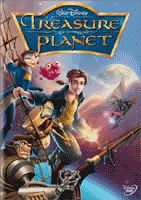
John Pomeroy's name is missing from the credits for Disney's Treasure Planet, the new animated feature that relocates Robert Louis Stevenson's novel Treasure Island to outer space, but it might as well be there. Even more than Atlantis, Treasure Planet is full of characters who seem constantly on the verge of glancing nervously at the camera's lens.
What might be called "the Bluth disease" has been a long time incubating in the Disney features, but now, in Treasure Planet, it has cut down everyone in its path. Even the sturdy Glen Keane, one of the two contemporary Disney animators whose work has best withstood comparison with the great animation of the past (the other is Andreas Deja), was not immune. His Long John Silver is a twitchy, gelatinous mess.
If it is relatively easy to explain how the Bluth features turned out the way they did, the Disney story is more complicated. Rather than riding their films over a cliff in the Bluth manner, the Disney people sabotaged them with a sort of time bomb.
The decisive period for Disney was the middle to late eighties, when the slovenly features of the seventies and early eighties (Robin Hood, The Fox and the Hound) gave way, after the ascension of the Michael Eisner-Jeffrey Katzenberg team, to much more tightly organized and much more formulaic films (The Little Mermaid, The Lion King). The formulas were those of the pre-Sondheim Broadway musical, encompassing a rudimentary boy-girl plot, high-energy songs, swishy comic-relief characters, and a fundamentally cynical worldview only partly masked by an aggressive sentimentality. Like the Broadway shows they resembled (and were sometimes turned into), the new Disney features flattered their audiences into feeling both knowing and warmhearted.
As the features changed, so did the part animators played in their production.
The Disney features of the seventies were made when the last of the famed animators known as the "nine old men" were still active. In them, animators like Milt Kahl and Ollie Johnston could be found amusing themselves with set pieces (Kahl's Madam Medusa, Johnston's self-portrait as elderly cat, to cite two examples from The Rescuers) that weren't necessarily attached very firmly to the rest of the film. The dreadful features of the eighties that followed the retirement of the "old men" fell into a generally similar pattern.
With the advent of Eisner and Katzenberg, there were fewer opportunities for animators to go off and play in a corner. A film's animators now had to serve the interests of the film more directly. This new arrangement recalled the symbiosis that existed when the greatest Disney shorts and features were being made, in the thirties and early forties; but the resemblance was misleading.
Sixty and seventy years ago, as interviews and the transcripts of meetings have made clear, there was a constant give-and-take among animators, writers, and directors—orchestrated by Walt Disney himself—with almost everyone preoccupied with making the best film possible. In the nineties, for all the pulling and hauling (and waste of money) that went into the new Disney features, the underlying motive was not so much to make the best films possible as to find the most immediately effective expression of the formulas involved.
That distinction was fatal. When it is more than an empty slogan, sincerity in animation bears a necessary relationship to truthfulness. The animator tries to understand how even the most fantastic character would behave if it really existed, and he animates it in a way that reflects his understanding as accurately as possible. Formulas have nothing to do with such truthfulness. They are instead about generating a predictable response from an audience, regardless of whether that involves manipulating the characters in ways that make them less believable.
A reliance on formula storytelling was thus fundamentally at odds with "sincerity." When the animators were fully subordinated to the formulas, "sincerity" would be possible only in the debased form in which it already existed in the Bluth features. That is what has finally happened in Treasure Planet.
What has made Treasure Planet doubly disastrous is that the Disney people no longer know how to crank up a good formula, either.
The effectiveness of the formulas polished in films like Beauty and the Beast (1991) and Aladdin (1992) began diminishing in the middle nineties. The formulas' decline was accelerated by the death of the lyricist Howard Ashman, who with his composer partner Alan Menken gave the early musicals of the Eisner era their authentic Broadway flavor. Hercules (1997) signaled the bankruptcy of the Broadway formulas by asking its audience to take seriously, in its second half, what it had burlesqued mercilessly (and often cleverly) in its first half. But once the cynic has taken off his mask, there is no putting it back on.
The Disney people have been groping for new formulas for some years now, with limited success. In Treasure Planet, as in Atlantis, the formulaic solutions are in a boys'-adventure mold. In Treasure Planet, though, the formulas actually collide with one another, in a sort of animated demolition derby.
Jim Hawkins, a young boy in Stevenson's Treasure Island and in Walt Disney's 1950 live-action film based on the book, is in Treasure Planet a stereotypically rebellious teenager, the product of an unsuccessful effort to pander to an adolescent male audience. But he is also shoehorned, mostly through a heavy-handed montage sequence, into a father-son relationship with John Silver. However plausible the comparable relationship may have been in the earlier film, it is in the new one nothing more than a clumsy attempt to manufacture emotional depth. The boy is too old and too self-sufficient (he is a preternaturally skillful skateboarder) to have slipped so easily into such a relationship. Silver is a grotesque cyborg—half man, half machine—who has nothing fatherly about him.
The character designs magnify the unlikelihood of what the audience is being asked to swallow. Silver is ugly in a puzzling way—like other characters in the film, he suggests an animal more than a human being, but it's not clear what kind of animal he might be. Jim is a conventional pretty boy whose turned-up nose disappears, leaving a disconcerting blank in the middle of his face, when he is seen straight on. They scarcely seem to belong in the same film, much less to be capable of forming an emotional bond.
It is in the Silver-Hawkins scenes that the pervasive self-consciousness of the animation is truly deadly. Through it, the characters seem to be conveying their own skepticism about what they're doing. They all but defy the audience to care about what happens to them.
The sense of parts not fitting together is pervasive. Treasure Planet is a rich-looking film—most of its budget of a reported $140 million wound up on the screen—but there was minimal effort to blend its drawn and computer-generated animation, or to introduce some plausibility into its depiction of eighteenth-century ships that sail between planets. The images are often arresting, but nothing more. The dismissive phrase "eye candy" applies here as to no other animated film.
Even when formula devices are not in conflict with one another, their omnipresence is a lead weight on the film. There is the inevitable flatulence gag (an alien who speaks in farts), and the inevitable coupling of doglike and catlike creatures (the financier and captain, respectively, of the RLS Legacy) that results in the inevitable armload of babies. That coupling occurs despite the contempt the female cat captain has shown repeatedly for her male canine companion. As in Atlantis, gratuitous insults are striking in their abundance and their apparent authenticity—is this what it is like to work at Disney Feature Animation?
I saw Treasure Planet early on a weekday afternoon, at a large, plush Washington, D.C., theater, and I literally had a private screening—I was the only person there. To judge from boxoffice reports, my experience was far from unique.
Treasure Planet deserved to fail. And yet: what a sad, wasted opportunity. There's no reason that a science-fiction version of Treasure Island could not have been an exciting and suspenseful film, but such a success required both a proper respect for Stevenson's story and an imaginative recreation of it. That approach might have resulted in, for example, both a younger Jim Hawkins and a truly villainous John Silver, with a relationship between the two far more complex than what Treasure Planet offers.
Supposedly, Treasure Planet was a labor of love, the cherished project of its co-directors John Musker and Ron Clements, whose credits include several of the most successful Disney features of the eighties and nineties. The object of their devotion has turned out to be a film as mechanical as John Silver's robotic arm. That outcome no doubt says a good deal about Musker and Clements as filmmakers, but I'm afraid it says even more about the environment in which they work.
[Posted May 2003]