
COMMENTARY
Roses Among the Sporns
Mouse over the banner on this page, and you'll see the credit "Banner by Michael Sporn." I've known Michael Sporn for thirty years. We began corresponding in 1974, when he was only about two years into his career as an animator, and we first met in 1975, in New York. In January 1976, Michael and his friend Maxine Fisher picked me up at John Benson's apartment on Manhattan's West Side, and we drove to New Jersey for a long interview with Otto Messmer, the writer/animator/director of the Felix the Cat cartoons of the twenties. Michael and I went together on other interviews in the New York area in the years after that, visiting people like John Fitzsimmons, who was Winsor McCay's assistant, and the animators Johnny Gentilella and Myron Waldman.
 Michael
has made dozens of short films at his own New York studio since
1980. As he has said, he makes "commercial films"—for
the most part, films commissioned by other organizations—"but
they have to have an artistic bent to them, or there's no reason
for me to have done them." Even his self-financed films have
clearly been made with an audience in mind. They are not the self-indulgent
exercises so often associated with the phrase "independent
animation."
Michael
has made dozens of short films at his own New York studio since
1980. As he has said, he makes "commercial films"—for
the most part, films commissioned by other organizations—"but
they have to have an artistic bent to them, or there's no reason
for me to have done them." Even his self-financed films have
clearly been made with an audience in mind. They are not the self-indulgent
exercises so often associated with the phrase "independent
animation."
Many of the earliest Sporn films were faithful adaptations of children's books for the Weston Woods company. More recently, he has made TV specials—some fluffy, some remarkably serious—for cable and broadcast networks. Always, he has worked with budgets microscopic compared with the wasteful extravagance of the big Hollywood studios.
In a sense, Michael peaked early, in 1981, when he made rear-projected animation for a Broadway musical with Lauren Bacall, Woman of the Year, and again in 1985, when Dr. DeSoto, a charming Weston Woods film adapted from a book by William Steig, was nominated for an Academy Award. I taped that year's awards presentation, in the hope that Michael would win, and there's a glimpse of him on the tape; he was seated near Jon Minnis, who won for Charade, and Minnis passed in front of him on the way to accept the Oscar.
In the most important sense, though, Michael, who is now in his mid-fifties, has never peaked at all. I have never known him to surrender to the bitterness and cynicism that always threaten struggling artists, or to the self-deception so common among the sad hacks who don't want to admit they've given up on themselves and their art. Michael is now, as he was when I first knew him, intensely self-critical and wholly devoted to animation as an art form. When he says, "I think animation has the potential of being the greatest of all the arts," he means it, and he lives it.
 He
speaks those words in the "making of" documentaries on
two new DVDs, "The Films of Michael Sporn," Volumes 1
and 2, which collect four of his films. Volume
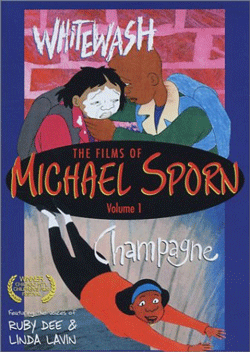
1 has Whitewash, an HBO production from 1994, and Champagne,
an independent film from 1996. Volume
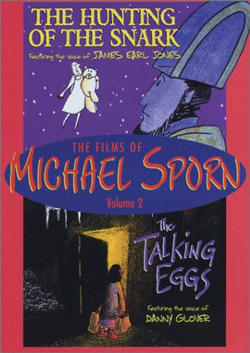
2 has The Hunting of the Snark, an independent film whose
production spanned most of the 1980s (it was first shown publicly
in 1989), and The Talking Eggs, a PBS show from 1992.
He
speaks those words in the "making of" documentaries on
two new DVDs, "The Films of Michael Sporn," Volumes 1
and 2, which collect four of his films. Volume
1 has Whitewash, an HBO production from 1994, and Champagne,
an independent film from 1996. Volume
2 has The Hunting of the Snark, an independent film whose
production spanned most of the 1980s (it was first shown publicly
in 1989), and The Talking Eggs, a PBS show from 1992.
In many circles—at many publications—the idea of reviewing the films of a friend of so many years would be instantly rejected, but the animation world (like the comic-art world) is too small for such priggishness to be of much use, whether it is films or books that are under review. I don't think there would be a measurable gain in my objectivity were I to shun the company of Michael Sporn—or John Canemaker or John Benson, to cite just two writers whose company I have long enjoyed and whose writings I can review without qualms.
Such people take their work seriously, and do their work well, and so a review can become not just an evaluation of a specific performance but also a consideration of the larger questions a book or film raises. Canemaker's recent book The Art and Flair of Mary Blair is a good example. Because John states the case for that artist cogently, I was stimulated, in my Commentary elsewhere on the site, to articulate what I find lacking in her work. Similarly, I'm lying in wait for Romance Without Tears, a Benson-edited anthology of romance comics. I don't know that I will share John's enthusiasm for the stories in the book, but if I don't, I will have no choice but to try to make my case as persuasively as I know that John will make his.
In other words, reviewing the work of friends need not be an exercise in mutual back-scratching. It can instead be part of a sort of lively extended conversation about subjects on which both reviewer and reviewed have strong, well-considered, and sometimes opposing opinions. The disagreements that arise in such circumstances are, or should be, one of life's pleasures, rather than one of life's burdens.
I haven't liked all of the Sporn films that I've seen, but I've enjoyed most of them, and I don't think I've been as critical of any of them as Michael has been. And I've been pleased to find in the best of them, including The Hunting of the Snark and Champagne, the two independently produced films on the new DVDs, qualities that will keep me coming back to them.
Michael worked for John and Faith Hubley in the mid-seventies (he also worked for Richard Williams, on Raggedy Ann and Andy), and I think he has always looked to John Hubley as an inspiration and an example. Hubley's photo is visible over his shoulder at one point in a shot included in both documentaries. Like Hubley, who was a layout artist before he became a director, Michael attaches great importance to the design of his films; he says in the documentaries that he has tried to bring into his films "twentieth century graphics," as opposed to the "nineteenth century graphics" that he sees in the typical television cartoon.
That may sound like an echo of the snobbery that prevailed at UPA a half century ago, but Michael is an animator, too, and I don't find in his films the unthinking subordination of animation to design that made so many UPA cartoons smug and boring. Certainly there is no evidence of that in Snark and Champagne. As different as those two films are, they grew out of very similar impulses. In both cases, Michael responded to material that engaged him intensely by making a film almost entirely on his own.
Lewis Carroll's nonsense poem The Hunting of the Snark had intrigued him since he was a teenager, when he made an 8mm home animated cartoon based on it. The grownup Sporn—squeezing work on his new version in between paying projects—hired the famous actor James Earl Jones to record the poem, knowing, as he says in his audio commentary, that having such a resource at hand would goad him to finish the film. After Maxine Fisher skillfully reduced Carroll's very long poem to a manageable size, cutting the number of stanzas by more than two-thirds, Michael storyboarded the film himself and then animated it and drew the backgrounds. Almost everything on the screen in this nineteen-minute film, including the coloring of the characters, is his work, except for a couple of dream sequences made up of drawings by his longtime collaborator, the gifted Bridget Thorne.
Champagne's genesis lay in two hours of tape-recorded interviews by Maxine Fisher with the immensely likable Champagne Saltes, an African American girl, fourteen years old at the time, who was living at a convent while her mother was imprisoned. Thirteen minutes from those interviews became the soundtrack for the film. Michael began animating without a storyboard, although midway into his work on the film he started using a storyboard by another longtime collaborator, Jason McDonald.
Neither film owes its success solely or even primarily to Michael's doing most of the work himself. With rare exceptions (most notably among abstract films like Oskar Fischinger's), even the most personal of animated films will of necessity be a collaborative effort. What really sets Champagne and Snark apart is their wholeness of vision. Michael's response to the material in both cases was to make an animated film from it—not to animate it, not to interpret it through "twentieth century graphics," but to make an animated film.
It's this same impulse that lies behind all the best animated films, of whatever kind. Dumbo, The Great Piggy Bank Robbery, Rooty Toot Toot, Motion Painting No. 1—go down the list, and however different the films, the common element is that their principal creators saw each film as a whole, and saw it as an animated film. If that wholeness of vision is present, the elements that make up a film can vary greatly in the weight assigned to them, so that in some cases the strongest single element may be an involving narrative (as in Dumbo), risk-taking character animation (Piggy Bank Robbery), or design that ranges from witty (Rooty Toot Toot) to majestic (Motion Painting No. 1). All that matters is that the film's elements cohere.
When they do, as in Michael Sporn's Snark and Champagne, the result on the screen is fluidity, the seemingly effortless and instantaneous translation of thought into action. Michael's audio commentary for Snark and Champagne is especially valuable in this regard because it illuminates how his engagement with his material flowered in the making the films—there's a powerful sense, in the commentary as in the films themselves, of an unfolding, a spontaneous grasping of the possibilities that animated films offer.
Listening to Michael talk about the expedients he employed in making Snark, in particular, reminded me of listening to people who worked at Disney's in the thirties talk about how they generated and solved problems, sometimes almost simultaneously. Michael's painted cels illuminated from below, the tiny fields he used for his animation of a turbulent ocean—such things are not gimmicks, but rather improvisations that almost invariably serve to move the film forward.
At one point, Michael invokes the words "nightmare" and "fun" in talking about one complex scene in Snark, and it seems clear that it was the latter because it was also the former. He remarks once or twice that a particular effect could be achieved much more easily today with a computer, but clearly his heart is in making hand-drawn cartoons, which still have greater potential for subtlety and fine shadings of many kinds. Typically, the animation in his films is drawn and colored on paper, and then cut out and pasted on cels, a procedure about as far removed from computer animation as possible.
As a character animator, Michael will never be confused with his Disney contemporaries Glen Keane and Andreas Deja, but what's most important is that his all-embracing approach means that each character emerges as an individual—Champagne Saltes above all, but there's also no confusing the members of the motley crew that hunts the Snark.
When there is no such wholeness of vision, and a film's makers approach their work piecemeal, the result is not simply that the film as a whole is diminished, but that any elements given unnatural prominence are diminished, too. This is true of those UPA films whose supposedly innovative design reduced them to twitching wallpaper, and of the shambling Disney features that showcased "personality animation" in the seventies and eighties.
In Michael's two sponsored films, Whitewash and The Talking Eggs, the elements also tend to splinter apart, so that design calls attention to itself as distinct from the animation, and both seem clumsier as a result—a particular problem when the animation already has a scrawny, bare-bones look. The sponsored films too often lapse into conventionality, as in Whitewash, when a white gang has viciously attacked a young black girl—making her "white" by spraying her face with white shoe polish—and one member of the gang shows some altogether unconvincing reluctance to take part.
Curiously, three of the four films on these DVDs have casts dominated by African American characters, even though most Sporn films do not. In The Talking Eggs, the racial element is muted, but Whitewash's racially charged subject matter (based on a real incident) is a drag on that film. I think it is extraordinarily difficult for white artists to deal with such hate crimes without becoming awkward and self-conscious, and Whitewash is no exception to that rule.
But Michael Sporn, like any artist, should be measured by his best work, and I think that Champagne and The Hunting of the Snark are very good indeed.
As much as I like those two films, I don't want to claim too much for them. Although they're longer than the short cartoons of the "golden age," they seem smaller in scale, a stature I think is all but guaranteed by the importance Michael assigns to design. I still think that animation's greatest achievements are reserved for films with fully developed characters at their center, and the characters in Michael's films, as well-defined as they are, are certainly not as compelling as those in many short cartoons of the past. (His characters, like their settings, are design-oriented, frequently echoing the work of New Yorker cartoonists.) The attractions that Champagne and Snark do offer, though, are more than sufficient to repay watching them multiple times.
I wonder sometimes what would happen if Michael finally had adequate budgets and could escape the madness that lets a Ralph Bakshi or a Don Bluth command millions while a Michael Sporn scratches for thousands. Would bigger and better films result, or would the inventiveness now demanded by his circumstances diminish? I'd certainly like to find out. In the meantime, I think that the beauty and artistic integrity of Michael's best work demand that it be seen.
Even if he is my friend.
[Posted February 15, 2004; updated March 10, 2004]