
COMMENTARY
The Real McCay
[This review of the original edition of John Canemaker's Winsor McCay: His Life and Art was published in 1987 in The Comics Journal. The book was reissued in 2005 by Abrams, in a revised and expanded edition.]
Early in the [twentieth] century, Winsor McCay drew Sunday comics pages like "Little Nemo," marvels of draftsmanship and visual invention, and made animated films like Gertie the Dinosaur, unequaled in their realistic animation of movement until Walt Disney made his best films a quarter century later. McCay's career was not brief—he died in 1934, in his late sixties—but his best work was concentrated in the decade before 1914, when he drew his finest "'Nemo" pages and performed in vaudeville, using his animated cartoons as part of his quick-sketch act.
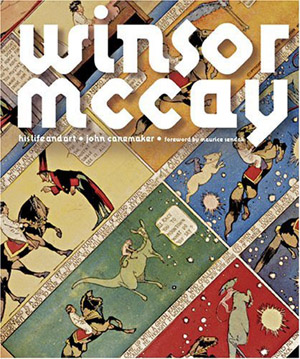 Now,
more than 50 years after his death, he is the subject of a sumptuous
new book from Abbeville Press. John Canemaker's Winsor
McCay: His Life and Art is probably the best biography of
a cartoonist ever written, and is surely one of the best dozen or
so books on comic art ever written. Anyone who makes any pretense
to a serious interest in the comics should own this book, even if,
like me, you are not persuaded that McCay ever produced comic strips
or animated cartoons as wonderful as the ones his prodigious talents
seemed to promise.
Now,
more than 50 years after his death, he is the subject of a sumptuous
new book from Abbeville Press. John Canemaker's Winsor
McCay: His Life and Art is probably the best biography of
a cartoonist ever written, and is surely one of the best dozen or
so books on comic art ever written. Anyone who makes any pretense
to a serious interest in the comics should own this book, even if,
like me, you are not persuaded that McCay ever produced comic strips
or animated cartoons as wonderful as the ones his prodigious talents
seemed to promise.
McCay strikes me as one of those people whose talents are so awe-inspiring that we resist the notion that those talents were very narrow. I can easily imagine him as, say, the decorator of some eighteenth-century English country house, filling walls with glorious vistas, opening ceilings with impeccable renderings of airborne gods and goddesses; and if he had done that kind of work, we would accept him as a supreme practitioner of a relatively minor but still delightful art form. But McCay worked in our century, in art forms—the comic strip and the animated cartoon—that many of us have come to regard as capable of very strong expression indeed.
"Little Nemo" reminds me of the Newport mansions that were built around the time McCay was drawing his earliest Sunday pages: architecturally impressive, undeniably beautiful—but chilly and impersonal. McCay's characters are incidental to his frequently astonishing settings, which seem to have been designed for some titanic fantasy that never quite gets under way. The action is swallowed up by the design. McCay's balloons are a giveaway—they seem pasted on, an intrusion in each panel rather than an element of it. The characters often seem like intrusions of the same kind.
Likewise, however subtle and natural the animation in McCay's films—in the fragmentary Gertie on Tour, for instance, his dinosaur moves, with amusing and uncanny accuracy, like a huge house cat—I have seen no film by him that commands attention as the best "Out of the Inkwell" and Felix the Cat cartoons do. In those cartoons, it is the film as a whole, and not just how the characters move, that the cartoonists are concerned with. The Fleischers and Otto Messmer thought of the animation medium in broader terms than McCay did. Not grander, just broader; they saw more things that could be done with it. In the same way, some of McCay's contemporaries among newspaper cartoonists—his inferiors as draftsmen and designers—had insights into the comic strip's potential as a vehicle for drama and comedy, for engaging narrative of all kinds, that he never had.
Even if McCay was of less than the very first rank as a comic-strip artist and a filmmaker, he was still a peerless draftsman, an inspired decorator of panels, an expert analyzer of motion—and, for those reasons, an especially appropriate subject for this kind of art book. There is little to criticize here in the choice of illustrations, or in the way they are reproduced. I might wish for more of McCay's artwork and fewer photographs, but this is a biography, and not just a portfolio, and the photographs have their place.
John Canemaker's text is that great (and most welcome) rarity, a genuine work of scholarship about a cartoonist. If I have one quarrel with the text, it is this: Even though Canemaker does a generally superb job of putting McCay in the context of his times and places—to the point of giving us a thumbnail sketch of Cincinnati in the 1890s, when McCay worked there designing and painting posters—he does little to put McCay's work in a similar context, of contemporary Sunday pages and animated cartoons. There is some historical scene-setting, of course, but no real measuring of McCay as an artist against his contemporaries (Canemaker is, in making comparisons, more likely to invoke Da Vinci and Degas than Herriman and Fleischer). Although he is hardly blind to McCay's lapses from the high standards he set in work like the best "Nemo" pages, Canemaker generally takes McCay's superiority to other cartoonists as a given, more to be celebrated than to be demonstrated or explained. This is no fatal flaw, since, as I've indicated, McCay's superiority in certain respects really is so obvious; and Canemaker's analyses of how McCay achieved his effects in individual Sunday pages and films are almost always acute.
I wish that Canemaker could have stepped back a little and made a searching comparison of McCay's work with that of his contemporaries as animators and comic-strip artists, but I can understand why he could not put that kind of distance between himself and his subject. Canemaker's book is a labor of love, in the best sense: He brings to McCay's work a lover's intense scrutiny. He sees a great deal, and he loves what he sees. What he sees is really there, for the most part, and he makes you want to love it as much as he does. I cannot; but many readers will. And even those who share my feelings owe it to themselves to read a book that is not only beautiful in itself, but also is in so many ways a model for other books about comic art.