
COMMENTARY
MIA
Anyone who works in the popular arts knows that the mass audience is capricious and incomprehensible. Sometimes, though, that audience rewards work that is personal and deeply felt and rejects the meretricious. Such happy outcomes may be rarer now, given the prevailing crassness, but there was one in the fall of 2003, when sales of the Looney Tunes Golden Collection DVDs far exceeded expectations, and the combination live-action/animation feature film Looney Tunes: Back in Action tanked at the box office.
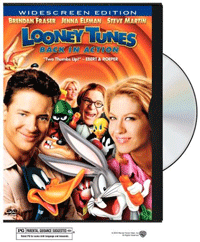 Back
in Action was conceived and executed as farce. Farce, in the
words of one dictionary of literary terms, is "little concerned
with subtlety of characterization or probability of plot."
The best Warner Bros. cartoons, by contrast, are almost wholly concerned
with subtlety of characterization and probability of plot. The new
DVD set is full of excellent examples. Set Chuck Jones's Long-haired
Hare alongside Back in Action, and my case is made. To
speak of the Looney Tunes' "zaniness" or "craziness"
in the way so many ostensible admirers of the Warner cartoons do
is to reveal a crippling ignorance of the films themselves.
Back
in Action was conceived and executed as farce. Farce, in the
words of one dictionary of literary terms, is "little concerned
with subtlety of characterization or probability of plot."
The best Warner Bros. cartoons, by contrast, are almost wholly concerned
with subtlety of characterization and probability of plot. The new
DVD set is full of excellent examples. Set Chuck Jones's Long-haired
Hare alongside Back in Action, and my case is made. To
speak of the Looney Tunes' "zaniness" or "craziness"
in the way so many ostensible admirers of the Warner cartoons do
is to reveal a crippling ignorance of the films themselves.
("Probability of plot" should not be confused with mere probability. What happens in Long-haired Hare is probable not in the real world, but on the terms set by the cartoon itself.)
Joe Dante, who directed Back in Action, is from all accounts a great fan of the Warner cartoons, but there's scant evidence of his affection in the feature, apart from sporadically amusing cameo appearances by dozens of Warner characters, some of them (like Cottontail Smith from Super-Rabbit) truly obscure. Rather, the film seems to be constantly glancing toward Who Framed Roger Rabbit?, another misbegotten combination of live action and animation. Back in Action credits Larry Doyle, a veteran of The Simpsons, as screenwriter, but the script reportedly passed through many, many hands, and the film has the written-by-committee aura that so often clings to expensive box-office duds.
Roger Rabbit at least benefited from an amusing premise: that "toons" lived alongside human beings, as second-class citizens. In Back in Action, the existence of cartoon characters in the human world is a given, but their "zaniness" constantly strains credulity. The cartoon characters are so completely free of our world's physical constraints—at one point, Daffy Duck's head is sliced off, a minor inconvenience as it turns out—that they might as well be djinn. The characters are not completely absent, thanks mainly to Joe Alaskey's very good re-creations of Mel Blanc's original voices, but there is no confusing these shoddy knock-offs—impostors is probably not too strong a word—with the originals.
The film's effectively supernatural animated characters have been shoehorned into a foolish spy story that fails to offer even the two or three belly laughs that can rescue the lamest farce (as with the Naked Gun series). Almost invariably, such gags are cheerfully obscene—most notoriously in There's Something About Mary, a weak film turned into a hit by one astonishing joke—but such gags were off-limits in this film aimed at a juvenile audience. There is of course a flatulence gag—what children's film could do without one?—but the sex is limited to glimpses of Jenna Elfman's fetching cleavage.
Back in Action is so poorly conceived that even inspired animation couldn't rescue it, but the animation, mostly hand-drawn (with computer-generated shading) and directed under Dante's wing by Eric Goldberg, is unceasingly frantic, and often guilty of the arbitrary distortion that erodes any sense of the characters' personalities. (The distortion in the best Warner cartoons, by contrast, seems to originate within the characters themselves and reveal their state of mind.) Timing issues—so often the major obstacle to a successful combination of animation and live action—are not of much importance here, because the animation is so poor otherwise.
When Goldberg was a Disney animator and director, I never felt the admiration for his work that I wanted to feel, given his imposing skills. His Genie in Aladdin, although obviously Warner Bros.-inspired, looked to me like a Bob Clampett character that had been animated by the Chuck Jones unit: a Clampett-like energy had been subdued, but with no corresponding gain in Jones-like precision. His Rhapsody in Blue segment of Fantasia 2000, so highly praised, struck me as an updated version of Bobe Cannon's too-sweet, too-gentle UPA cartoons of the early fifties—animated with the fluidity of Cannon's animation for Jones in the forties, to be sure, but still a bore. Goldberg also co-directed Pocahontas, probably the worst of the Eisner-era features.
Like Richard Williams, for whom he worked on The Thief and the Cobbler more than twenty years ago, Goldberg asks for animation on ones—that is, a new drawing for each frame of film—but animation on ones turns to goo when there's no grasp of the characters, as was emphatically the case in Back in Action. Animation on twos, the standard practice at the Warner cartoon studio, can impose a sort of discipline: because the individual drawings are more important, more needs to go into them—and more can be gotten out of them, if the director and animator are intelligent enough to seize the opportunity. In Back in Action, such discipline is wholly lacking.
Back in Action is the second attempt to make a Looney Tunes feature (I managed to avoid the first, Space Jam, when it was released in 1996), but it is only one of many attempts to revive the classic Warner characters. Even before the cartoon studio closed in 1963, the characters had been reduced to shadows of themselves, and all subsequent attempts to bring them back to life (some by their original directors) have failed, sometimes grotesquely. Revivals of the classic Disney characters, as on the current House of Mouse TV series, have been no better.
It may be natural to think of Bugs Bunny and Daffy Duck not as analogues to actors, but as animation's equivalent of great theatrical roles—Looney Tunes' answer to Prince Hal and Falstaff, character designs waiting for inspired directors and animators to revivify them. Even when the Warner cartoon studio was active, after all, Bugs Bunny differed subtly in the cartoons of the different directors. But Jones, Freleng, Clampett, Frank Tashlin, and Bob McKimson all worked under the same roof, and their awareness of what their colleagues were doing meant that no one's Bugs was going to get too strange. The differences between, say, Chuck Jones's Bugs and Friz Freleng's Bugs, when both directors were at their peak, are microscopic compared with the differences between either of those Bugses and the Dante/Goldberg/Doyle version.
The great cartoon characters of the "golden age" are not empty costumes, waiting for someone new to step into them. They are as much creatures of their time as the great actors who were their contemporaries, the John Waynes and Clark Gables and the rest. To revive Bugs Bunny and Daffy Duck in a new film is as much a mistake as it would be to generate a computer-animated John Wayne to star in a new western. Bugs and Daffy are alive and well, but only in cartoons like those in the Looney Tunes Golden Collection. The characters bearing their names in Looney Tunes: Back in Action are zombies, and the public has done well to shun them.
[Posted November 26, 2003]