
COMMENTARY
On the Other Hand...
[Click here to read feedback about this review.]
A colorful and incident-packed life makes its own case for a biography, but most cartoonists don't live such lives. Their claim to a biography must rest on the impact of their work. By that standard, who among the important figures in Hollywood animation's history really deserves a full-length biography? Walt Disney, of course, but otherwise the choices—given that animation is a highly collaborative medium, and given that so many of its best films are miniatures—are not obvious.
I have a shelf full of animation biographies and autobiographies, and few of them fully justify their presence there. Somehow, people who loom quite large when their accomplishments are seen in the context of the cartoon industry shrink when they demand attention for themselves alone. I can't say I'm sorry that we have the autobiographies by Bill Hanna, Joe Barbera, and Jack Kinney, or Joe Adamson's biography of Walter Lantz—to mention only a few—but none of those books persuaded me that their subjects contributed more to the medium than I already thought they did; closer to the reverse. Shamus Culhane's autobiography succeeds modestly not because he was a major figure but because he uses the history of which he was a part as an attractive frame for his own career.
Chuck Jones is probably the cartoon maker, other than Disney, with the strongest claim to full biographical treatment, but his two autobiographical volumes—which are not just self-serving but also poisonously condescending toward many of his most important collaborators—have preempted the field. It may be decades before anyone attempts an honest biography.
Another biography I'd like to see would be of Bill Tytla, my choice as Disney's greatest animator and a fascinating character in his own right, one whose life followed a tragic arc. John Canemaker, in his catalog for an exhibit of Tytla's work, gave us the outline of such a biography, but, as in Jones's case, I would not be surprised if the artist's family were to complicate efforts to write a reasonably objective book-length biography.
And what of Ub Iwerks? He is at best a marginal case. Certainly he was an important figure at the Disney studio in the twenties, but he may not have been Disney's best animator, even then (that title may belong to Hugh Harman), and his work after he left Disney quickly petered out into insignificance, at least to animation. He was a technical wizard at Disney's after he returned there in 1940, to be sure, but does anyone watch Three Caballeros or Mary Poppins to see Ub's work?
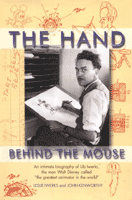
Not only were Iwerks's contributions of secondary importance to the success of the films, but they have been superseded by much more sophisticated technology. There's nothing dated about Bill Tytla's animation—or Frank Thomas's, or Ward Kimball's—but Iwerks's special effects are plainly the products of another era. All of this is not to say that a biography of Iwerks is a non-starter, only that the authors carry a heavy burden of proof. Unfortunately, I don't think Leslie Iwerks and John Kenworthy come close to meeting that burden in The Hand Behind the Mouse (Disney Editions, $24.95), their biography of Leslie's grandfather.
There's fresh information in the book, most notably about Ub Iwerks's family background, and the authors have otherwise drawn on a reasonably impressive body of research, conducted by themselves as well as others. But there are no notes that identify sources, and it's often impossible to determine the basis for particularly questionable statements from evidence in the text alone.
Beyond that, the research is constantly mishandled; bits of information from various sources are pasted together without much regard for whether they are even minimally consistent with one another. The authors have Iwerks playing a central role in critical episodes—the creation of Mickey Mouse, the use of a bouncing ball to keep the Steamboat Willie orchestra playing in sync with the images—even though the best evidence is that he played no such part.
As one consequence of such carelessness and special pleading, the book is loaded with factual errors, large and small, most of which could have been easily avoided. It has Carl Stalling seventeen years old in 1922 (Stalling was born in 1891), and it has Grim Natwick working for Iwerks in 1936, after Iwerks's Comicolor series ended (Natwick left Iwerks and went to work for Disney in 1934; he was animating the Snow White character in 1936).
I was particularly disappointed in the treatment of Iwerks's independent years. I was hopeful (although not very) that there might have survived in the Iwerks family some business records that permitted Leslie Iwerks and John Kenworthy to describe what really happened to the Iwerks studio in the thirties. No such luck; The Hand Behind the Mouse is not just cavalier about chronology, but its account of the studio's ups and downs is scrappy and vague when it is not inaccurate.
If, as I suspect, Ub Iwerks destroyed any studio records long before he died—and otherwise put that whole decade behind him—that would be consistent with his personality as depicted in the book. I think we can trust The Hand Behind the Mouse this far, that Iwerks was indeed a man who, once he'd mastered something (archery, for instance), dropped it and left it behind. Although the book presents this trait as evidence of Iwerks's superiority, the lesson I take from it is that he was a man who never really enjoyed himself.
Whenever there's a glimpse of Iwerks that rings true—whenever he seems to have been observed as a human being, rather than as some gleaming automaton—he almost invariably emerges as cold and unappealing. My favorite example is what he supposedly said when his ne'er-do-well father died at ninety-two: "Throw him in a ditch!" No matter how ample the provocation, there is no gainsaying the harshness.
The writing is amateurish throughout. Constantly, some long-dead person "recalls" this or that. Perhaps this abuse of the present tense arose by analogy: we say "Tolstoy writes in War and Peace," so why not say that Ub Iwerks "recalls"? But, of course, it's Tolstoy's book that speaks to us in the present; there's no such intermediary for Iwerks.
What I find most disturbing about The Hand Behind the Mouse is the attitude I detect behind it. It's not just a mess, like so many other animation books—it seems to be a willful mess. It's as if Leslie Iwerks and John Kenworthy were so determined to exalt Leslie's grandfather that they bulled their way past normal standards of historical accuracy, clear writing, and simple fairness. Their book does no service to Ub Iwerks's memory.
[The Hand Behind the Mouse is also the title of a documentary film about Ub Iwerks by Leslie Iwerks; it has been released on videotape by Walt Disney Home Video. The film suffers from many of the book's flaws—it suggests very strongly that Ub Iwerks was responsible not just for the creation of Mickey Mouse but for that character's enduring popularity—but it is so obviously superficial that it is somehow less offensive.]
[Posted May 2003]