
COMMENTARY
The Juggler
[Click here to go to my thoughts after a second viewing of The Incredibles, or here to read feedback about the film and my review.]
In Hollywood Cartoons: American Animation in Its Golden Age, I wrote about Walt Disney's triumph with Snow White and the Seven Dwarfs in these terms:
"After two years of intensive labor, Walt Disney stood early in 1938 on the threshold of an enormous popular success—the best kind, gained not by pandering to his audience but by trusting that it would respond to what moved and excited Disney himself."
 I
go to see big-studio animated films because I believe such triumphs
are still possible. Today's animated films, like most movies of
all kinds, are vast collaborative efforts, involving hundreds of
artisans and staggering amounts of money, and they must entertain
tens of millions of people if they are to pay for themselves. Despite
the overwhelming incentives—stronger today than ever before—to
approach filmmaking as just another kind of manufacturing, some
artists who make big-studio films still try to speak from the heart
to the individual members of their huge audiences, just as Walt
Disney did in his glory days.
I
go to see big-studio animated films because I believe such triumphs
are still possible. Today's animated films, like most movies of
all kinds, are vast collaborative efforts, involving hundreds of
artisans and staggering amounts of money, and they must entertain
tens of millions of people if they are to pay for themselves. Despite
the overwhelming incentives—stronger today than ever before—to
approach filmmaking as just another kind of manufacturing, some
artists who make big-studio films still try to speak from the heart
to the individual members of their huge audiences, just as Walt
Disney did in his glory days.
It's also true, of course, that many animation studios have purged themselves of such ambitions.
Early this fall, just before DreamWorks' latest computer-animated movie, Shark Tale, opened, I had dinner at a Mexican restaurant next to a table where a family of six was talking about that movie. They were obviously looking forward to seeing it. As I overheard scraps of their conversation, it became evident that their leisure time was dominated by new movies like Shark Tale, as well as by new DVDs, new television shows, and, I would guess from the ages of the youngest members of the family, new pop music, new video games, and so on. If books played any role in their lives—I heard none mentioned—I'm sure they were the latest bestsellers. As best I could tell, the whole family lived culturally in an Eternal Now, where noisy, shallow entertainments gave way constantly to replacements that were only superficially distinguishable from their predecessors.
America's pop-culture industry has worked very hard in recent years to create an audience that values newness and not much more. Shark Tale was targeted at that audience, and successfully so, to judge from its box-office receipts of more than $150 million. The film's plot echoes much older stories—it's a deep-sea combination of The Brave Little Tailor and The Reluctant Dragon, with fish as the characters—but the real point of the film is its thick coat of pop-culture borrowings.
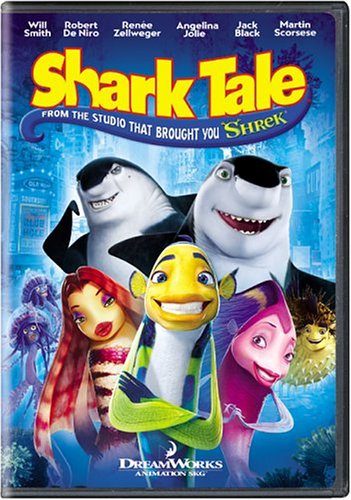 As
in Shrek 2, DreamWorks' other animated hit from 2004, there's
no satirical purpose behind Shark Tale's unceasing invocations
of recent pop music and live-action movies; the borrowings serve
only to feed the self-regard of the people who consume such stuff,
and who presumably enjoy having their taste validated. Unlike the
thinly camouflaged "parodies" in Shrek 2, the product
placements for Krispy Kreme and Coca-Cola in Shark Tale are
as blatant as a thumb in the eye. There's a fart gag—obligatory
by now in any DreamWorks film—but this time it's underwater,
no doubt sending into raptures every kid who has passed gas in the
bathtub. In other words, everything is the same as before in DreamWorks
films, only more so. Technically, too, Shark Tale feels like
a step forward from Shrek 2. In particular, the surfaces—cruddy
whale tongue, velvety sharkskin—have been even more precisely
captured.
As
in Shrek 2, DreamWorks' other animated hit from 2004, there's
no satirical purpose behind Shark Tale's unceasing invocations
of recent pop music and live-action movies; the borrowings serve
only to feed the self-regard of the people who consume such stuff,
and who presumably enjoy having their taste validated. Unlike the
thinly camouflaged "parodies" in Shrek 2, the product
placements for Krispy Kreme and Coca-Cola in Shark Tale are
as blatant as a thumb in the eye. There's a fart gag—obligatory
by now in any DreamWorks film—but this time it's underwater,
no doubt sending into raptures every kid who has passed gas in the
bathtub. In other words, everything is the same as before in DreamWorks
films, only more so. Technically, too, Shark Tale feels like
a step forward from Shrek 2. In particular, the surfaces—cruddy
whale tongue, velvety sharkskin—have been even more precisely
captured.
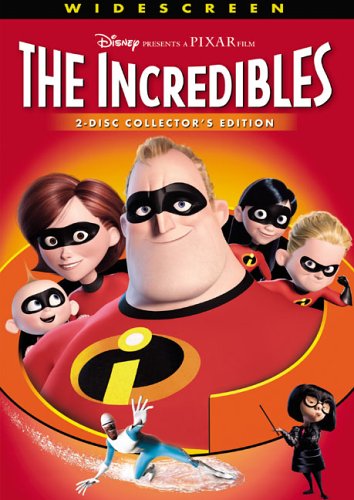
One of the many striking things about The Incredibles, Brad Bird's new Pixar feature about a superhero family, is that it turns its back so emphatically on that trademark DreamWorks preoccupation with surfaces. The hero's and the villain's huge jaws—which would be decorated with stubble and blemishes if this were Shrek 3—are defiantly smooth, apart from subtle modeling that goes only as far as needed to suggest flesh, rather than plastic or metal.
Bird, who previously used computer animation only in support of the hand-drawn variety in The Iron Giant, has made his inexperience work in his favor. He has asked that the technology not give him what it can already do well (those convincing surfaces) but, instead, that it give him what he needs to tell his story as he wants to tell it. He seems to take his collaborators' technical expertise for granted, and he reins it in, as with those smooth jaws, when its full exercise doesn't suit his purposes. At every critical point, Bird has made artistic decisions that clearly reflect his own wishes.
As a result, The Incredibles is, if not one of those triumphs I spoke of at the beginning of this piece, close enough that there's no reason to quibble. It's the best of Pixar's six features, and the first computer-animated feature I've seen that gives me hope that the medium may eventually have the same capacity for artistic expression as hand-drawn animation.
Bird surely deserves most of the credit for this breakthrough, and probably all of it. Whereas Shark Tale is the product of essentially anonymous filmmaking-by-committee—the credits show three directors and three producers, under the malign guidance of executive producer Jeffrey Katzenberg—Bird's name is alone on the screen as writer and director of The Incredibles, as is John Walker's name as producer. To see those names naked on the screen is rather like hearing that familiar claim of personal responsibility for political commercials—"I'm candidate X and I approved this message"—but knowing that it means something, for a change.
As personal as it is, though, The Incredibles is also a big-budget action-adventure film, and so Bird has had to take his audience's expectations fully into account. He has no choice but to swim in the same toxic pop-culture soup in which his competitors at DreamWorks have eagerly immersed themselves; he is competing with Jerry Bruckheimer, after all, not with John Ford. What is so heartening about The Incredibles is that Bird has shown that it's possible to be fully aware of today's degraded pop culture, and to respect its mistreated audience, without surrendering to the culture in the way that the DreamWorks people have.
In the design of Bird's characters—the Incredibles themselves, and their supporting cast—there is none of DreamWorks' heedless urge to recreate the real world in a particularly ugly form. Unlike all the previous Pixar features, The Incredibles has a cast made up entirely of ostensibly human characters—an invitation to disaster, one might think, because the look of real human skin has always defeated computer animators, for clearly identifiable technical reasons. The answer, the new film says, is not to keep butting one's head against that particular wall but to come up with characters who are persuasively human, but whose skin doesn't need to look real.
That strategy didn't involve making the Incredibles look more "cartoony." There are any number of "cartoony" human characters in The Incredibles—the costume designer Edna Mode, Mr. Incredible's boss at the insurance company, a government agent who looks like Richard Nixon—and they are, for the most part, less convincing than the Incredibles themselves, who are, at first glance, far more bizarre-looking. Mr. Incredible, aka Bob Parr, is a hulking Art Deco sculpture of the thirties come to life, and his macrocephalic wife, Helen, and daughter, Violet, recall lots of bad advertising art (I kept thinking of Harry and Harriet Homeowner, the big-headed mascots of the old Hechinger's hardware chain). In Helen's case, there are also strong suggestions of bendable, posable dolls, since she is, after all, Elastigirl.
Bird's designs banish distracting associations, with real human actors as well as with hand-drawn humans of the kind that have populated many other animated features; he then works very swiftly to establish the characters' reality in other ways, through beautifully staged action and, most importantly, through their responses to one another. By the time the Parrs get up from the dinner table, they have become, like the Simpsons (Bird's work on that show was surely helpful here), a family that may look odd but is totally familiar otherwise.
One reason I disliked The Iron Giant, Bird's highly praised 1999 feature, was that the character designs seemed scrawny, their capacity for expression deliberately suppressed, perhaps in unfortunate emulation of Japanese anime. Surprisingly, given his long career in hand-drawn animation, his characters in The Incredibles are not just three-dimensional in the narrow sense, but they also show a capacity for individual expression that goes beyond anything in The Iron Giant. The stylization that is so often paralyzing in hand-drawn animation turns out to be liberating in computer animation; when characters must move in three dimensions, a stylized design can force their movements away from conventional poses and gestures.
The Parrs behave like a real family throughout the film, and so there's no need for them to proclaim their love for one another in plumped-up scenes with fraudulent music. The Incredibles is the first Pixar feature that does not stray into sentimentality of the kind that all but wrecked Finding Nemo. (I realized after the film was over that I had no specific memories of its score, only a lingering sense that the music always supported the action—a sign that the composer, Michael Giacchino, did a superlative job. His soundtrack is mercifully free of the warmed-over pop songs that litter the soundtracks of DreamWorks films.)
It's because Bird lays the groundwork so expertly in the first fifteen or twenty minutes of his film, in both personality and plot terms, that The Incredibles proceeds smoothly through its astonishingly long running time of almost two hours. What happens in the last half of the movie, when the Incredibles confront their enemy Syndrome on his headquarters island, is problematic not because of length, but because in many respects it is indistinguishable from similar sequences in live-action adventures. The technology—which has been Bird's friend in the first half of the movie, by helping him to give his characters life in unexpected ways—is his enemy here because its progress in recent years has been so rapid, to the point that animated effects can often pass for the real thing. Bird's characters are emphatically animated, though, and so what's on the screen sometimes bears an unsettling resemblance to old-fashioned combination work.
Bird flirts with danger in other ways; I often had the sense that he was juggling a great many pins at once, occasionally dropping one or letting it come perilously close to the floor. For example, the riskiness of his character designs was brought home to me in the occasional scene in which Helen Parr, Elastigirl, is seen from the rear; when her face is not visible, the strangeness of her body is disconcerting.
And then there are the characters' voices. They're terribly important to the success of The Incredibles—not because they're big-star voices, like those in Shark Tale (which invite a gee-isn't-that-Renee-Zellwegger response), but because the voice acting is so good. If the Parrs seem to be a real family, it's thanks in large part to Craig T. Nelson and Holly Hunter, who play Mr. Incredible and Elastigirl. Bird must be given a great deal of the credit for the excellence not just of their voice acting, but of the voice acting throughout the film. His own performance—as the voice of the outrageously accented designer Edna Mode, a sort of miniature Dr. Strangelove—is vividly colored, and clearly he knows how to get what he wants from voice actors. Here again, Bird's involvement with The Simpsons may have been an important influence; but it also may have encouraged him to let the voices do a little too much of the work.
Bird has also dropped one of his pins, I think, by mistaking his amusing central conceit—that the Incredibles and other superheroes have been forced into a sort of superhero protection program by a wave of lawsuits arising from their rescues of ungrateful citizens—for a serious idea. His superheroes are persecuted, the film says, because they're truly exceptional in a society (by implication, the one we live in) that pretends that everyone is exceptional and thus exalts mediocrity. Syndrome, the villain, is not just a diabolical killer but a determined leveler. When Mr. Incredible says, "They keep finding new ways to celebrate mediocrity," he is clearly speaking for Bird himself, a director who had to wait until his forties to enjoy an opportunity like those that came earlier to lesser talents like Don Bluth and Mark Dindal.
But there's a problem. In most superhero comic books, the hero acquires his powers through one of several means: an accident (Spider-man, the Fantastic Four, Daredevil), rigorous mental and physical discipline (Batman, Captain America), or by being from another planet (Superman, Hawkman). Only rarely is the superhero's superiority genetic, but that's the case with the Parrs. From all appearances, they and their fellow superheroes are mutants, like Marvel's X-Men, and Bird seems to take it for granted that mutants like the Parrs—or anyone else with superior powers—should be allowed to exercise those powers. The boy Dash's super-speed thus entitles him to win races at the expense of boys who are not genetically gifted in that way but who may have put far more effort into developing whatever gifts they have. I haven't seen the recent X-Men films or comic books, but I don't recall that the original X-Men comic books of the sixties took quite so simplistic a view.
Movies are terrible vehicles for advancing ideas of any kind, except as propaganda, just as they're weak at revealing individual psyches, except in character animation of the most sophisticated sort. (What movies do best is show how people relate to one another.) The Incredibles is not as tendentious as The Iron Giant—in which Bird assumed a pose of moral superiority to the people who struggled with the nuclear threat in the fifties—but in his new film, as in the earlier one, he toys with ideas filled with booby traps for the unwary. This time, at least, it's easier to shrug off the questionable argument and enjoy the film.
As much as Bird has accomplished in The Incredibles, he must clear some higher hurdles if computer-animated films are ever to rival the best of their hand-drawn predecessors. In The Incredibles, as in the earlier Pixar features, there's no strong sense of individual animators' contributions. Individual animators reveal themselves most clearly when they generate in their characters the illusion of spontaneity—that is, like good actors of all kinds, they reveal themselves when they reveal their characters—and I suggested before The Incredibles was released that "to ask a CGI cartoon to appear spontaneous is like asking the same thing of a building or an ocean liner." To adopt the language I applied to stop-motion animation, it seems to me that computer-animated films are "constructed—assembled brick by brick."
That's true of The Incredibles no less than of its predecessors, although Bird has done everything a director could do to work his way around that problem. I could make the same point about "construction" in regard to a lot of hand-drawn films, however. Look at a Disney or Warner Bros. or Harman-Ising cartoon from the early to mid-thirties, and there's much the same sense of self-conscious labor, for reasons that Ward Kimball identified when I spoke with him in 1976:
"Animation is very slow. When you're an actor, you depend on spontaneity in a scene, and it's hard to work up spontaneity when you're doing separate drawings … The faster you can work, the more spontaneity, and that was one of the secrets of the early [Norman] Ferguson animation drawing. He could draw almost as fast as he could think."
The greatest Disney animators, like Bill Tytla, ultimately achieved the illusion of spontaneity not by working as Ferguson did, but by turning the very nature of hand-drawn animation to their advantage. As I wrote in Hollywood Cartoons: "Careful analysis, and the painstaking drawing it required, were potentially the threshold of a much greater subtlety of emotional expression than Ferguson, so limited in technique, could bring to his animation. What Ferguson achieved through rough, rapid sketching, other animators might surpass by first mastering a character's actions and then moving through them, to the character's emotional life."
It seems likely that such a development now lies ahead for computer animation. I didn't think so before I saw The Incredibles, but Brad Bird has made me a believer.
Second thoughts: I saw The Incredibles again about a week after my first viewing, and I came away with my favorable opinion of it reinforced. I felt throughout the film that Brad Bird was pressing hard against the limits of the medium as it currently exists; watching it is a little like riding as a passenger in a high-performance automobile with an expert driver at the wheel. (I did not feel that way in the least while I was watching Boundin', the lightweight short that preceded the feature, or the trailer for John Lasseter's Cars, Pixar's 2005 release. Weighed against The Incredibles, the Cars trailer has a shockingly old-fashioned look. If the film is very much like the trailer, it could be Pixar's first casualty in the box-office wars.)
The Incredibles is an amazingly well-directed film, its action almost always crystal-clear, in contrast to the many live-action adventure films that lapse into incoherence at critical points. Bird takes full advantage of the computer's ability to generate artificial environments, and of the opportunities to move freely within those environments. It's in the animation of the characters that the sense of "construction" remains the strongest, because movement must seem to originate within the characters, not with the camera or the director, and it doesn't, not quite. As I said in my original review, Bird—like everyone else who works in computer animation—hasn't found a way to clear that hurdle.
He does come remarkably close in some scenes, though. Not with the throwaway gestures that others have mentioned, but in animation of Holly Hunter's dialogue for Helen Parr, Elastigirl. Sometimes there's a fleeting but powerful illusion that the animation is mirroring Helen's thought. It's in such scenes, very small in scale compared with most of the film, that I sense something happening in the animation that may resemble what I wrote about in my original review, when I spoke of "first mastering a character's actions and then moving through them, to the character's emotional life."
(There may well be more such moments in the film than I've yet noticed, in action scenes especially, as one of my correspondents suggests: "Pay attention particularly to Dash as he discovers his powers while being chased by the bad guys. During all the fast-paced action, there is a lot of great acting in the boy's facial expressions—from fear to amazement to fear to pride to fear, and so on. What made such action scenes so much better on second viewing is that they weren't just about the action—they were about each character discovering himself or herself, again and for the first time." I suspect that this is one of those films that will be especially rewarding during repeated DVD viewings.)
Not everyone cares for Helen. One of my correspondents dismisses her as "a carping, suburban harpy who seems more interested in imposing her will on her husband than in fighting crime. The film is supposed to be an affirmation of family life but instead presents a nightmare scenario of a henpecked, emasculated husband tied to a wife who is obsessed with doing him one better and who belittles him at every opportunity. In real life a couple like this would end up in divorce court."
I think that's dead wrong. Helen is to me the most real character in the film, a thwarted career woman who tries to make the best of her diminished circumstances—after all, they have been forced to move more than once—and to encourage her husband, a sullen romantic, to make the best of them, too, for the sake of their marriage and their children. Superheroes they may be, but the circumstances are down to earth (and, I would guess, not entirely unfamiliar in the animation community). But Hunter—and, I assume, Bird—make it impossible to accept Helen as a feminist saint, because there is in Hunter's delivery a slight, and ever so slightly alienating, trace of—what? Self-pity, perhaps, or fretfulness, or a combination, or something else entirely; I can't put my finger on it, but it's not ingratiating, and not meant to be. Perhaps it was that voice that triggered my correspondent's rejection of the character. Complexity in a character all but guarantees that at least a few members of the audience will be repelled.
Speaking of complexity: This time around, I paid particularly close attention to the dialogue about "mediocrity," and I'm afraid I came away more skeptical than before. Bird's thinking on this point is either terribly muddled or subtle beyond my understanding. For instance, why would it be a victory for "mediocrity" if Dash were not to race against boys who are his own age but are physically vastly different? You might as well say that it is a victory for "mediocrity" if a college senior is not allowed to compete against sixth graders. Equating "mediocrity" with "inferior physical ability," as The Incredibles does, is simply silly. Any sports nut could call up case after case of athletes who squandered great natural gifts or, on the other side, converted modest native ability into impressive achievements through hard work and determination. Should we scorn the over-achiever and applaud the arrogant bum?
I'm not even sure that it's a victory for "mediocrity" when The Incredibles'superheroes are forced to hang up their uniforms. On the evidence of the film's opening minutes, superheroes do a heck of a lot of damage, even when they're getting a cat down from a tree. For that kind of damage to be acceptable, there have to be supervillains who are capable of inflicting even more serious damage—and, of course, Buddy/Syndrome is exactly that kind of villain. When the Incredibles vanquish him and his robot, the populace is quite naturally appreciative, despite the scale of the havoc that defeating the supervillain has required. But wait a minute...Buddy's victory over the superheroes is supposed to be a victory for mediocrity...but how can that be, when Buddy is enormously gifted, albeit evil? Are we to take him seriously when he says that nobody will be super when there are no superheroes left? My head hurts...
Oh, the hell with it. Bird is a clear thinker where it counts,
as a storyteller and an artist. He has made what is probably the
most intriguing and stimulating animated film of the last few decades,
and I look forward with great anticipation to whatever he decides
to do next.
[Click here to read my Essay about The Iron Giant.]
[Posted November 20, 2004; updated November 24, 2004, and corrected June 13, 2014]]