
COMMENTARY
But What Is Disneyland For?
[Click here to read feedback about this review.]
I visited Disneyland on my first trip to Los Angeles, in June 1969. Walt Disney had been dead only two and a half years, and the park was still very much his, not just in its general conception but in its details. I expected to like it, but as the day wore on I was surprised to realize that I didn't much care for it. It was only late in the day, at "Pirates of the Caribbean," that I felt any enthusiasm for what I was seeing.
 Subsequent
visits did not erase my skepticism. On my most recent visit, my
dismay with the submarine ride drove me out of the park in mid-afternoon.
Subsequent
visits did not erase my skepticism. On my most recent visit, my
dismay with the submarine ride drove me out of the park in mid-afternoon.
I've always been disturbed by my reaction to Disneyland. Even in the last and weakest of Walt Disney's animated features, I see traces of the artistic innovator who made the great short cartoons and the early features. It's harder to find such traces in the live-action features, but that's not surprising, because Disney's involvement in them was clearly limited. He was, after all, devoting most of his time to other things—Disneyland, in particular. It's his intense involvement with the park that makes me uncomfortable with my own coolness toward it. If he was so wrapped up in Disneyland, why do I find so little of the essential Walt Disney in it?
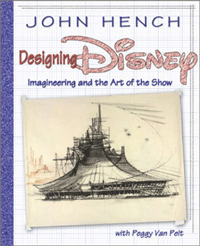
There's abundant evidence of Disney's intense involvement in such recent books as Designing Disney's Theme Parks: The Architecture of Reassurance and Walt Disney Imagineering: A Behind the Dreams Look at Making the Magic Real. The most recent such book is Designing Disney: Imagineering and the Art of the Show, a slender but lavishly illustrated volume that owes its unique authority to its principal author. John Hench is now well into his nineties, but, after more than sixty years on the Disney payroll, he is still actively involved in the activities suggested by his book's title—the design of attractions at what are now a half dozen Disney theme parks.
The book comes equipped, too, with a preface by Frank Gehry, the architect of the wildly acclaimed new Walt Disney Concert Hall in Los Angeles, and a co-author, Peggy Van Pelt, with a Ph.D. As modest as are the book's dimensions, it would be hard to imagine a more imposing case for Disneyland's importance.
Hench does not shrink from making extraordinary claims for what he calls "our greatest achievement," Disneyland. His language, as applied to the Disney cartoons and theme parks in interviews, has always been rather grand, sometimes masking the intensely practical considerations that led to particular choices. His book is no different.
For example, he says this about Mickey Mouse, in an extended caption: "As a graphic representation, Mickey is a symbol of life. He is a series of round shapes that have a distinctive relationship characterized by the flow of one curve into another, creating lines that relate to each other in the musculature of a human being. Curves typically indicate movement typical of the living human figure. I see Mickey as a record of dynamic movement."
I felt here, as in much of the rest of the book, that Hench had skipped a step. Mickey, like many another cartoon character in the twenties, owed his curves to the limitations of his animators. As I put it in Hollywood Cartoons: American Animation in Its Golden Age: "Vertical forms tend to stutter as they move across the screen, whereas curving forms tend to flow." Those tendencies were exaggerated in the hands of the early animators, most of whom were more limited in their skills than the animators of later years. Mickey has outlasted many other characters that were equally curved; his curves were only one small element in his success.
Only rarely as I read the book did I feel that Hench was extending his reach to all the considerations—grubbily practical as well as aesthetic—that have governed the design of the Disney parks. Sometimes the practical intrudes seemingly by accident, as when, in the engagingly expert chapter on color, Hench writes of the "dark ride" called "Pinocchio's Daring Journey." The ride, he says, "flows seamlessly into Geppetto's Toys & Gifts and the nearby Village Haus Restaurant, all unified, like a stage set, by a color palette of rich wood browns and earth tones accented with warm colors typical of Italian wooden toys and clocks. The theatrical background extends the ride experience beyond the ride itself, into the shopping and dining experiences." Those latter "experiences" being, of course, additional opportunities for the Walt Disney Company to extract money from "guests" who have already paid handsomely to enter the park.
The "experience" of being parted painlesssly from one's cash is not what brings people back to Disneyland, and I don't think it has been uppermost in the minds of designers like Hench. But I'm left wondering just what kind of experiences Hench and his colleagues—and, especially, Walt Disney before them—have wanted and expected their visitors to have. Disneyland and its successor Disney parks have been planned and executed as carefully, as thoughtfully, as any great cathedral or, for that matter, Gehry's Disney Hall. And yet, there's no question what kind of response the builders of Europe's great medieval cathedrals wanted to elicit. Chartres, Bourges, Salisbury, Florence—all such cathedrals demand contemplation of the eternal and the divine. Some may do so more successfully than others, but there is rarely ambiguity about their purpose. Disney Hall is likewise a temple, to music of the rarefied kind. When Essa-Pekka Salonen chose the compositions for the inaugural concert, he picked not "It's a Small World" but Le Sacre de Printemps.
It's tempting to say that the experience waiting at the heart of Disneyland is nothing more than just another damn roller coaster. But as Hench points out, Disneyland had no "thrill rides" until 1959, four years after it opened. From its inception, Disneyland was not a true amusement park. It lacked not just the old amusement parks' seediness but their edge, the titillation of rides that seemed to, and sometimes did, place the riders in physical peril. That has changed somewhat—under the pressure of competition, Disneyland has added a variety of thrill rides, and a few people have been hurt or even killed on them—but most of the rides and shows were, and are, very mild stuff.
Hench doesn't dwell on the Disneyland rides so much as on things like the "concept of 'themed' environments—places designed so that every element contributes to telling a story." But themed environments have been with us for a long time—the first real suburban shopping center, Country Club Plaza in Kansas City (a place that Walt Disney surely visited after it was built in 1922), is "themed" in its evocation of Spain. The great movie palaces of the twenties were routinely "themed"; examples have survived in cities as diverse as Atlanta and Santa Barbara. Many great hotels have always been "themed." Whole organizations like the Masons and the Shriners, with their mock-Islamic trappings, are nothing if not "themed." Disney may have given "theming" a new burst of life, as he "developed and popularized" the idea, to use Hench's phrase, but it is all too easy to overstate the importance of what he did.
So, is it, as Hench says, "the guests' sense of progressing through a narrative, of living out a story told visually … [that links] together the great variety of attractions [Disney] envisioned for his new kind of park"? Here judgment is inevitably more subjective, but not everyone involved with the park has bought into the "story" idea. Marc Davis, for one, in a 1973 interview with Bob Thomas, spoke of Disney's attitude during preliminary work on the "Haunted Mansion" attraction: "By that time, Walt knew that we were not telling stories. … He said very definitely, 'You can't tell a story in this medium.'" (A transcript is at the Disney Archives.) At the very least, the "stories" being told at Disneyland are impoverished compared with the rich narratives of the best Disney animated features.
Hench is hardly alone in assigning more weight to Disneyland than it can bear. Ray Bradbury, for one, said a few years after the park opened that he found there "vast reserves of imagination before untapped in our country." It seems to me, though, that imagination has always been in short supply at Disneyland, and deliberately so. The park's very blandness has been reassuring to many visitors, especially the parents of small children. I think they come to Disneyland not for imaginative stimulus, but to be soothed by a perfectly orderly, predictable environment. I find such environments irritating and oppressive, and I'm sure that's why I have never been able to warm up to the park.
Frank Rich, writing in The New York Times, linked Arnold Schwarzenegger's election as governor of California to Walt Disney's vision of Disneyland, which Rich described as "an alternative America that he could script and control down to the tiniest detail of its idyllic Main Street U.S.A." It's not necessary to share Rich's scornful view of Disney and Disneyland to acknowledge the essential accuracy of what he wrote. Disney was both artist and entrepreneur, two categories of human endeavor that blur into each other. Very often, being in complete control is terribly important to people of both kinds.
Disneyland has always been seen—accurately, I think—as an outgrowth of Disney's fascination with trains, as a sort of tabletop model-train layout grown to enormous size. Unlike a tabletop, Disneyland has always been filled with real people—and had to be, if the park was to pay for itself. The presence of all those people could have worked against Disney's maintaining control: what if they didn't behave the way he wanted them to? It was here, as Hench makes clear, that Disney manifested true entrepreneurial savvy. He understood that it is easier to maintain control over your customers if they're doing what they think they want to do, as opposed to doing what they think you want them to do. To preserve that illusion of autonomy, Disney was more than willing to make countless small adjustments.
"To design most effectively for our guests," Hench writes, "we learned that we had to observe them up close, waiting in lines with them, going on rides with them, eating with them. Walt insisted on this. … This was new to us; as filmmakers, we were used to sitting in our sweatboxes at the studio, passing judgment on our work without knowing how the public might actually respond to it. Going out into the park taught us how guests were being treated and how they responded to patterns of movement and the ways in which they expressed their emotions. We got an idea of what was going on in their minds."
My thought when reading this was, how fortunate we are that such instant feedback was not available when Walt Disney was making Snow White and the Seven Dwarfs and Fantasia. He always showed a decent respect for his audience, but at critical points he pulled back and made his films the way he wanted to make them—an exercise of control that was materially different from the kind of control he exercised over Disneyland. A theme park makes no sense if it is not pleasing hordes of customers; the rides are incomplete if they are not filled with people. But a film can make sense, in artistic terms, even if it is playing to almost-empty theaters, as some of Disney's did.
Perhaps Disneyland would have undergone a transformation if Disney had lived, and the wit and invention embodied in "Pirates of the Caribbean" and then in "The Haunted Mansion" would have become the rule at the park, rather than the exception. Disney might have found in "Audio-Animatronics" a liberating tool. The park might have become more than a precision-tuned refuge for harried parents of small children. That seems unlikely, though. By the time he died, Disney was less and less interested in attractions of the kind that dominated his "Magic Kingdom." Ultimately, he found the tabletop too confining; but a return to the kind of creative freedom he had once enjoyed in film was no longer possible. And so he turned his enormous energies toward much grander projects.
Many people like to think of Disney's career as a smooth continuum (punctuated, to be sure, by financial reverses) in which the theme parks succeeded the animated features as his greatest achievements. John Hench's book is, at bottom, an attractive restatement of that view. For me, though, there is a radical discontinuity between the Walt Disney of the thirties and early forties—the maker of animated films—and the Walt Disney of the fifties and early sixties—the theme-park proprietor. The discontinuity arises not from a break between his roles as artist and entrepreneur, because Disney was always both, but in the weight he chose to assign to each role. Reading Hench's book has not altered my feelings about which of the two Walt Disneys deserves my love and admiration.
[Posted October 2003]