
COMMENTARY
Comic Books on Campus
By Dana Gabbard
A friend who happens to be on the mailing list of Friends of the Oviatt Library at California State University, Northridge (CSUN), tipped me off that the library was about to open an exhibition titled "Celebrating Comic Books: An American Tradition." When I learned that the postcard she received said that the show drew on donations from long-time Western Publishing editor Chase Craig and included correspondence from Carl Barks, my mind was made up: I was going to attend the formal opening.
 Like the proprietor of this website, I am a Carl Barks fan. Since I stumbled
across his stories in my teenage years my activities as a Barks fan have
included publishing a fanzine (Duckburg Times), authoring several articles,
and helping organize panel discussions at the massive comic-book convention
held each summer in San Diego. My chief ambition is
to publish the bibliography of writings on Barks that I have been
researching fitfully since the 1980s.
Like the proprietor of this website, I am a Carl Barks fan. Since I stumbled
across his stories in my teenage years my activities as a Barks fan have
included publishing a fanzine (Duckburg Times), authoring several articles,
and helping organize panel discussions at the massive comic-book convention
held each summer in San Diego. My chief ambition is
to publish the bibliography of writings on Barks that I have been
researching fitfully since the 1980s.
While working on the bibliography, I began wondering about the insight into Barks's career that primary sources might provide. At some point Barks donated to the Disney studio's Walt Disney Archives a collection of letters sent to him by fans, reaching back to the first, from John Spicer in 1960. And of course the Archives has much material relating to Barks's years working at the studio. One mystery since his death in 2000 had been the ultimate disposition of Barks's estate, including his work records and other materials of interest to researchers. That mystery is now partially solved with the news that Bonhams has an upcoming sale in Los Angeles that includes artwork, comic books, prints and ephemera from Barks's estate.
The sales catalog notes: "Due to the large amount of material from the Estate of Carl Barks, there will be four to six additional online auctions conducted independently of Bonhams & Butterfields. These auctions will be organized by Jerry Weist (jerryweist@comcast.net) and Chris Boyko (cboyko@amnn.org). Please contact Jerry and Chris directly if you want to more information about these online auctions, the first of which is scheduled for late June [2007]."
 From corresponding with
Zetta Devoe at Western Publishing over ten years ago, I got the impression
that most of Barks's editors (like Eleanor Packer and Alice Cobb) were not
known to have kept any personal papers that might eventually have made their
way into a library or other accessible location. Is it any wonder that I
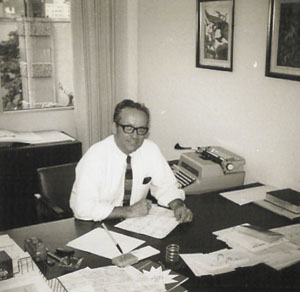
was delighted to learn that Barks' final editor, Chase Craig [seen at right at his desk at Western Publishing's Hollywood office, in a 1969 snapshot—MB], had retained his
personal papers and that his family had donated them (along with his
personal collection of many of the comics he edited) to the special collections department. at
CSUN's library?
From corresponding with
Zetta Devoe at Western Publishing over ten years ago, I got the impression
that most of Barks's editors (like Eleanor Packer and Alice Cobb) were not
known to have kept any personal papers that might eventually have made their
way into a library or other accessible location. Is it any wonder that I
was delighted to learn that Barks' final editor, Chase Craig [seen at right at his desk at Western Publishing's Hollywood office, in a 1969 snapshot—MB], had retained his
personal papers and that his family had donated them (along with his
personal collection of many of the comics he edited) to the special collections department. at
CSUN's library?
The formal opening was March 6. I missed all but the final moments of Professor Charles Hatfield's lecture on the history of comics, which evidently provided a suitably academic context for the show. Once it ended I joined the small crowd of fifty or sixty attendees who made their way to the C.K. and Teresa Tseng Gallery of the library. What greeted my eyes was a moderate-sized open space filled with various glass cases containing comics and comics-related material.
Besides the Craig family donation, the exhibition also drew on David S. Somerville 's collection of comic books, recently donated to CSUN. The range of comics on display was impressive, encompassing every significant era, publisher, and genre (including the proliferation of modern-day reprintings of early superhero tales in thick, pricey tomes). Despite the academic setting, the show mostly presented the materials with a minimum of analysis, which I found a breath of fresh air after the heavy-handed pretensions of the recent "Masters of American Comics" museum show.
Among the items drawn from the Craig donation were a caricature from his time at the Leon Schlesinger animation studio and examples of the "Charlie McCarthy" comic strip he worked on and the "Odd Bodkins" strip he wrote circa 1941-42 (which is often said to be the first satire of the then new superhero genre). Then I spotted to my utter surprise a true treasure: an August 6, 1928, letter to Craig from E. C. Segar. This evidently was a response to Craig's query to the cartoonist seeking advice after graduating from art school. Besides the encouraging text the middle of the sheet has a nice large drawing of the then-star of the "Thimble Theatre" comic strip, Castor Oyl, along with the Wiffle Hen. (It was in early 1929 that Segar created the character who soon became a sensation and pushed Castor into obscurity—Popeye.)
Of course, for me the pièces de résistance were the two Carl Barks letters to Chase Craig on display. In the first, dated October 7, 1966, Barks discusses his retirement, the story "King Scrooge the First" (which he wrote but did not draw; it was published in 1967 in Uncle Scrooge No. 71), and some then-recent interactions with fan Malcolm Willits, who was instrumental in discovering Barks' identity. In the second, dated December 14, 1970, Barks discusses the Junior Woodchuck stories he was then writing and mentions some advice on writing comics he had given fan and college professor Donald Ault, who had shown interest in writing some stories of his own for submission to Western Publishing. He also mentions that the Disney studio's newly hired archivist, David R. Smith, had just contacted Barks about the possibility of his supplying artwork for an exhibition the Walt Disney Archives was mounting.
Overall the exhibit is a pleasant diversion. Nothing earthshaking, but an enjoyable overview that includes a few stellar pieces from comic book legends Barks and Segar. The exhibition is free and available for viewing through August 3, 2007, during library hours: Monday through Thursday, from 7:45 a.m. to 11 p.m.; Friday, from 7:45 a.m. to 5 p.m.; Saturday, from 9 a.m. to 5 p.m.; and Sunday from 10 a.m. to 10 p.m.
A finding guide to the Chase Craig Collection is posted at: http://library.csun.edu/Collections/SCA/SC/FG/fdgds4a.html A finding guide to the Carl Barks correspondence donated by the Craig family is posted at: http://library.csun.edu/Collections/SCA/SC/FG/fdgds4b.html The Chase Craig collection is fully processed. Researchers wishing to examine it should contact Curator Tony Gardner of the Special Collections & Archives: tel. (818) 677-2597 fax. (818) 677-2589 e-mail: Tony.Gardner@csun.edu The Library also has a reference librarian who can answer researcher questions. She is available during morning hours at (818) 677-2832. Special Collections and Archives is open M-F from 9 a.m. to 4:30 p.m. (closed weekends).
Details about the Bonhams auction with items from Carl Barks's estate are
posted on the auction house's website (search lots starting with 1250 to
examine the Barks items [lots 1250-1393]):
http://www.bonhams.com/cgi-bin/public.sh/pubweb/publicSite.r?sContinent=EUR&screen=catalogue&iSaleNo=15284
[Posted May 19, 2007; updated June 4, 2007.]