
COMMENTARY
Grin and Bear It
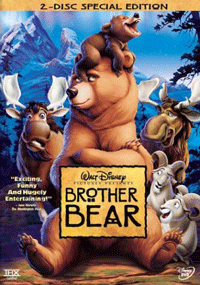
Brother Bear, the third and apparently last hand-drawn feature to emerge from the Walt Disney Company's Florida animation studio, is in many ways a beautifully executed film, one whose settings evoke the grandeur and immensity of the Far North very impressively. I've been to Alaska, and while I'm not sure that the film shows how Alaska looks, it certainly shows how it feels. The story is more than serviceable, too, rising to a powerful climax that echoes the prince's "resurrection" in Beauty and the Beast. As in the earlier film, the Disney people are willing to grapple with fundamental emotions—in this case, how we respond to the deaths of those we love—that other animation factories, Pixar included, tiptoe past. Moreover, because the story takes place in an Ice Age world still home to mammoths, political correctness barely raises its head, despite the film's cast of Native Americans.
 What
a pity, then, that Brother Bear is fatally lacking. It's
as if, having stretched so far, the film's makers—perhaps its
directors, Aaron Blaise and Bob Walker, or, more likely, culprits
higher in the Disney hierarchy—suffered a failure of imagination,
or simply a failure of nerve. Brother Bear, you can hear
them fret, is turning into a beautiful, serious film, maybe too
beautiful and serious for juvenile audiences coarsened by a steady
diet of sexual innuendo and flatulence gags. Better not to take
chances. Rather than try to get inside the heads of the three Indian
brothers, Kenai, Denahi, and Sitka, so that they sound like real
people, give them anachronistic, smart-ass dialogue. Have the bears,
the cub Koda in particular, talk the same way. Throw in a couple
of silly, wisecracking moose and some other funny animals, too.
Have bears and moose hitch a ride on a mammoth, however ridiculous
that looks, because, after all, the kids ate up such stupid stuff
in Ice Age. Lean on human characters who look like retreads
from Mulan—hey, that film was successful, right?—and
on slick animation that invariably settles for the first pose, the
first expression, that serves the purpose, however dull and obvious
the result.
What
a pity, then, that Brother Bear is fatally lacking. It's
as if, having stretched so far, the film's makers—perhaps its
directors, Aaron Blaise and Bob Walker, or, more likely, culprits
higher in the Disney hierarchy—suffered a failure of imagination,
or simply a failure of nerve. Brother Bear, you can hear
them fret, is turning into a beautiful, serious film, maybe too
beautiful and serious for juvenile audiences coarsened by a steady
diet of sexual innuendo and flatulence gags. Better not to take
chances. Rather than try to get inside the heads of the three Indian
brothers, Kenai, Denahi, and Sitka, so that they sound like real
people, give them anachronistic, smart-ass dialogue. Have the bears,
the cub Koda in particular, talk the same way. Throw in a couple
of silly, wisecracking moose and some other funny animals, too.
Have bears and moose hitch a ride on a mammoth, however ridiculous
that looks, because, after all, the kids ate up such stupid stuff
in Ice Age. Lean on human characters who look like retreads
from Mulan—hey, that film was successful, right?—and
on slick animation that invariably settles for the first pose, the
first expression, that serves the purpose, however dull and obvious
the result.
It is their smirking, adolescent dialogue, more than anything else, that condemns films like Brother Bear and Sinbad to the kiddie ghetto. (I haven't yet seen Master and Commander: The Far Side of the World, but I somehow doubt that Russell Crowe says, "I like the way you dish up those frog legs, dudes" when his crew sinks a French warship.) Dialogue like Brother Bear's would make sense only if the film were in some sense a burlesque, but of course it's nothing of the kind. The dialogue, and the foolishness that so often accompanies it, are simply the products of a clumsy adult effort to win the confidence of what the Disney people regard as their target audience: hip, skeptical modern kids. That Brother Bear has done moderately well at the box office—it is far from a runaway hit—may be testimony to the success of that strategy, but I doubt it. It seems much more likely that the bulk of the film's audience has shrugged off the kiddie nonsense and responded instead to the film's visual beauty and its inherently strong story.
Sinbad's failure, on the other hand, suggests that flipness alone will not take you very far. Evidently, Disney intends to test audience tolerance for more such stuff next spring, when it releases its last hand-drawn feature, Home on the Range. If the trailer that precedes Brother Bear is any guide, Home on the Range will be a cynical mess, its script saturated in grade-school snideness and its animation drawn in a crude, scratchy style that evokes fifties animation and the TV animation derived from it at their worst. That will be a sad ending for hand-drawn animation at the studio that gave birth to the greatest films of the kind. But it's better, I suppose, for hand-drawn animation to seek a foster home than for it to endure more abuse at the hands of its parent.
[Posted November 26, 2003]