
CAPSULES
Who Killed Cock Robin?
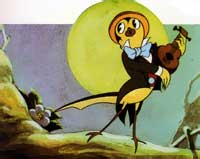 The title character in Who Killed Cock Robin?, from John Grant's Encyclopedia of Walt Disney's Animated Characters. Copyright Disney Enterprises. |
[Click here to read feedback about this Capsule.]
A Walt Disney Silly Symphony. New York premiere on June 27, 1935, at Radio City Music Hall (where it played for three weeks, through July 17). Released nationally on June 29, 1935, by United Artists. No screen credits except for Walt Disney. Credits from studio records and interviews: director, David Hand; story, Bill Cottrell, Joe Grant; story sketch, Bob Kuwahara; animation, Ham Luske, Norm Ferguson, Bill Roberts, Dick Lundy, Eric Larson, Hardie Gramatky, Gerry Geronimi, "Bob" [probably Wickersham]; music: Frank Churchill.
To read the section of Hollywood Cartoons: American Animation in Its Golden Age in which I discuss Cock Robin and how it fit into the evolution of Disney animation, click here.
For the outline distributed in the Disney studio around the start of work on this cartoon, click here.
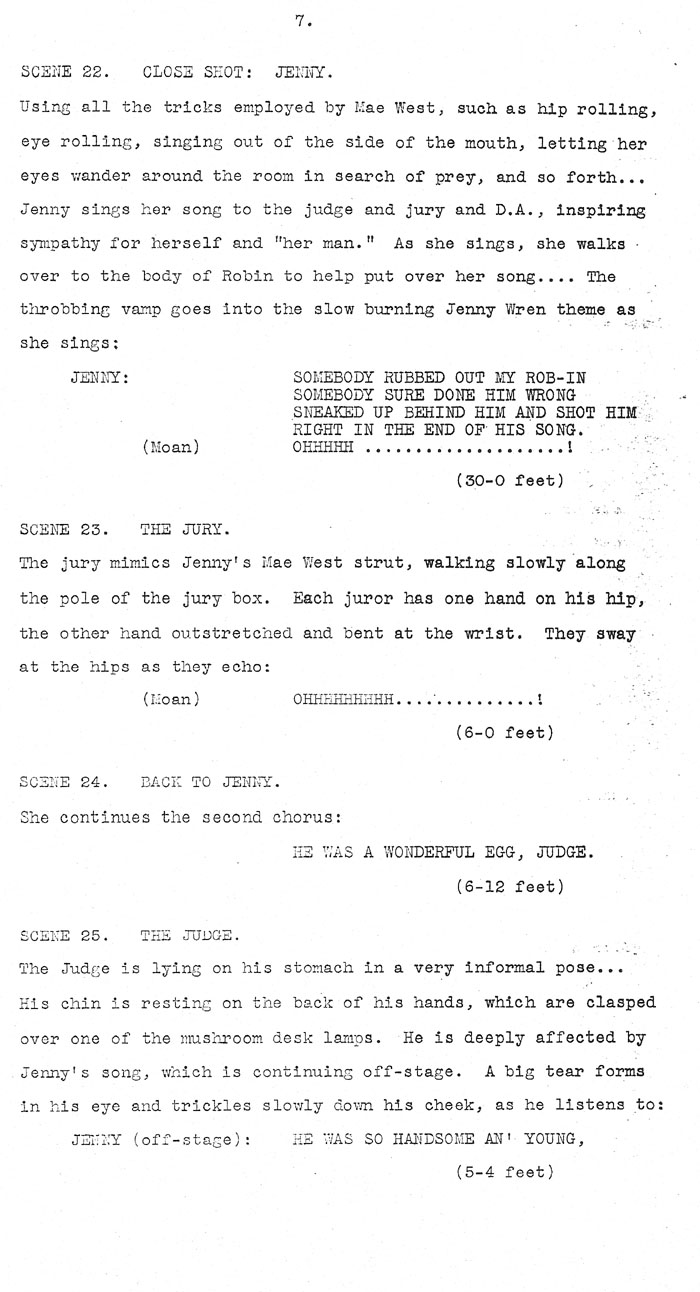
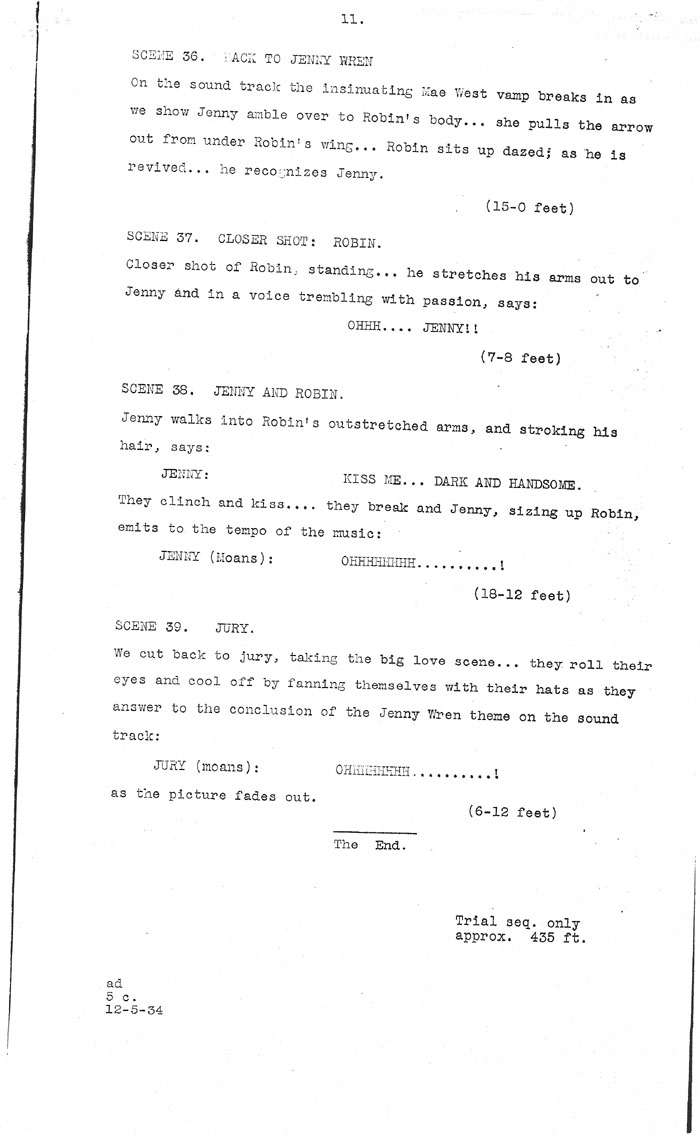
For the continuity or script dictated by Bill Cottrell on November 28, 1934 (nineteen pages, plus a cover sheet and a cast of characters), click here to go to page 1, here for page 2, here for page 3, here for page 4, here for page 5, here for page 6, here for page 7, here for page 8, here for page 9, here for page 10, here for page 11, here for page 12, here for page 13, here for page 14, here for page 15, here for page 16, here for page 17, here for page 18, here for page 19, here for page 20, and here for page 21. Links on each page of the script permit navigating directly from one page to another.
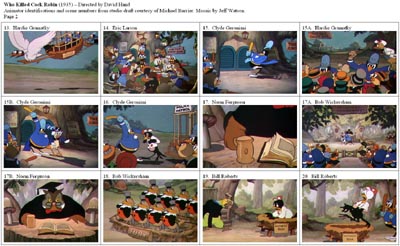
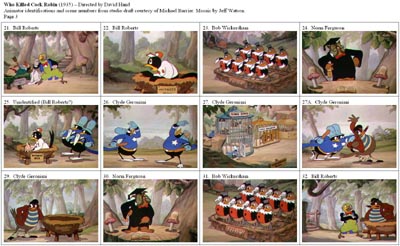
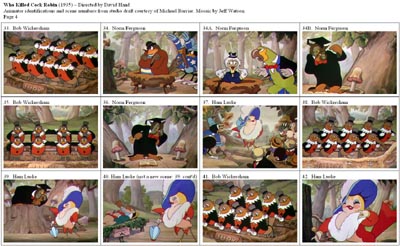
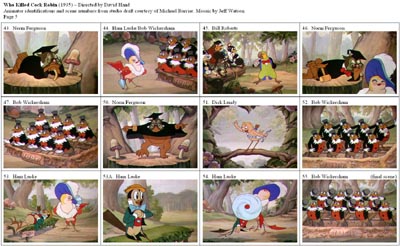
For the draft of Cock Robin, with animators' credits for each scene, click here for page 1, here for page 2, here for page 3, here for page 4, here for page 5, and here for page 6.
The earliest trace of Who Killed Cock Robin? is a one-page outline, distributed in the Disney studio in March 1934; the deadline for gag suggestions was March 23. At that point, Wilfred Jackson was scheduled to direct the cartoon. As was usually the case, a fair amount of work had been done on the story before the outline was distributed, although there's no indication of who the writer was.
The outline's version of the story differs considerably from the film, in which most of the action takes place in court. The outline opens with Cock Robin "walking through the bird village, swinging his cane and flirting with all the lady birds." The character was envisioned as the sort of sweet-talking heart-breaker Bing Crosby played in early-thirties features like Going Hollywood: "He is whistling a song, possibly 'When the Blue of the Night'" (Crosby's radio theme song).
There's no hint in the outline that Jenny Wren would be a caricature of Mae West: "We show Cock Robin and Jenny Wren doing a very graceful flying waltz which will be similar to a real waltz in action, but done in the air. This can be a high spot in the picture for graceful action and as a novelty"—the sort of animation set-piece that had been central to the Silly Symphonies in their first several years but was rapidly fading in importance as the Disney people learned how to delineate character and tell stories.
The outline's trial—in contrast to the film, where three birds are arrested, a crow was to have been the only suspect—is presented as a Rashomon-like affair, with Jenny and the crow offering starkly different portrayals of Cock Robin. The crowd at the trial—"true to type," the outline says—lurches back and forth between wanting to lynch the crow and wanting to lynch Cock Robin.
There was to be no comic-romantic ending like the film's, with Dan Cupid turning up to tell the crowd that he fired the arrow that knocked Cock Robin from his perch. Instead, the outline calls for the cartoon to end "with the irate birds chasing Cock Robin out of town, throwing things after him." Ominously, the outline itself ends with this note: "We can use a suggestion for a good gag finish to this picture."
Perhaps because the story was in such a state of disrepair—as skeletal as the outline is, it clearly encompasses more material than could have been accommodated in a seven-minute cartoon—there's no evidence of any further work on Cock Robin for more than six months. But then things speeded up. On November 28, 1934, Bill Cottrell dictated a nineteen-page continuity to a stenographer. Animation was under way a little more than a month later.
Cottrell's continuity includes not just scene breakdowns but also footage estimates for each scene, down to the frame. The action—described in detail, complete with camera moves—is very close to what wound up on the screen, and the dialogue too is very close. Jenny Wren is now explicitly a Mae West caricature, and the other characterizations are likewise in line with those in the film. For example, Dan Cupid: "Cupid has a hysterical laugh like Ed Wynn, and talks in a lisping nance voice. All his actions typify the hand-on-hip, I'll-slap-your-wrist attitude of a nance [an effeminate homosexual]."
A second, seventeen-page Cottrell continuity for Cock Robin, dated January 8, 1935 (the day after the first animation scenes were handed out), differs from the first mainly through the deletion of some gag material for the police patrol wagon as it rushes to the scene of the "crime." (In fact, the later continuity is dated November 28, 1934, on its first page, which a literal-minded secretary apparently retyped.)
Some material that was the same in both continuities was deleted for the finished film, probably for reasons of time, although it's just as well that it was dropped. There was to be an ambulance-chasing lawyer named "Sam Ginsbird," for instance, and the three prisoners were to be really hung, with Dan Cupid's arrow cutting a rope.
Despite such deletions, the satirical flavor in Cottrell's continuity, with the criminal justice system the target, carried over into the film. After Cock Robin's apparent death, the police rush ferociously but indiscriminately into the Old Crow Bar, scooping up suspects with no possible relationship to the "killing" other than being in the wrong place at the wrong time. As the police bring the three suspects to the witness stand, they pound each one on the head repeatedly with their nightsticks. The jury sings, "We don't know who is guilty, so we're going to hang them all." But in the continuity, and in the film, there is a strong operetta flavor, with rhymed dialogue and snatches of patter song, and as a result the satire has no real sting.
(Joe Grant, Cottrell's collaborator on Cock Robin and other Silly Symphonies, offered this explanation for Cottrell's light touch: "Bill, being English, was responsible for the Gilbert and Sullivan approach to it." Cottrell's parents were in fact English; they emigrated to the U.S. around 1900. But he was born in South Bend, Indiana, in 1906.)
It's quite possible or even likely—given the compressed schedule and the way things were being done at the Disney studio in 1934-35—that there was never a complete storyboard for Cock Robin based on Cottrell's continuity. After the film was made, surviving sketches were assembled, one sketch to a scene, in what the Disney Archives calls a "story sketch book," but the sketches in such books, especially those from the early to mid-thirties, were often preliminary layout drawings, rather than story sketches. Such drawings were made to show how the action was to be staged, rather than put across a story point. The distinction wouldn't have mattered much to anyone using a sketch book then; the books apparently served as ready reference to a film in the days when looking at the film itself was more complicated than popping a videocassette into a VCR.
Some of the drawings in the story sketch book for Cock Robin—like the ones reproduced on page 104 of the original 1973 edition of Christopher Finch's Art of Walt Disney—are relatively finished preliminary layouts. Others are much cruder preliminary layouts; still other drawings look like actual story sketches, many of them by Bob Kuwahara, the first Disney artist whose job was just to draw story sketches (as opposed to being a writer who also drew sketches). In any event, many hands were at work on these sketches. That was not unusual—preliminary layouts in particular might be drawn by the director, the layout man, or someone else in the unit, and story sketches likewise could be contributed by many different people.
In 1986, I talked with Cottrell about his work as the lead writer on the Silly Symphonies, the short cartoons that paved the way for Walt Disney's triumphant early features. For several years, first on the Symphonies and then on part of Snow White, Cottrell wrote and Grant drew, in what Cottrell remembered as most satisfying partnership.
"Joe was great to work with," he said. "Almost every morning, it seemed, he came in with a new drawing that he'd done [the previous] night, or a clay figure. He was interested in the business; he had a lot of enthusiasm for it, and thought about it at home, obviously. ... We were interested in [motion] pictures, and we would see ... all the pictures made by directors who had interesting styles. ... Joe was a good artist, and he contributed so much to the pictures because of his ability to draw and conceive characters."
The Grant-Cottrell team was responsible for a string of successful cartoons, Who Killed Cock Robin? among them. In "Production Notes—Shorts," a memo he wrote late in 1935, Walt Disney singled out Cock Robin as one of the year's "seven definite and outstanding hits," bracketing it with such cartoons as The Band Concert and The Tortoise and the Hare. But something about it still troubled Cottrell, more than fifty years later.
"I wonder," he said, "why we didn't go all-out, with the whole thing, with caricatures all the way through it."
It was a good question. Only one character, Jenny Wren, is an unmistakable caricature, of Mae West. A number of other characters look as if they should be caricatures, but they aren't, not like Jenny Wren. When Cock Robin is shot and falls, he utters three last "a-boos" before "expiring," but that's really just a Crosby reference, from a character who is not a Crosby caricature.As Cottrell noted, "We had the Bing Crosby type of voice for Cock Robin, because he was a crooner of that era, but we didn't caricature him [as Crosby]; I don't know why not."
Other characters suggest Harpo Marx and Stepin Fetchit, but only in the most general terms, and most of the cartoon's all-bird cast resists identification with any particular movie star.
The urge to see a caricature where one was not intended afflicted Alexander Woollcott, a critic who was, as Cottrell said, "a very popular radio man in those days, and wrote for The New Yorker"—and was caricatured more than once in Frank Tashlin's Merrie Melodies for Warner Bros. Woollcott "went over to Walt's house for dinner one night," Cottrell said, "and I was invited [Cottrell was Disney's brother-in-law—he was married to Lillian Disney's sister], and he said, 'On that picture Who Killed Cock Robin? who did you have in mind for the judge?'" The judge was an owl, and Woollcott had an owlish appearance, but Disney evidently resisted the temptation to flatter his guest. "Walt, I don't believe, gave him a specific answer," Cottrell said. "I think he kind of evaded it. Woollcott, I think, would have liked for him to have said, 'We had you in mind,' but it wasn't said."
For some reason, Cottrell said, "it just didn't occur to us to say, 'Let's go all out and make this a total caricature picture.' Joe and I talked about it many times afterward, and wondered why we didn't, because Joe was a great caricaturist."
When I spoke with Grant in 1986, a few days after speaking with Cottrell, he laid their hesitation to a practical difficulty, one having to do with the skill level the Disney animators had reached by early 1935. "We had a problem of just exactly who could do the job, to follow through," he said. "At that time, I couldn't make a model sheet of caricatures that would turn and could have that mobility."
This would not have been an empty concern. Less than a year later, Disney made Mickey's Polo Team (released in January 1936), another Cottrell-Grant collaboration, and the screen was filled with Grant's very active caricatures of stars like Laurel and Hardy and Harpo Marx. The animators on that film—principally Art Babbitt, Bill Roberts and Grim Natwick—were by then fully capable of animating "caricatures that would turn and could have that mobility." In early 1935, though, most of the Disney animators were still climbing upwards from the much stiffer caricatures in Mickey's Gala Premiere, the 1933 cartoon for which Grant had drawn caricatures in his debut as a Disney artist.
By sometime late in 1934, David Hand had been assigned to direct Cock Robin. He began handing out scenes to the animators on January 7, 1935; he distributed the last scenes six weeks later, on February 20. As was his wont, Hand had assembled a strong set of animators, and in assigning scenes he cast his strongest animators by character: Ham Luske handled most of Jenny Wren and Cock Robin, Norm Ferguson the owl judge, Bill Roberts the parrot prosecutor, and Dick Lundy Dan Cupid. Animators like Hardie Gramatky and Gerry Geronimi handled scenes with less distinct characters (the stretcher bearers, the police).
By 1935, Disney's best animators had long since assumed responsibilities that at other studios were likely to be in the director's hands. Ferguson spoke in 1936 of how animators might add "some little business which may precede the gag itself but which will serve to strengthen it when it is finally pulled. Such touches may not be developed or worked out in the music room [the Disney term for the director's room] but are inspired as the animator gets into the scene."
For example, Ferguson said, "in Cock Robin, where the [parrot] said, 'What do you say, Judge?' and the judge answered, 'Hang them all.' Originally the judge was just supposed to be standing there when he said, 'Hang them all.' But when I started to work on the scene, the thought occurred to me to have Jenny Wren there making eyes at the judge—the judge deeply interested in Jenny—then the [offscreen] voice, 'What do you say, Judge?' interrupted his attention to Jenny—so he says, 'Hang them all' and turns back to Jenny." Such opportunities were frequent, Ferguson said, and "the animators should take advantage of them."
Ferguson had more than earned the right to exploit such opportunities—he was the first Disney animator whose characters, like Pluto, seemed to have an inner life—but his work was already starting to suffer a little by comparison with that of his peers. His animation of the owl judge feels rather mushy (it was referred to dismissively a few years later, during story work on the owl in Bambi), whereas the parrot prosecutor, animated by Bill Roberts moves much more assuredly in three dimensions. The parrot brings real meaning to the word "stalks" as he walks hunched over with his head thrust forward.
The film's breakthrough character, though, is Jenny Wren, who in Ham Luske's hands moves with a subtlety that was new to Disney animation. Luske offered this capsule description of Jenny's walk when he wrote an outline of animation theory and practice at the end of 1935: "JENNY WREN - floats through her walk. Picks up foot daintily, transfers weight, sways over before putting foot down." In 1938, Luske told a group of his colleagues that a young actress, more than Mae West herself, had been the source of that walk and other true-to-life mannerisms. "This young girl had studied Mae West and knew her character and personality," he said. "Although she was accustomed to the stage and did things that Mae West herself didn't do ... she was darned good. We obtained several pictures of Mae West [presumably films in which West starred] and found that we didn't get as much out of her acting in the pictures as we did out of the girl's imitation."
Luske, although a highly meticulous animator in some respects, wasn't one in other ways. As Mark Kausler has pointed out to me, he could be careless about the synchronization of dialogue and mouth movements. Where Jenny Wren is concerned, though, the voice, the character design, and the movements fit together so well that any failings in lip-sync simply don't matter much. For the first time in Disney animation, in Luske's handling of Jenny, there's visible some of the precision and fluidity that would make possible the animation not just of convincing caricatures, but of characters who could hold an audience's attention for the length of a feature.
************
Who Killed Cock Robin? was released on DVD in 2001 as part of the two-disc Silly Symphonies "Walt Disney Treasures" set. To access the film, and Walt Disney's introduction of it from a Disneyland TV show, through an "Easter egg," click on the chick above the word "Wise" on the "Favorite Characters" menu on Disc One.
To read about the actress who provided Jenny Wren's Mae West-like voice in this cartoon, see Keith Scott's message on the Feedback page.
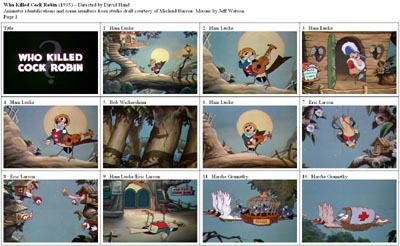
To see "mosaics" assembled by Jeff Watson, made up of a frame grab from each scene in the cartoon, with the animator or animators of each scene credited, click on the thumbnails below:
[Posted May 2003; updated March 21 and April 12, 2007]